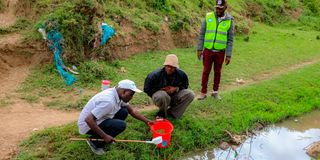
Kenya Medical Research Institute (KEMRI) Driver Silas Kipkoech (left), Entomologist field Technician LidonMike Ochieng (centre) and Narok Community Health Promoter Shadrack Kimani Musyoka checks a man-made water channel for stagnant water and mosquito breeding spots in Narok on April 18, 2026.

The muddy water ponding from an excavated site is surrounded by different apartments in Syokimau, Machakos County. It is about the size of a local football pitch. Residents live in oblivion of the ticking time bomb that is brewing in their vicinity.
William Omwansa, a Community Health Promoter (CHP), is here to collect mosquito larvae. This is the second stage of a mosquito. He has a tablet strapped around his body. His hands are full with a collection kit for the mosquito larvae. On one hand, there is a larval dipper; which is a cup attached to a handle that is about 100 centimetres. On the other hand, is a bucket that is meshed on the side acting as a sieve during his collections.
It took three days for William to learn how to identify a mosquito larva, an exercise that he now does twice every week with ease. His training, done by scientists from the Kenya Medical Research Institute (Kemri), also involved learning how to distinguish and collect the specific larvae using a pipette, finding a suitable location for collection, recording the location of the samples with a unique Identification number, and storing them well until the Kemri scientists come to collect them.
When we meet him in Machakos, he is flanked by Michael Ochieng’, an entomologist, and Silas Kipkoech, a driver from Kemri, who have been traversing about 21 counties mapped to be at risk of having a new malaria-causing vector called the Anopheles stephensi (An.stephensi). It is their second site for the day, and we accompanied them from Kitui County.
Anopheles stephensi, was first detected in the northern part of the country; specifically, Turkana and Marsabit counties, and is believed to have entered the country through the transport corridors from Ethiopia.
It is a vector that originates from South Asia, and the Arabian Peninsula. It was first detected in Africa in Djibouti in the year 2012, leading to high malaria cases and becoming a dominant malaria-causing vector for the small country in the horn of Africa. Djibouti at the time was on the brink of eliminating malaria, and recorded about 27 malaria cases annually. When the new vector set camp in their country, data from the year 2020 shows that the number of people infected with malaria caused by this vector had risen to about 73,000.
Apart from Kenya, the vector has since spread to Ethiopia, Sudan, Somalia, Nigeria and Ghana.
In Kenya, it continues to follow the transport corridors and scientists are now studying to see how far it has proliferated in the country, where it prefers to reside and its potential impact to public health, especially in the spread of malaria.
By virtue of experience, William knows where to get the species while doing his fieldwork. He goes to the corners of the water ponding with his larval dipper. He collects a bit of water and then looks at it to see whether there is anything for him.
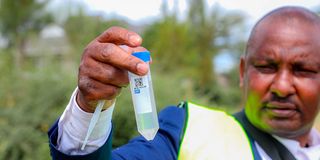
Kenya Medical Research Institute (KEMRI) Machakos County Community Health Promoter William Omwansa displays a test tube containing mosquito samples preserved in alcohol after collection during vector surveillance, including Anopheles stephensi, in Machakos on April 17, 2026.
“There are quite a number here, this is gold,” he says while sieving his ‘gold’ find by pouring it in the bucket.
William then sorts it using morphological identification (physical features that can be seen with a naked eye).
“The Anopheles vectors are usually flat and stay on the surface of the water. They are usually very active and move around anytime someone tries to touch them, but the other one (culex), the head faces down and is usually in a rest position,” he says.
After that, he records the details of his collection and then stores it in a cool box inside a tube that has alcohol.
The collection is done twice in a week, Monday and Thursday or Tuesday and Friday.
When Michael and his team move around the country, they notice different things about the habitat of this vector and how far it is going.
“This is the first time we have found Anopheles species here in Machakos,” says Michael.
William notices a stack of old tyres in one of the neighbourhoods, and when he finds stagnant water there, he checks if there are any larvae. Michael explains to Nation that this vector thrives in man-made habitats such as the water ponding, car wash, tyres, any form of an open water storage material, especially in urban areas.
William does not find any vector inside the tyres when we are there. He checks an open water bottle that has some water. There is nothing. We move to a stream that is just behind a residential area. It is also clear.
“These vectors don’t like flowing water, they prefer the stagnant and man-made type,” Michael tells us.
Our final site for the day is a water tank used at a carwash. William gets to the top of the tank and scoops some water. It has nothing. We cannot move further than a two-kilometre radius from his allocated area. His tablet provided by Kemri has the Global Positioning System (GPS), which records the exact location where the samples are located.
“I have not heard anyone saying that they have malaria, they just complain that the mosquitoes are too many,” he says.
Before getting to Kitui and Machakos, Michael and Silas were in Garissa, and they went all the way to Dadaab where most refugees are hosted. Michael says that since their study started last year, it is the first time they have collected samples from the refugee camp in Dadaab.
We travelled to the Southwestern part of Kenya, in Narok County to collect more samples from the CHP allocated. It is night time when we get there, so we postpone the work to the following day because samples cannot be collected in the dark.
Silas, Kemri's driver, says that despite having his major role, he has learnt to work as a team while in the field. He knows how to identify the samples and also get the fast-moving anopheles inside the collected water.
“We face a few challenges, mostly related to logistics. We were once stuck because of road wreckage, especially when we meet lagas… it comes in the form of a mountain and it closes the road…so we have to stay and sleep in the bushes. In other areas, there is insecurity, so we have to wait until the security personnel come to escort us.
Also Read: Beyond awareness - How community action and responsible self-care are changing fight against malaria
In Narok, we find Simon Munge who has been collecting the larvae since last year.
“We were taught the different types of mosquitoes and how they look, but our major concentration was on the Anopheles mosquitoes,” he says.
“I have found quite a number of larvae, but lately, it has been difficult to find one, especially after the rains. I have not recorded any malaria cases in my household as well, but most people are complaining about mosquitoes in their houses,” he adds.
In our field visit, we did not find any larvae. We visited two rivers in Narok, stagnant water near a car-wash, a construction site and a residential area.
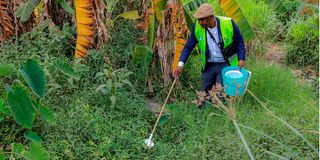
Kenya Medical Research Institute (KEMRI) Machakos County Community Health Promoter William Omwansa collect mosquito samples from water sources using a tube during routine surveillance to study species presence, including Anopheles stephensi in Machakos on April 17, 2026.
Next steps
After the field visits and collection of the samples, the next step of the study is the analysis of the larvae to check whether it is the An.stephensi. Already, there are different malaria-causing vectors in the country. The most predominant vector is the Anopheles gambiae mostly found in Lake Victoria. The other vectors are the Anopheles arabiensis, and the Anopheles funestus.
We also go to the molecular analysis lab at the Centre of Global Health Research in Kemri, Kisumu where the samples from the field are received. We find Brian Morgan, a research scientist sorting the samples that arrived from Wajir County, together with trainees.
“Welcome to the dirty lab,” he tells us.
Brian calls the lab we are in the dirty lab because that is where most of the heavy lifting is done including reception, confirmation of the QR code information online and in the physical tubes and counting of each of the larvae collected, one by one.
“After we count the number per tube, we divide that by two for specific analysis of their genetic make-up,” Brian tells us.
“One sample could be used to identify the species, to check if the mosquito infected anyone with malaria, or what kind of blood meal it had taken in the field,” he adds.
A blood meal is the type of blood they find inside a mosquito after slicing it.
Brian says that they have to section different parts of the mosquito in the dirty labs; legs, wings and then the head and thorax to check if it was infective and the abdomen for the blood meal analysis.
In the blood meal analysis, scientists can tell whether the mosquito took human blood or an animal’s blood.
After the ‘dirty’ work is done, the samples are taken to the next lab, which has machines that do the final analysis that identify the exact type of the samples collected.
In this study they use the Polymerase Chain Reaction (PCR) for preliminary detection of An. stephensi after identification using morphological (physical features) and thereafter further confirmation through sequencing.
Brian explains that the PCR detection method uses a process that has been documented, that optimizes the identification of a certain species.
This means that they already have instructions inside the machine that can differentiate one mosquito species from another. These instructions are called protocols. The scientists know the temperatures they can work with best, and even how they can reconstitute the volumes to get the results.
A single sample has to go through three different protocols.
“The processes here have to be handled with care because any slight contamination of the samples leads to repeats, which extends the time used to get the results,” he explains
At the end of it, they have to do visualization to confirm that the results actually match what they are looking for. Just like human beings, the same species of mosquitoes could have different characteristics that make them distinct.
This is why scientists have to do genetic sequencing in order to get specific features of samples from the same species.
In short, the PCR analysis is able to tell apart different organisms, and the sequencing tells us that even the same organisms have differences.
“We can use sequencing to tell whether a certain An. stephensi collected in Turkana, is different from one collected in Mandera, maybe because of their origin, or even their exposure,” he adds.
Brian Morgan explains that the analysis of the samples collected from the field depends on the number of samples.
“Lately, we have been receiving about 600 tubes, if we work so hard, we can do the analysis in about two weeks,” he says.
“This is why we get real time reports to update the status of our project,” he adds.
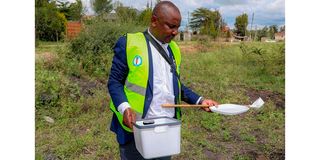
Kenya Medical Research Institute (KEMRI) Machakos County Community Health Promoter William Omwansa examines a swamp-like or man-made water channel to identify mosquito breeding areas during surveillance work in Machakos on April 17, 2026.
Inside the study
The project is called AnoSTEP Afrika, which is a multi-country research initiative investigating the growing threat of An. stephensi to malaria control efforts across the continent. It is funded by the Wellcome Trust, and the initiative is coordinated by Tanzania’s Ifakara Health Institute (IHI), the principal recipient of the grant.
Brian Polo, research scientist at Kemri and study coordinator for the AnoStep Afrika project in Kenya, explains that the study is a comprehensive assessment of biology and public health of the impact of public health for An. stephensi in Kenya.
The scientists started by identifying sites that could possibly have this vector in Kenya. They used a model called Bayesian model, where the scientists who were analysing possible sites had information on areas that already had this larvae and areas that were already recording malaria cases in the country. They used the geographical information of both the terrain and the temperature to also come up with the possible locations for the vector.
After collecting the larvae twice every week from the CHPs, the samples are taken to Kemri in Kisumu for analysis every month. These samples are collected in 21 counties and in about 60 sites.
Brian explains that at the stage of collection, the CHPs cannot tell with their naked eyes the type of malaria-causing vector.
Each tube that comes from the field has a unique code, and information is sent to Kisumu to a server where the scientists track the work even before the samples get there.
“We review that information periodically and we retrain the CHPs on how best to collect the larvae,” he says.
Surveillance has so far mapped over 50 mosquito breeding sites in search of An. stephensi larvae, according to PS for the State Department for Public Health Mary Muthoni. The vector has now been confirmed in 12 counties: Wajir, Garissa, Lamu, Tana River, Isiolo, Turkana, Samburu, Baringo, Elgeyo Marakwet, Kitui and Mandera. It has not yet been incriminated — meaning it has not been found carrying malaria parasites in the country.
By December of last year, the scientists had confirmed the presence of An. stephensi in three additional counties that had not been previously recorded. They are; Samburu, Tana River, and Kilifi.
“By March this year, the vector is now moving upwards headed towards Nairobi,” he tells the Nation.
The scientists, however, need to analyse the results to see how far the vector has spread in the country.
“It is one thing to identify, but if we just look at it, then we may end up the Djibouti way,” warns Brian.
Teresa Bange, lead social scientist in the AnoStep project explains that the vector needs to be understood holistically.
“What we know so far is that it is anthropogenic in nature, this means that human activities could be fuelling its spread,” she says.
As a social scientist, her work is to understand how our role as human beings play a part in the spread of this vector to new places.
They are using different methods to understand this. The first one is to observe human activity at the household and community levels. The CHPs are observing these households once a month, looking at their water usage, and storage practices.
They also look at how they dispose of this water, checking if people are creating a conducive environment for the vector to thrive.
Kenya Medical Research Institute (KEMRI) Driver Silas Kipkoech (left), Entomologist field Technician LidonMike Ochieng (centre) and Narok Community Health Promoter Shadrack Kimani Musyoka checks a man-made water channel for stagnant water and mosquito breeding spots in Narok on April 18, 2026.
“We help in characterizing the habitats, it could be on a water tank, stagnant water due to a farming activity, or a laundry area,” she explains.
Teresia says that the vector is expanding into zones that are not malaria endemic. She says that if it establishes itself there, we might begin seeing malaria in places that previously recorded no cases.
The scientists’ analysis done last month shows that the vector is following the road, heading to the big cities.
“We have known malaria as a rural problem, but if this vector is bringing it to our towns, it is going to be chaotic in the near future,” she says.
There is no evidence in Kenya, so far, that links this vector to malaria transmission.
Brian says that the biggest challenge that the scientists have with this vector is that they get it a lot in the larval stage, but they still do not understand where it rests when it becomes an adult.
“When we go to do adult collection using our conventional methods, we rarely find them. When we do, we find very few. For us to incriminate it, we need an adult mosquito, then we get the blood meal that they have, and then we check whether that blood meal has malaria parasite and whether it came from a human being,”
Brian and his team will be doing another study in Turkana to try and evaluate different trapping methods to evaluate which is the best to trap An. stephensi. It is not a unique problem in Kenya, even other countries have documented in published studies showing that it was hard to find adult An. stephensi.
It is a dodgy adult, but its impact is huge, at least based on the data from other countries
Silas Agumba, a research scientist and medical biotechnologist is also the lead for the behavioural evaluation of this vector. His study will check if the vector chooses a specific temperature, or a climatic condition.
“Time, and science will tell,” says Silas who will lead the behavioural evaluation.
Follow ourWhatsApp channel for breaking news updates and more stories like this.