Stethoscope and a gavel.

Anita, a six-year-old, was rushed to the Moi Teaching and Referral Hospital (MTRH) on January 9, 2021 as she struggled to breathe just moments after being discharged from another medical facility.
Her mother, Mercy Kiprono, says that Anita had swallowed a sunflower seed several days earlier.
Mercy maintains that she was received by Cameroonian, Dr Ernest Nshom, and that a surgery was booked at MTRH the same night.
“She looked okay by the time we arrived at MTRH, they had done some first aid and stabilised her. She could talk, and she told us what happened when she was playing” says Mercy.
That night was the start of a series of hospital visits which have now culminated into negligence allegations against the MTRH and questions on whether the Kenya Medical Practitioners and Dentist Council (KMPDC) has played its part in offering recourse to people like Mercy.
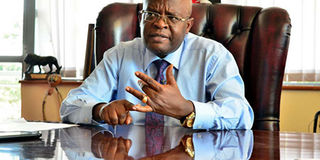
Kenya Medical Practitioners and Dentists Board ex-Chief Executive Officer Daniel Yumbya.
At the time Mercy’s case was filed, the KMPDC’s day-to-day affairs were led by CEO Dr Daniel Yumbya. But this, and several other cases, have stretched into the era of Dr David Kariuki, who replaced Dr Yumbya in 2022.
The KMPDC in response to Nation’s queries admitted that the council is struggling with a sharp increase in cases filed owing to successful awareness campaigns in the past.
The KMPDC said that its decisions are strictly governed by evidence, both at the committee which first handles complaints filed, and the full council which ratifies every case.
“All determinations are strictly evidence-based. The Council relies solely on the material and evidence presented before it. Matters are first considered at the Committee level and subsequently ratified by the full council. This ensures that all decisions are consistent, fair, and firmly grounded in both legal and professional standards,” the KMPDC said.
On the night Anita was first admitted, she was booked for surgery but would instead remain admitted until January 19, 2021 when a CT scan showed a ring-shaped foreign body in the girl’s right bronchus.
Three days later, a surgery was conducted and Mercy was informed that doctors had found a tooth in the bronchus, and removed another two teeth during the procedure.
Dr Nshom informed Mercy that they had conducted a thoracotomy – incision into the chest wall between ribs to access organs such as the lungs, esophagus or heart.
Mercy retorted that she had only consented to a bronchoscopy, a less invasive procedure which involves the use of thin, flexible tubes with cameras.
'Be glad she is alive'
Then, Dr Alfred Wanyonyi directed Mercy and her husband to the nurses’ station. Mercy would later claim that he was rude to them, and said they should be glad that their daughter was alive.
“I could not question that. They had wrapped the teeth around one of my daughter’s legs. I took that photo. We found only two teeth. We never found the third one to this day. He (Dr Wanyonyi) told us to follow protocol when there are any questions, and that we should be grateful that Anita did not go to the Intensive Care Unit. I was with my mother-in-law and she asked me to stop asking questions,” she says.
Anita was discharged on January 28, 2021 with medication. But Anita started vomiting on February 8, 2021, prompting a return to MTRH where she was diagnosed with Pneumonia.
A series of visits back to MTRH followed, until May 10, 2021 when Anita collapsed while playing, and was pronounced dead on arrival at the same facility.
Three days after Anita’s burial, Mercy wanted to meet the MTRH CEO. Mercy claims that after one of the doctors called to apologise, the hospital conducted a cultural ritual involving giving a cow to Anita and her family, and tethering it next to Anita’s grave.
The doctor who had apologised told Mercy that he had arranged for the ritual.

Moi Teaching and Referral Hospital in Eldoret, Uasin Gishu County.
“It is a cultural thing. The doctor came home, and we had a meeting. I still had questions, and they still remained unanswered. As a woman, I was not supposed to talk, I just watched,” she says.
Mercy filed a complaint against MTRH, Dr Nshom, Dr Wanyonyi, Prof Barasa Otsyula and Dr Stephen Ondigo at the KMPDC.
In those proceedings, Dr Ondigo took the fall for the incident, admitting that he was the primary medical professional in Anita’s treatment, in contradiction with Mercy’s claim which stated that the other doctors had a more significant role.
Dr Nshom, Dr Wanyonyi and Prof Otsyula maintained that they were not part of the procedure in which teeth were allegedly removed from Anita’s lungs. Dr Ondigo would later state that the teeth confused doctors who thought they were the ones causing Anita’s health troubles.
On May 5, 2023, the KMPDC dismissed the case against Dr Nshom, Dr Wanyonyi and Prof Otsyula. Dr Ondigo was directed to initiate mediation with Mercy and her family. The MTRH was fined Sh350,000.
Mercy’s case is now being heard by the Senate’s Health Committee, which is expected to make a determination on whether further action should be taken on MTRH or any of the medical professionals accused of negligence.
In the cases she filed at the KMPDC, Brian Odhiambo, Susan Njenga and dozens of others who accuse doctors of negligence, one things stands out – there is extensive delay of years in hearing and determination of cases.
In some, complainants like Mercy and Amos Kimebur have had reservations about the KMPDC’s decisions.
The KMPDC, however, maintains that its decisions are evidence-based, and that it is aware of some complaints by members of the public which have been taken seriously.
“Yes, the Council is aware of the concerns raised by some Kenyans regarding the handling and treatment of complaints filed with the Council. These stem partly from a high volume of cases, the need for thorough expert reviews, adherence to due process (including giving respondents an opportunity to reply), and operational constraints like staffing levels. KMPDC is actively implementing measures to strengthen our complaints-handling system,” KMPDC CEO Kariuki said.
“We are currently reviewing our internal processes to enhance efficiency, reduce any backlog, and improve turnaround times — while strictly maintaining the integrity, fairness, and quality of decisions. This includes digitisation of the process, addressing administrative and operational challenges that have affected timely delivery of rulings in some instances,” Dr Kariuki added.
Amos Kimebur has in the last six years hoped that the love of her life, Pauline, would wake up and be the bubbly girl she met in the year 2003. Her three children are praying for the day they would call ‘mama’ and she would actually respond.
When we visited Amos, Pauline was sleeping in a room that was fully converted to a ward in their house in Mountain View estate, Nairobi. There was a nurse on site. There has been a shift in their family. Amos has had to hire people to take of her wife who has been in that vegetative state after a surgery that was conducted in 2020. Amos’ mother takes turns to come and stay with the daughter-in-law.
“It is not easy, it has not been easy,” he tells Nation.
“She has been the glue for the family, the foundation for the family, and she continues to be,” she tells us. She didn’t have any issues the night before. I remember us going for dinner the previous day at a restaurant in Westlands. She was okay,” she says.
She went to the Karen Hospital which was her go-to facility. Amos, after dropping their kids off in school on that day, joined her in the hospital.
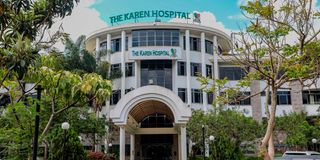
A view of Karen hospital in Nairobi in this picture taken on October 20, 2024.
At the hospitals, several tests were taken, all with negative results. After further tests, she was diagnosed with acute pancreatitis. Further examination was done and the doctor assured Amos that he had found the problem and that Pauline would be okay.
The next day, Amos passed by their daughter’s school. She was in form 1 at the time and it was her orientation day. She had hoped her mother would also be there, but Pauline was still in the hospital. She finished school without her mother ever stepping there.
Pauline was taken in for a surgery, which should have taken just 30 minutes. But an hour passed. And then two. Now, Amos begin to worry. After a lot of pushing, doctors told him that Pauline was okay and the surgery was successful.
“When we reached the theater, the nurse showed us into a room, a holding room. We sat there. Already, there were already indications that things were not as good as I expected,” he shares.
Four doctors walked into the room: our usual doctor, a cardiologist, an anaesthetist and another lead doctor.
“I could see the sombre mood on their faces,” he remembers.
They said again that the procedure went well, and that when they were doing something called reverse anaesthesia, they noticed that Pauline's heart rate was coming down at a very high speed.
“They told us that at that point they rushed to call the cardiologist to check what was the problem, and they realized there was a clot that was on the lungs, and it was heading to the heart,” he says.
She was told that what followed after was that Pauline went into a cardiac arrest and they even tried to resuscitate her.
“The news of cardiac arrest coming from someone who has been very okay, and someone who even drove herself to work, was a shock. And given the fact that those indications were not given to us at any time, was even more shocking,” he says.
Amos saw Pauline being wheeled out of the theatre shortly after that conversation. She appeared lifeless.
“I touched her and even asked the doctors whether they were telling the truth. Could she have been dead?” he says.
Pauline could not breathe on her own, she had to use oxygen at the hospital. They assured him that he would wake up. Amos asked the doctors separately how much time it took to resuscitate his wife. One said five minutes, the other 10 minutes, but it was later confirmed that it took more than 30 minutes. She stayed at the Intensive Care Unit for three weeks, and there was no indication that she would get better.
They stayed in the hospital from January 17 to March 16, 2021. They left the hospital with a Pauline that was fully dependent on people. She could not walk, eat on her own, lift a finger or even respond to someone who calls her. They were told that the situation would get better. Six years later, Pauline still lies in that bed in a home-based palliative care and no doctor has ever followed up to check on her.
“She suffered a brain injury. Her brain cells are dead. Initially, she couldn’t open her eyes, but after sometime, she did,” he tells us.

Patient medical history and a stethoscope.
Amos decided to seek help and he thought that the Kenya Medical Practitioners and Dentists Council would be a great place to start. They lodged a complaint on October 22nd in the year 2021. He tells us that it was hard to get an audience with anyone.
Letters went unanswered. Physical requests for meetings were snubbed, and sometimes, postponed. Requests for investigations were always treated like it was nothing serious.
“I made so many visits at KMPDC and there was no feedback,” he says.
By the year 2023, the case had not moved to the preliminary stage. Amos did not give up. He kept going.
“The more I went there, I realised KMPDC is not pro-the patient,” he worries.
Pauline’s case was finally concluded, in September last year, with KMPDC saying that there was no evidence for negligence. Pauline is yet to wake up. She lies in her bed waiting to be helped, but who shall come to save her?
The KMPDC held that it has taken other actions, such as closing some medical facilities, to protect patients and reduce the number of complaints filed.
“Alongside complaints handling, we continue rigorous inspections and enforcement actions against non-compliant facilities and practitioners to prevent issues that lead to complaints in the first place. Recent countrywide exercises have resulted in closures and downgrades of hundreds of facilities failing to meet safety and quality standards — directly safeguarding patients,” the KMPDC said.
Follow our WhatsApp channel for breaking news updates and more stories like this.