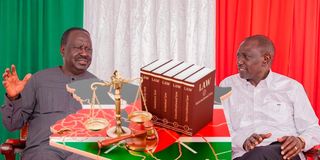
Exactly 15 years after the promulgation of the 2010 Constitution, debate is mounting over whether Kenya’s supreme law should be amended. Any such reform would require a national referendum, as only citizens can authorise significant constitutional changes.
Opposition leader Raila Odinga , who was central to the writing of the 2010 Constitution, has emerged as one of the strongest advocates for review.
His proposals range from restructuring devolution to abolishing the provincial administration, which the Kenya Kwanza government has been reviving by training chiefs, attaching police officers to them, and putting village elders on the State payroll.
Mr Odinga argues that the provincial administration is a colonial relic that undermines devolution. He has called for a three-tier system of government — national, regional and county — to enhance development.
Former Prime Minister Raila Odinga delivers his speech during the commemoration of Katiba day on August 27, 2025 at Kenyatta International Convention Centre in Nairobi.
Photo credit: Billy Ogada | Nation Media Group
“I believe the time has come to re-examine the model of devolution. For instance, Nigeria, with over 200 million people, has fewer states than Kenya has counties. I am not proposing the abolition of any county, but the provincial administration should be scrapped,” he said. He further urged that Members of Parliament surrender the National Government Constituencies Development Fund (NG-CDF) to counties, saying MPs should focus solely on oversight.
“We are not supposed to be funding projects through NG-CDF when we already have two levels of government. If you are both an MP and a contractor, then who is really exercising oversight?” he asked. Mr Odinga admitted his proposals have drawn criticism but vowed not to relent.
Attorney-General Dorcas Oduor holds the Constitution of Kenya during the commemoration of Katiba day on August 27, 2025 at KICC in Nairobi.
Photo credit: Billy Ogada | Nation Media Group
“There is no compromise. Tunaenda kwa wananchi . I know this position makes me unpopular, but I will stand my ground,” he said.
Governors and local leaders are expected to fight back against reforms that would dilute their control over resources and potentially end their political careers. Some proposals even suggest reverting to the pre-2010 provincial system of eight regions.
Speaking during a commemoration of the Constitution’s 15th anniversary at the Kenyatta International Convention Centre (KICC) in Nairobi on Wednesday, Mr Odinga insisted that Article 1 — which grants sovereignty to the people — has not been effectively realised.
“Kenyans seem to understand sovereignty through elected representatives, but there is zero clarity on how to exercise sovereignty directly to achieve meaningful results,” he said.
Katiba@15: President William Ruto's full speech
He also urged a review of laws that establish national institutions and funds performing functions better suited to county governments.
Changing the Constitution requires a lengthy process. Two main routes exist: the parliamentary path, where legislators propose amendments, and the popular initiative route, where citizens can propose changes directly.
President William Ruto delivers his speech during the commemoration of Katiba day on August 27, 2025 at Kenyatta International Convention Centre in Nairobi.
Photo credit: Billy Ogada | Nation Media Group
Article 257 provides for the popular initiative, requiring the collection of at least one million signatures to launch the process. A draft bill is then submitted to county assemblies. If approved by a majority, it is introduced in Parliament. Should Parliament fail to pass it, or if it touches on issues outlined in Article 255(1), the matter must go to a referendum.
President William Ruto , who attended the KICC event as chief guest, warned that corruption in the judiciary could derail the Constitution’s promise. “Our Constitution was born out of hard and painful lessons. The tragic events of 2007–2008 remind us how far our mission is,” Dr Ruto said, urging vigilance against judicial misconduct.
He described devolution as a hallmark of equity. “Since devolution began 12 years ago, the National Government has transferred a total of Sh4 trillion to counties. This year, under the Division of Revenue Act, we have allocated an unprecedented Sh415 billion — nearly Sh30 billion more than last year,” he said.
The President highlighted two recent legislative milestones — the County Public Finance Law Amendment Act of 2023 and the County Allocation of Revenue Act of 2025 — both of which he signed into law.
Prime Cabinet Secretary Musalia Mudavadi also addressed the event, questioning the cost of repeated constitutional amendment attempts.
“The 1963 Constitution was amended 30 times, including the infamous Section 2A. The 2010 Constitution has already faced 14 attempts at amendment. Is it impossible to amend it, or have the attempts failed to meet the constitutional threshold?” he asked.
Mr Mudavadi noted that the Department for Parliamentary Affairs had estimated that public participation in legislating laws over five years cost about Sh18 billion.
“We must ask ourselves whether we want to spend nearly Sh20 billion on legislating laws instead of buying medicine for hospitals or building schools,” he said, adding that duplication in public participation processes should be addressed. “Sometimes Parliament, the Executive and county governments hold separate public participation events on the same law or policy. These layers of duplication are costly and unnecessary,” he said.
Kenya’s history with constitutional amendments is turbulent. Most past attempts have failed, many blocked by the courts. Politicians have often been accused of pushing changes to advance personal or political interests. The most notable case was the Building Bridges Initiative (BBI), backed by Mr Odinga and retired President Uhuru Kenyatta . It was struck down by the courts after a lengthy legal battle. Currently, another process — through the National Dialogue Committee (Nadco) — seeks constitutional change. Proposals include creating the office of Prime Minister and an official opposition leader. At a Nation Media Group forum marking the Constitution’s anniversary, constitutional law expert Prof Ben Sihanya echoed Mr Odinga’s call for change, particularly on the gender question. “Unless we amend the Constitution, it will be impossible to solve the two-thirds gender stalemate through appointments. Democracy has its own rules. You cannot force voters to elect women. Even if you dissolved Parliament and held fresh elections, you would not achieve the two-thirds threshold without a constitutional formula,” he said.
Mr Odinga also criticised State institutions that he said have failed to live up to the Constitution’s vision. “Some institutions have let the country down. The National Police Service has left us worse off than before 2010. The abuse of the right to life, degradation of dignity, torture, and denial of personal security by the police have increased. It is time to rethink police reform,” he said.
As Kenya reflects on 15 years under the 2010 Constitution, the debate is intensifying over whether the framework has outlived its effectiveness or requires fine-tuning to match the country’s realities.
Supporters of reform argue that duplication of institutions, wasteful spending, and unresolved questions — such as equitable representation and gender balance — demand constitutional change.
Critics, however, warn that political elites may use the reform agenda to entrench their power, weaken oversight, or roll back hard-won gains.
Ultimately, any amendment would require the people’s approval in a referendum. For now, the calls by Mr Odinga, the caution by President Ruto, and the concerns raised by leaders like Mr Mudavadi and Mr Sihanya suggest that Kenya’s most important legal document is once again under scrutiny, 15 years after its birth.