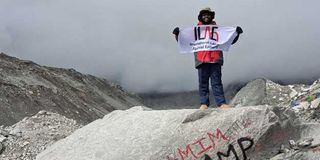
For 17 days, Rev Fredrick Beuchi climbed through the unforgiving slopes of the Himalayas, each breath growing thinner as the mountain rose, with each step carrying a message that began long before he ever saw Mount Everest.
Then, at 5,348 metres above sea level, he finally stood at Everest Base Camp. Far behind him were 130km of steep trails, exhaustion and three days of delayed flights. But for the Methodist Church of Kenya cleric, the journey was also a continuation of a campaign shaped by his experience caring for his younger sister and wife, both of whom live with epilepsy.
From the foot of the world’s highest mountain, Rev Beuchi sought to raise awareness of epilepsy and challenge misconceptions that associate the condition with witchcraft, demonic possession or curses. “After close to 17 days of climbing, covering over 130km at an altitude of 5,348m and three days of delayed flights, today we finally left the Himalayas Mountains back to the City of Kathmandu,” he stated after the climb. “This is a sure sign that what God starts he will finish. All honour and Glory be to God.”
Rev Fredrick Beuchi during his 28-day expedition to Mount Everest undertaken to raise awareness about epilepsy and challenge myths and stigma surrounding the condition.
Photo credit: Pool
The achievement came after he embarked on a 28-day expedition on September 2 with epilepsy awareness at the centre of his mission. As he began his descent, Rev Beuchi passed through the Everest Death Zone, where climbers who died attempting to conquer the mountain are remembered. He used the experience to reflect on the need to pursue the cause with determination.
“When you find that one thing worth dying for, do it with all passion and love because you may not have the luxury of time.”
His journey began long before Everest, rooted in his family's experience with epilepsy. His younger sister was diagnosed with epilepsy at the age of two and is now 20. As a child, she experienced twitches, seizures and convulsions that left the family frightened and struggling to understand the condition.
The turning point came in 2013 when Rev Beuchi, who was then living in Kwale, travelled to Nairobi after seeing a television report about a medical camp for people with epilepsy in Uhuru Park.
At the camp, he met a specialist who later travelled to Mombasa, where his sister was taken to hospital for further examination.
“By then my sister was seven years old, getting a seizure after every 20 minutes. You can imagine the pain,” he said.
He recalled how she would suddenly fall down, jerk violently, bite her tongue and foam at the mouth.
“It was so scary, so I could not travel with her. But the doctor at the medical camp travelled to Mombasa, where we took her to hospital. She was examined and put under medication.”
His sister has since been seizure-free for about a decade. “That’s where the urge of wanting to tell the story and bridge the gap started,” he said.
Rev Beuchi said his sister had suffered cerebral malaria, which was treated, but the illness had already affected her brain and put her at risk of developing epilepsy. The family has also had to learn what can trigger her seizures. Rev Beuchi said over-excitement can trigger an attack, meaning even moments that would ordinarily be celebrated have to be approached with caution. “I cannot surprise her with anything because over-excitement can trigger a seizure.”
His role as a caregiver was later extended when he married a woman living with epilepsy. The experience has given him a deeper understanding of the challenges faced by people living with the condition and their families, he said. The family spends about Sh30,000 every month on medication, with his wife and sister taking several tablets. “This year I am attempting to climb the biggest mountain in the world, Mt Everest, from September 2, which will take me 28 days,” he said before beginning the expedition.
“My passion for epilepsy awareness is due to being a caregiver to a sister and a wife living with epilepsy. Epilepsy is a disease. It has nothing to do with witchcraft, possession by demons or a spell, as has been thought by many.”
That message has been at the centre of his extreme-sports expeditions since 2018, when he walked 480km from Nairobi to Mombasa in 12 days. In 2020, he cycled from Nairobi to Arusha in three days before climbing Mount Kilimanjaro in seven days.
In 2023, he completed his first ultramarathon, running 52km. The following year, he climbed Mount Fuji in Japan. “I am an epilepsy awareness ambassador; I raise awareness of epilepsy through extreme sports expeditions,” he said.
He estimates that his initiatives have helped him reach more than five million people with information about epilepsy. “We must stop stigma, create awareness, demystify myths and misconceptions around epilepsy.”
His family’s experience has also shown him how stigma can affect education. His sister’s education was affected after some schools became reluctant to admit her because she required medication at specific times. “She qualified but whenever we told the school that she was epileptic and they should give her drugs during certain times, they saw it as a huge responsibility and directed us to take her to a special-needs school,” he said.
The family wanted her to attend a regular school and interact with other children, but Rev Beuchi said finding a school willing to accommodate her needs proved difficult. His own marriage is another example of why epilepsy should not prevent people from living their lives, he said. “You can marry someone with epilepsy. I am a living example. We now have one child who is not epileptic,” he said.
Rev Beuchi's Everest expedition was flagged off in Kilifi by Deputy Governor Flora Chibule. Following his arrival at Everest Base Camp, Ms Chibule congratulated him, describing the achievement as a demonstration of courage, determination and resilience.
“I am filled with immense pride and joy as we celebrate our own Rev Frederick Beuchi from Mazeras, who has successfully reached Everest Base Camp in Nepal, a remarkable feat of courage, determination, and resilience.”
Rev Fredrick Beuchi during his 28-day expedition to Mount Everest.
Photo credit: Pool
Ms Chibule said she had the honour of flagging off Rev Beuchi on August 28 as he embarked on the journey. She said his mission was to shatter stigma, challenge misconceptions and raise global awareness. “Inspired by his deep love and unwavering support for his wife and sister, both of whom live with epilepsy, his extraordinary achievement sends a powerful message to the world: Epilepsy is a manageable medical condition and should never be allowed to limit anyone’s dreams, potential or pursuit of greatness.”
Ms Chibule congratulated him, saying his journey should inspire people living with epilepsy and their families. The drive is linked to broader efforts to boost epilepsy care. The Epilepsy Pathway Innovations in Africa project seeks to improve prevention, diagnosis and treatment in Kenya, Ghana and Tanzania, with activities in Kilifi and Nairobi. It combines community engagement and digital innovation to expand access to quality care, improve treatment adherence and address stigma.
At a meeting in Nairobi in March, stakeholders highlighted the need to strengthen primary healthcare systems, increase access to treatment and build the capacity of health workers.
For Rev Beuchi, the Everest expedition was another step in a campaign that “puts epilepsy awareness on the global map by shouting it at the base of the World’s highest mountain”.
It describes epilepsy as a chronic noncommunicable disease of the brain characterised by recurrent seizures caused by excessive electrical discharges in groups of brain cells.
WHO says epilepsy is not contagious and that up to 70 per cent of people living with the condition could become seizure-free with appropriate use of antiseizure medicines.
Around 80 per cent of people with epilepsy live in low- and middle-income countries, where treatment gaps remain significant.
For Rev Beuchi, the Everest expedition was another step in a campaign that has taken him across roads, mountains and borders in an effort to raise awareness.
“Our mission was to put Epilepsy Awareness on the Global map scale by shouting it at the base of the World's highest Mountain,” he said.
He said the mission was part of efforts towards a “Seizure Smart World” and the Global Epilepsy Awareness Campaign, which focuses on the Intersectoral Global Action Plan objectives to improve care, treatment and quality of life for people with epilepsy and other neurological disorders worldwide.