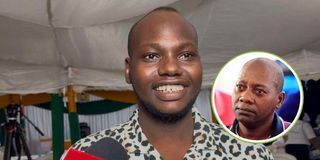
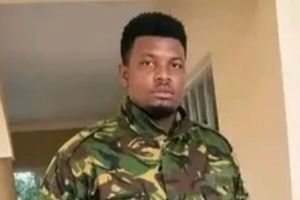
Dan Mackenzie, the 24-year-old son of preacher Paul Nthenge Mackenzie, has welcomed his father’s conviction for the murder of 190 children and an adult in Shakahola Forest, describing the verdict as a relief for families who lost their loved ones.
“It is a relief to us and to the victims who lost their loved ones in Shakahola. Justice has been served. They have been convicted. It was painful for us and for the victims. Now it is a relief, and we are waiting for the sentence,” he said.
Dan, who distanced himself from his father’s religious practices, maintained that he was not saddened by the conviction because he had not participated in the crimes.
“I am not sad that my father has been convicted. I am okay and relaxed. I am okay because I didn’t do it. He is guilty,” he said at the Mombasa High Court, where Mackenzie and 28 co-accused were found guilty on all 191 counts of murder.
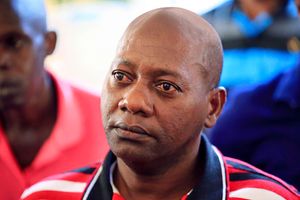
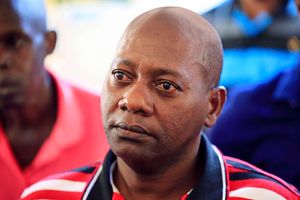
Pastor Paul Mackenzie follows proceedings during the High Court verdict delivered by Justice Diana Kavedza at the Mombasa Law Courts on October 19, 2026.
Photo credit: Kevin Odit | Nation Media Group
The verdict brought back painful memories of Dan’s childhood, when he was subjected to fasting at the age of 12. His resistance eventually led to a breakdown in his relationship with his father, forcing him to leave school in Class Seven and turn to boda boda riding in Malindi town, where he still works.
“We started fasting when I was 12 years old. I refused. My father just gave up on me and told me that I was on my own. That is how I ended up venturing into boda boda riding in Malindi town. That is what I do to date," Dan said.
Dan also recalled being beaten by church members for nearly three hours for refusing to comply with demands to attend a church service. He identified Smart Mwakalama, Mackenzie’s deputy, as one of those involved.
Mwakalama, a co-founder of Good News International Ministries, was described as a key logistics coordinator who transported followers from the church’s Furunzi branch in Malindi to Shakahola Forest. He was also accused of leading more than 400 people to fast to death in the belief that they would meet Jesus.
“I have been a victim of what my father has been doing over there in Shakahola. That is why I did not end up in Shakahola, because I was tired of him. I was forced to fast for a week when I was 12 years old. I was beaten by those church members, one of them being Mwakalama, along with the others, for almost three hours just to attend a church service," he said.
Dan added that he only learnt what had been happening in Shakahola after his father’s arrest and the start of court proceedings.
“That is when I knew that the things he used to do to us were what he was doing in the forest,” he said.
He also spoke of his five siblings, three sisters and two brothers, who were rescued by police during a raid on the family home in Malindi earlier this month.
They had been living with their grandmother at the family home in Furunzi since Mackenzie’s arrest in April 2023, when the Shakahola deaths came to light.
Their grandmother was briefly detained, interrogated and freed after reports emerged that the children were being forced to fast, but was later released.
Dan said he had reported the matter to the police prompting the raid that led to his siblings’ rescue.
“I hope they will now have a good life. They are three sisters and two brothers,” he said.
During a High Court visit to Mackenzie’s home in June, Dan told the court that his siblings had been deeply immersed in their father’s religious practices and that radicalisation had taken root within the family.
He appealed to the court in a separate but related case in which Mackenzie and others face charges of murder as a crime against humanity over the deaths of 53 people in Kwa Bi Nzaro village.
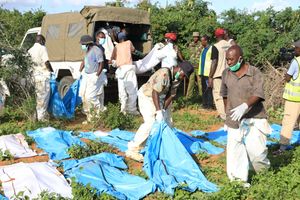
The victims were former Good News International members who had escaped the 2023 police operation in Shakahola, during which hundreds were rescued and bodies exhumed from shallow graves.
Despite the stigma associated with being Mackenzie’s son, Dan said his neighbours understood that he had nothing to do with the crimes.
“I live well with people, and they tell me that what happened in Shakahola was about my father and that I have nothing to do with it. So I live well with my neighbours, who are really good to me,” he said.
“To the families who lost their relatives in Shakahola, I would like to say that may their souls rest in peace. It is sad what they went through. I hope this has brought them relief.”
Pastor Paul Mackenzie (left) confers with his lawyer Lawrence Obonyo (right) at Mombasa Law Courts on October 19, 2026. Mackenzie and 30 co-accused were found guilty in 191 counts of murder in the Shakahola case.
Photo credit: Kevin Odit | Nation Media Group
Asked what he would tell his father if they met, Dan said they had already spoken after the judgment. The exchange, however, had done little to change his position.
“My father told me that I had betrayed him. I don’t know why. For me, I have nothing to tell him,” he said.
Dan also condemned religious leaders who use faith to radicalise and mislead followers, drawing on his own experience.
“I don’t know about religion. I have been a victim of that. It is absolutely insane what they do,” he said.
He said the conviction marks a turning point in a painful family history, offering relief to the victims’ families while leaving him to rebuild his own life after years of conflict with his father’s teachings.
The conviction comes in the backdrop of the deaths of 429 followers of Mackenzie, who allegedly subjected them to extreme fasting in the belief that it would help them reach heaven.
The court found Mackenzie guilty of murdering 190 children and an adult in Shakahola between January 2021 and September 2023.
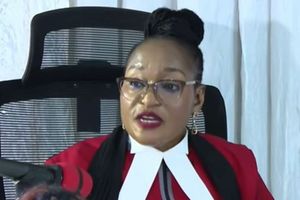
The High Court’s findings explain why Mackenzie and his co-accused were convicted, with Justice Diana Kavedza finding that the deaths resulted from an organised system of radicalisation, coercion and deliberate deprivation of food and water.
Paul Mackenzie's son says he's not sad after father's murder convictions, says he was a victim at 12
In its analysis, the court found that GNI exhibited the defining features of a doomsday cult, including absolute leadership, isolation, manipulation, domination and love bombing.
However, the judge emphasised that classifying the group as a cult did not, by itself, establish criminal guilt.
The court found that Mackenzie and associate pastors radicalised followers by deliberately misinterpreting scripture to promote an extreme belief system.
Their teachings were translated into actions that included withdrawing children from school, denying them medical care, rejecting government authority and isolating followers before relocating them to Shakahola.
“The accused persons, led by Mackenzie, radicalised members of GNI through the six pillars identified above,” the judge stated.
The court further found that the prosecution had proved the remains recovered from Shakahola were human and that the forensic process was sufficiently reliable.
The recovery, exhumation, documentation, preservation and examination of the remains followed an organised procedure, supported by identification numbers, photographic and video records, pathologist supervision and controlled transmission of samples.
Justice Kavedza rejected the argument that the absence of a forensic archaeologist rendered the process defective.
On the causes of death, the court established that death had occurred in all 191 counts. Starvation was confirmed as the cause in 72 cases, while other deaths involved asphyxia, manual neck compression and traumatic head injuries.
Although decomposition prevented the pathologist from determining the precise cause of death in 110 cases, the surrounding circumstances supported the conclusion that the victims had also died from starvation.
The court found that Mackenzie issued a directive requiring followers to fast to death, beginning with children. The regime was enforced through violence, confinement and the withholding of food and water. Those who resisted were beaten, tied up or locked inside houses.
“Malice aforethought was established against Mackenzie through direct intention and against those who knowingly enforced the fasting regime through knowledge of probable consequences,” the judge stated.
The court also rejected the argument that children had freely consented to fasting to death, finding that they lacked the free and informed consent required to make such a decision.
Their resistance and the circumstances surrounding their deaths further undermined any suggestion that the fasting was voluntary.
On parental responsibility, the judge stressed that parents have a legal duty to protect their children’s lives, health and welfare, rather than determine that they should die in pursuit of religious beliefs.
“Parental responsibility is a legal duty to protect the child's life, health and welfare. A parent has no legal entitlement to determine that a child should die in pursuit of a religious belief,” said the judge.
The court found that the prosecution had established an organised system in which different accused persons performed interdependent roles, including leadership, security, enforcement of fasting, food provision, grave digging, transportation of bodies and concealment of deaths.
However, common intention had to be established individually through evidence linking each accused person to the common purpose and showing that the deaths were a probable consequence of pursuing it.
In its final determination, the court found all 29 accused persons guilty as charged and convicted them of the murder of 190 children and one adult under section 203 of the Penal Code.