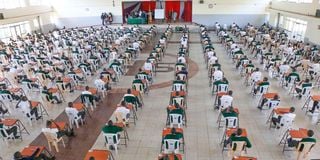
The government is unable to account for more than 700,000 students who sat the 2024 Kenya Certificate of Secondary Education (KCSE) exams and scored between grades C plain and E, raising alarm over the fate of an entire generation slipping through the cracks in the education system.
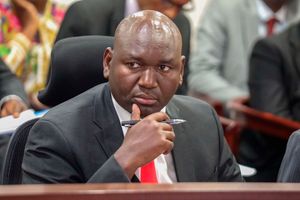
Out of 961,144 candidates who sat last year’s KCSE, only 246,165 can be traced, according to the Kenya Universities and Colleges Central Placement Service (KUCCPS) Chief Executive Officer, Dr Agnes Wahome. These are the students who scored C+ and above and qualified for university degrees.
According to data presented by the placement agency, the candidates who qualified for degree courses (C+ and above) are as follows: A Plain, 7,728; A- (Minus), 71,695; B+ (Plus), 19,131; B Plain, 43,103; B- (Minus), 75,268; C+ (Plus), 99,240, bringing the total to 246,165.
The remaining 711,389 students who fell short of the degree cut-off but were eligible for diploma, certificate, and artisan courses have not been placed, tracked, or accounted for by the agency.
According to KUCCPS rules, a C– qualifies one for diploma programmes, a D plain for craft certificates, and an E for artisan training. None of these pathways is reflected in official placement data.
“This raises a number of concern because we have not been able to really track them,” Dr Wahome told the Senate Education Committee on Friday evening in Mombasa, which immediately pressed the Ministry of Education to take responsibility.
Dr Wahome further noted that an additional 3,590 students had their results graded as ‘U’ (Ungraded) because they opted to re-sit a specific subject in which they had failed to qualify for medical training colleges.
“They realised they had a low grade in Biology or Chemistry, so when they re-sit, they are classified as U. Out of the 961,144 candidates, around 246,165 scored C+ and above, qualifying to pursue a degree course,” she explained.
Dr Wahome also said that during the 2025/2026 placement cycle, a total of 338,955 students made applications and secured placement in universities and colleges.
“Out of this, 182,241 were placed in degree programmes, 105,757 in TVET, 38,653 in KMTC (Kenya Medical Training College) across 90 campuses, 500 in the Diploma in Law (Paralegal Studies), while 11,804 were placed in Teachers Training Colleges. We ensure no child is left behind,” said Dr Wahome.
The placement boss added that some 25,000 others who qualified for degree programmes (C+ and above in KCSE) opted for non-degree programmes in various colleges and TVET institutions. Other institutions benefiting from the placement are Teachers Training Colleges (TTCs), which received students for Diploma in Secondary and Primary Education, while KMTC received students for health-related programmes at Diploma and Certificate levels, and public TVET colleges received students for Diploma/Level 6, Craft/Level 5 and Artisan/Level 4 and 3 certificate courses.
“If students realised they chose private universities, we allow them a month to do an inter-institutional transfer and once they report, they have up to two years to make a move to even a different programme in the same university or another,” said Dr Wahome.
During the cycle, KUCCPS began placement of students at the Kenya School of Law for the Diploma in Law (Paralegal Studies).
The numbers point to systemic failures in the country’s transition from secondary school to higher education and technical training. Without an effective tracking mechanism, the country risks leaving behind hundreds of thousands of youths, feeding into unemployment, social discontent, and wasted human capital.
This comes even as Education Cabinet Secretary Julius Ogamba, on June 1, disclosed that about 50,000 students from the 2024 KCSE cohort could not be accounted for by KUCCPS. The figure included more than 42,000 eligible candidates who never applied for placement, and nearly 7,000 who applied but were not placed.
The year before, then-Education Cabinet Secretary Ezekiel Machogu made a similar admission, acknowledging that more than 631,000 eligible learners were left out of any formal placement. At the time, KUCCPS conceded it had no mechanism to determine whether the students had enrolled in private institutions, pursued opportunities abroad, or abandoned higher education entirely.
Although KUCCPS says new digital systems such as the Kenya Education Management Information System (KEMIS) will improve tracking, current data shows Kenya still lacks visibility on the majority of school leavers, especially those who enrol in private colleges and informal training centres.
The placement boss added that some 25,000 others, who qualified for degree programmes (C+ and above in KCSE), opted for non-degree programmes in various colleges and TVET institutions. Dr Wahome said the 2025/2026 placement cycle targets the 2024 KCSE examination cohort as the priority group for placement into universities and all years 2000 up to date for placement into other programmes.
Applicants are placed based on their choices and merits, and affirmative action is also applied. Dr Wahome said during the placement cycle, students were placed in degree programmes in both private and public universities.
The crisis comes at a time when the state is under pressure to expand access to technical and vocational training as an alternative to university education.