A packet of tea sits quietly on a supermarket shelf in Nairobi. Outside, a bus assembled in Kenya moves through traffic.
Nearby, a bottle of juice, a pair of leather shoes, a steel rod, a box of medicine, a transformer, even a simple packet of tissue paper, all part of everyday life, all carrying labels that speak to where they come from.
Across Kenya’s economy, millions of products carry labels that quietly shape consumer trust and national identity: “Made in Kenya,” “Product of Kenya,” or “Assembled in Kenya.”
But behind those labels lies a highly technical and increasingly important debate about industrialization, trade, value addition, consumer confidence and economic sovereignty.
For manufacturers, regulators and consumers, the question is no longer simply where a product was packaged or sold. It is about where value was added, where transformation took place, who benefits economically and whether Kenya can genuinely build a competitive industrial base in a globalized economy.
Kenya Association of Manufacturers CEO Tobias Alando makes his remarks during the launch of the Manufacturing Priority Agenda (MPA) 2026 at the Radisson Blu Hotel in Nairobi on February 17, 2026.
Photo credit: Francis Nderitu | Nation Media Group
In an exclusive interview with Nation, the Chief Executive Officer, Tobias Alando of Kenya Association of manufactures (KAM), said the label “Made in Kenya” identity has become central to the country’s efforts to strengthen local manufacturing, grow exports and reduce dependence on imports.
“A ‘Made in Kenya’ label is more than just a mark of origin.” Alando said, “It is a legal certification that a product meets Kenya’s local manufacturing standards.”
It also needs to comply with basic value addition criteria in line with domestic market regulations under the EAC rules of origin.
“It also needs to comply with basic value addition criteria in line with the domestic market regulations under the EAC rules of origin.” Alando explained.
According to KAM, the label represents much more than geography.
“Economically, the label represents local value addition, supports job creation,” Alando explained, “and gives businesses access to opportunities under the government’s ‘Buy Kenya, Build Kenya’ initiative.”
The label also acts as a symbol of authenticity and quality, appearing on products, packaging and advertising to identify goods proudly produced in Kenya.
Kenya’s manufacturing industry today stretches beyond the traditional image of factories producing basic consumer goods.
Member companies are grouped into 13 industrial sectors based on the products they manufacture, the processes they use and the raw materials they rely on.
“The classification system is aligned with the framework used by the United Nations Industrial Development Organization,” Alando explained, “allowing manufacturers facing similar challenges and opportunities to collaborate and advocate for industrial growth,”
The industrial sectors outlined by the KAM represent the main pillars of Kenya’s manufacturing economy, bringing together a wide range of production activities that support value addition, jobs and industrial growth across the country.
“They include agriculture and food processing, automotive, construction, chemicals, energy and electronics, food and beverages, leather and footwear, metals, paper, pharmaceuticals, plastics and rubber, textiles and apparel and timber and furniture manufacturing,” KAM said.
Within agriculture and food processing, manufacturers produce sugar and sweeteners, grain products, animal feeds, tea, coffee, agricultural inputs and equipment, as well as fresh produce including potatoes, tomatoes, avocados and bananas.
The automotive sector includes vehicle assemblers, motorcycle assemblers, bus body builders and vehicle parts manufacturers.
Kenya also manufactures cement, quarry products and building accessories such as polyvinyl chloride (PVC), polypropylene (PP) and chlorinated polyvinyl chloride (CPVC) pipes under the building, mining and construction sector.
The chemical and allied sector produces fertilizers, pesticides, veterinary products, paints, resins, cosmetics, personal care products and foam products such as mattresses.
In energy, electricals and electronics, manufacturers produce petroleum products, lubricants, cables, transformers, lifts, machinery and electronic equipment.
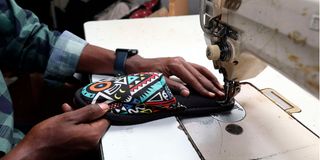
A worker operates a sewing machine while crafting footwear at Kitu Kali Limited workshop in Nairobi on April 15, 2026.
Photo credit: Bonface Bogita | Nation Media Group
Food and beverages, the largest KAM sector, includes alcoholic and non-alcoholic beverages, baked goods, dairy products, confectionery, edible oils, salt, honey, avocado products, meat and fish products.
Kenya’s leather and footwear industry includes tanneries, shoe manufacturers and leather goods producers.
Metal and allied industries manufacture steel, aluminum products, wire products and fabricated metal products.
The paper sector produces paper sacks, corrugated paper, tissue products, diapers, sanitary towels and labels, alongside printing industries.
The pharmaceutical sector manufactures antibiotics, vitamins, IV solutions and medical equipment.
Plastics and rubber industries manufacture flexible packaging, PET products, woven and non-woven products, rigid plastics, pipes and fittings.
“The diversity of these sectors reflects the depth and resilience of Kenya’s manufacturing base,” Alando emphasized, “that the structure enables targeted policy engagement and stronger industrial coordination.”
The textile and apparel industry includes export processing zone apparel manufacturers and local textile producers.
Kenya’s manufacturing sector
Meanwhile, the timber sector covers saw millers, furniture manufacturers, plywood producers, veneer makers, door manufacturers and wood processors.
“These industries demonstrate the depth and capability of Kenya’s manufacturing sector in serving both local and export markets,” Mr Alando said.
Despite the visibility of the label, many consumers still assume that “Made in Kenya” means every raw material, worker and production process must originate locally.
But under modern manufacturing systems and international trade rules, KAM states that is not necessarily the case.
“The Made in Kenya label does not necessarily mean that every raw material, worker, or manufacturing process is entirely Kenyan,” Alando explained.
“In most cases, it means the product has undergone substantial transformation or its final significant stage of manufacturing within the country.”
Under Kenya’s rules, a product can still qualify as Kenyan-made even when some raw materials or components are imported.
“For a product to be truly classified as Kenyan-made, it must either be fully produced within the country,” he explained, “or undergo substantial transformation locally when imported raw materials and intermediate products are used.”
Kenya Association of Manufacturers CEO Tobias Alando.
Photo credit: Dennis Onsongo | Nation Media Group
He further explained that this meant at least 35 percent of a product’s value must be added in Kenya, or it must meet regional trade requirements through a change in tariff classification.
“This means at least 35 percent of the product’s value must be added in Kenya,” Alando explained, “or the product must meet regional trade requirements through a change in tariff classification.”
At the most basic level, products must comply with the East African Community Rules of Origin.
Another important concept is local content. Kenya uses set criteria to determine if a product is locally made, focusing on where production or transformation takes place and the level of value added.
“One key measure is the ‘country of origin’ rule,” he said. “Another is ‘local content’,” he added.
According to KAM, this helps distinguish fully local products from those partly made using imported inputs but still significantly processed in Kenya.
Products may still qualify for the “Made in Kenya” label even if some components are imported, as long as they meet the required threshold of local transformation.
“This generally means that at least 40 percent of the product’s value is added locally through activities such as design, conceptualization, manufacturing, or processing.”
One of the most important safeguards in Kenya’s manufacturing sector is the Standardization Mark, commonly known as the S-Mark, issued by the Kenya Bureau of Standards.
“In addition, all locally manufactured goods are required to bear the Standardization Mark, or S-Mark, issued by the Kenya Bureau of Standards,” Alando said. “The mark confirms that a product meets national quality and safety standards.”
“First, ownership: a company must have at least 51 percent Kenyan shareholding,” Alando explained. “In cases where local ownership is below this threshold, the company must still demonstrate that its products meet the ‘Made in Kenya’ requirements to qualify for the mark.”
Companies must be based in Kenya and employ at least 50 percent Kenyan citizens, while complying with tax and regulatory obligations.
“At least 40 percent of the product’s design, conceptualization, or transformation must be undertaken in Kenya,” he explained.
“Manufacturing, by definition, involves different approaches and methodologies used to transform raw materials into finished goods,” Alando said.
“These include processing, fabrication, production and assembly, all qualifying under ‘Made in Kenya.’”
Governments globally rely on frameworks set by the World Trade Organization and World Customs Organization.
“A key global principle used by most countries is known as ‘substantial transformation,’” Alando said.“ This means a product’s country of origin is determined by where the last major manufacturing or processing took place.”
KAM explained that the label signals trust, safety and transparency for consumers, it improves compliance, branding and competitiveness for businesses,
It further notes that manufacturers face high costs, imports competition and regulatory complexity. Globally, origin labels are sometimes misused to avoid tariffs or inflate product value.
“The misuse and misleading use of country-of-origin labels has become a growing concern in global trade,” Alando warned.
KAM notes that Kenyan-made products to remain competitive in global markets, the manufacturing sector will need to move away from low-value, high-cost production and focus instead on high-tech, quality-driven goods.
This shift, according to industry stakeholders, will depend on reducing energy costs, ensuring a stable and predictable policy environment and improving access to raw materials needed for production.
“To achieve this, there is need for strong policy and regulatory support, upgraded production capacity and improved market access,” Alando said.
He added that this would require consistency in regulations, faster tax processes such as VAT refunds, investment in technology and skills, as well as better use of trade agreements including African Continental Free Trade Area (AfCFTA), East African Community (EAC), Common Market for Eastern and Southern Africa (COMESA) and European Union (EU) partnerships to expand market opportunities for local manufacturers.