Human error, driver fatigue and substance abuse have been identified as major causes of road accidents along the Mombasa-Malaba highway, raising concerns over safety as cargo traffic increases along the Northern Corridor.
Transport stakeholders have warned that the combination of careless driving, long working hours, speeding and inadequate road infrastructure is exposing thousands of motorists and other road users to growing accident risks.
The concerns come as Kenya prepares to mark the World Day of Remembrance for Road Traffic Victims on Sunday, November 15, amid rising road fatalities and renewed calls for motorists to observe traffic regulations, particularly during the festive season.
Kenya will mark the World Day of Remembrance for Road Traffic Victims under the theme, "Invest in Safety, Not Speed".
The main national event will take place at Jaramogi Sports Ground in Kisumu, with 12 other regions expected to hold parallel commemorations.
Stakeholders say reducing road fatalities will require more than awareness campaigns, calling for stricter enforcement, responsible driving, improved infrastructure and greater accountability among transport operators.
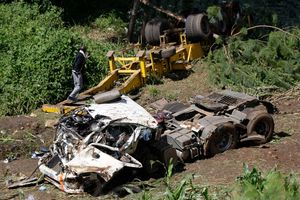
The wreckage of a truck that killed three people on board at Arimi black spot on the Elburgon-Njoro road in Nakuru County on May 14, 2026.
Photo credit: John Njoroge | Nation Media Group
National Transport and Safety Authority (NTSA) statistics show that 5,009 people died in road accidents in 2025, representing a 5.5 per cent increase from the 4,748 fatalities recorded in 2024.
Reported crashes also increased from 11,165 to 11,638, while the number of casualties rose from 24,245 to 24,905 over the same period.
National Police Service officer in charge of the Northern Corridor, Beatrice Kiraguri, said human error, driver fatigue and substance abuse were among the leading causes of crashes along the highway.
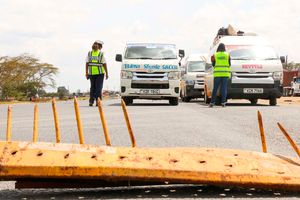
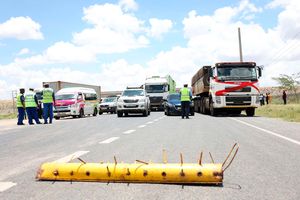
Speaking during a five-day road safety awareness campaign launched in Mombasa last Monday and ending in Malaba on Friday, Ms Kiraguri said drivers, transport companies, passengers and other road users had a collective responsibility to prevent accidents.
"The campaign targets long-distance truck drivers, public service vehicle operators, boda boda riders, pedestrians and communities living along the highway," Ms Kiraguri said.
The initiative is being coordinated by the Northern Corridor Transit and Transport Coordination Authority (NCTTCA) in partnership with the State Department for Transport, NTSA, Kenya National Highways Authority (KeNHA), National Police Service and Kenya Transporters Association (KTA).
More than 200 accident black spots have been identified along the highway, accounting for a significant proportion of the 270 dangerous locations documented nationally by NTSA.
NCTTCA Executive Secretary John Deng said the increasing number of fatalities demonstrated the urgency of coordinated interventions to protect road users.
"These sobering statistics underline the urgency of this campaign and our shared responsibility to prevent avoidable crashes and save lives," he said.
NTSA has made a direct appeal to elevate the country's road safety crisis into a formal national disaster declaration.
Photo credit: Pool
Mr Deng noted that the Northern Corridor was an economic lifeline connecting the Port of Mombasa to Uganda, Rwanda, Burundi, the Democratic Republic of Congo and South Sudan.
Thousands of trucks use the route daily to transport fuel, agricultural produce, manufactured goods and other essential commodities across the region.
He warned that accidents were not only a public safety concern but also an economic burden, causing cargo losses, infrastructure damage, environmental pollution and disruptions to regional supply chains.
The campaign started in Mombasa and proceeded through Voi, Machakos, Nairobi, Mai Mahiu, Gilgil, Nakuru, Salgaa, Burnt Forest, Eldoret, Turbo and Bungoma before reaching Malaba at the Kenya-Uganda border.
Apart from driver behaviour, transporters have raised concerns over congestion and inadequate road capacity, arguing that the increasing number of heavy commercial vehicles sharing the highway with matatus, motorcycles and private cars has heightened the risk of collisions.
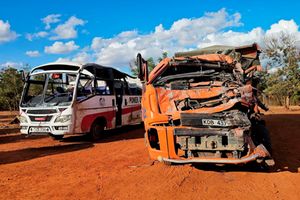
Scene of the accident at Twin Bridge along the Nakuru–Eldoret Highway, where five passengers aboard an 11-seater Toyota matatu were killed after the vehicle rammed into a stationary truck.
Photo credit: Boniface Mwangi| Nation Media Group
They are urging the government to accelerate the expansion of the Mombasa-Malaba highway into a dual carriageway to improve traffic flow and reduce head-on collisions.
Meanwhile, security operations along the highway are also facing resource constraints despite efforts to curb cargo theft, truck hijackings and diversion.
Although nine police stations serve the corridor, the Northern Corridor Transit Patrol Unit has only three vehicles, limiting regular patrols and rapid responses to security incidents.
Stakeholders say additional patrol vehicles and personnel are necessary to strengthen surveillance and protect motorists and cargo operators.