Kenya’s illicit alcohol trade begins with an unlikely commodity: molasses, the thick, dark syrup left behind after sugar is extracted from cane.
What starts as a legitimate by-product of the sugar industry can, once it falls into the wrong hands, become the raw material for an underground alcohol industry worth billions of shillings.
Molasses is bought from Kenyan sugar mills and moved across the border into Uganda, where a rapidly expanding distilling industry converts it into ethanol, a much more valuable product.
Some of that ethanol then makes its way back into Kenya through porous border routes, where it is sold to illicit alcohol manufacturers and compounders.
In effect, a by-product leaves Kenya as molasses and returns as ethanol — before being turned into cheap spirits that compete with legitimate, tax-paying manufacturers.
The economics make the trade attractive. Kenyan millers have been selling a tonne of molasses for about Sh40,000, while Ugandan distillers can pay more than Sh60,000, according to industry sources.
Once converted into ethanol, the value rises sharply: a litre of ethanol has been fetching about Sh400 on Kenya’s black market.
It is this price difference that helps sustain a cross-border supply chain feeding Kenya’s illicit alcohol market.
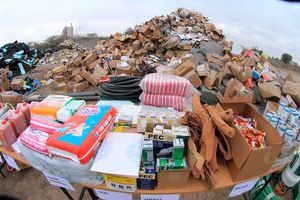
In January 2026, KRA intercepted 5,000 litres of illicit ethanol near Nairobi’s Standard Gauge Railway corridor following an intelligence tip-off. The ethanol, packed in 20 drums, was valued at Sh16.26 million.
Molasses is bought from Kenyan sugar mills and moved across the border into Uganda, where a rapidly expanding distilling industry converts it into ethanol.
KRA estimated that had it reached the market, the government would have lost Sh7.42 million in VAT and excise duty. The authority said the consignment could have yielded about 48,200 bottles of illicit alcohol.
The seizure followed an 8,750-litre consignment intercepted in Kisumu in July 2025. Two men were subsequently charged at Kisumu Law Courts after their lorry was found carrying 35 barrels of suspected ethanol concealed inside 66 empty wooden crates. KRA put the tax value of the consignment at Sh8.4 million.
But perhaps the clearest evidence of the link between molasses and illicit ethanol came in August 2024, when KRA and the Directorate of Criminal Investigations seized 40,971 litres of ethanol valued at Sh26.9 million.
The two tankers had entered Kenya through the Lwakhakha border, declaring their cargo as imported molasses. But only 2,720 litres of the contents were actually molasses. The bulk was ethanol hidden in specially constructed compartments inside the tankers.
KRA said 60,000 litres of smuggled ethanol had been impounded in 2023, while the seizure of more than 40,000 litres concealed as molasses was among its notable enforcement actions in the 2024/25 financial year.
The taxman has explicitly linked the trade to illicit alcohol, saying smuggled ethanol is mainly used to manufacture cheap counterfeit alcoholic drinks, creating unfair competition for legitimate manufacturers and posing health and safety risks to consumers.
For decades, Kenyan sugar millers treated molasses as little more than a waste product. That has changed.
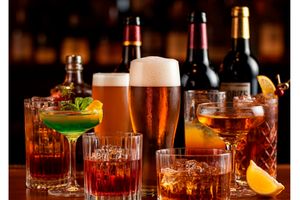
Molasses is now a valuable commodity because it can be fermented and distilled into ethanol, which is used to manufacture whisky, gin, rum and other spirits.
It can also be denatured and used as industrial alcohol in the cosmetics and pharmaceutical industries.
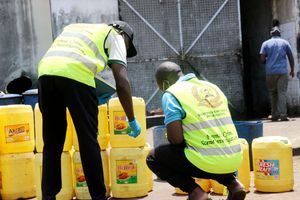
KRA officials inspect 15,000 litres of ethanol intercepted at Mai Mahiu, in Naivasha.
Photo credit: File | Nation Media Group
The Sugar Directorate says the number of licensed molasses exporters increased from two in the 2021/22 financial year to 16 by the financial year ended June.
At the same time, industry players have pointed to an explosion of unlicensed exporters, some posing as farmers, who buy the commodity for resale.
The shortage is particularly painful for Kenyan distillers, such as the Agro-Chemical and Food Company (ACFC) Kisumu-based ACFC is the largest distillery in Kenya.
Kibos Sugar Company, also in Kisumu County, operates a distillery alongside its sugar business. The other one London Distillers (K) Limited, an alcohol manufacturer and distiller.
Uganda has developed a much larger distilling industry, with 14 distilleries, 10 of which were opened within three years, according to industry information contained in the investigation.
Kenya, by comparison, had three distilleries struggling to access molasses from local sugar factories.
Ugandan distillers need molasses. Kenyan sugar mills have it. Traders exploit the difference in supply and prices.
Once molasses reaches a distillery, fermentation and distillation transform it into ethanol.
Kenya’s illicit alcohol trade begins with an unlikely commodity: molasses.
Photo credit: Pool
A tonne of molasses bought in Kenya for around Sh40,000 can command more than Sh60,000 from Ugandan distillers. The resulting ethanol can then be sold in Kenya’s illicit market for hundreds of shillings per litre.
A product worth tens of thousands of shillings as molasses can become worth hundreds of thousands of shillings after conversion into ethanol.
At about Sh400 a litre, 1,000 litres of ethanol would be worth roughly Sh400,000 on the black market. That creates a powerful incentive to incur the risks associated with smuggling the product back into Kenya.
And once the ethanol gets into Kenya, it becomes the key ingredient for an underground network of compounders making spirits outside the formal tax and regulatory system.
In western Kenya, ethanol can be sold to unlicensed alcohol manufacturers who compound and package spirits outside the formal tax system.
In a past Nation investigation, several 250ml spirits brands were found retailing for between Sh100 and Sh140.
Yet excise duty alone was estimated at about Sh113 per 250ml bottle. Once the cost of ethanol, the bottle, labelling, excise stamp, VAT and retailer’s margin are added, the cost of producing and legally selling such a drink would exceed the retail price.
Illicit manufacturers avoid the excise duty and VAT that legitimate businesses must pay, allowing them to sell products at prices that would otherwise be commercially impossible.
That creates a double loss for the country: legitimate manufacturers lose market share while the Treasury loses tax revenue.
The illicit alcohol market was estimated at Sh67 billion, with government revenue losses of about Sh66 billion, according to a June 2023 Euromonitor study.
Kenya and Uganda share a busy commercial border, with communities and businesses operating on both sides. The border is therefore difficult to police comprehensively.
The porous nature of the border makes it possible for legitimate regional trade to exist alongside illicit commerce.
The regional dimension extends beyond Uganda. Authorities have also intercepted ethanol at the Isebania border, with concerns that some consignments entering from Tanzania may originate from South Africa.
Kenya collects excise duty upfront when ethanol is purchased by manufacturers, while Tanzania collects excise at the point of sale. Industry players argue that such differences can create incentives for illicit cross-border trade.
The result is a strange regional loop where Kenya produces the molasses, and Uganda turns it into ethanol.
Some of that ethanol returns to Kenya, where it is used to make illicit alcohol.