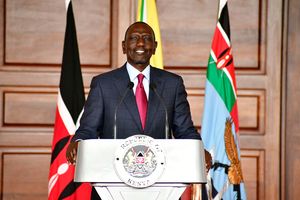
The Bill seeking to regulate the constitutional provision on public participation now rests with President William Ruto after Parliament approved a framework setting out standards and guidelines for effective and meaningful public participation.
This follows the National Assembly's approval of the Public Participation Bill, 2025, through its third reading on Wednesday, August 12, 2026. It now awaits Dr Ruto's signature to become law.
The MPs passed the Bill, co-sponsored by Rarieda MP Otiende Amollo and Ainabkoi MP and chairperson of the Departmental Committee on Delegated Legislation, Samuel Chepkonga, with amendments.
The Bill seeks to provide a framework for effective public participation by giving effect to the principle of participation of the people as enshrined in Articles 1, 10, 35, 69, 118, 174, 184, 196, 201 and 232 of the Constitution.
It sets out general guidelines, including requirements for notification, modes of notification, submission and processing of views, access to public participation processes and documentation, and conduct during public participation forums.
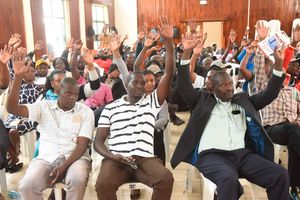
Participants during a public participation in Eldoret City on August 12, 2025.
Photo credit: Jared Nyataya | Nation Media Group
It also provides for the non-disclosure of certain information when undertaking public participation, the offence of failing to adhere to the principles and guidelines, and transitional provisions for public participation exercises that are already in progress.
The Bill also seeks to define "public participation", which is not defined in the Constitution despite the term being used in various Articles.
Parliament has been grappling with what exactly constitutes public participation, a question that has led to some laws being nullified by the courts for failing to adequately consider the views of the public during the legislative process.
Article 118(1)(b) of the Constitution provides a framework for the enactment of laws to facilitate effective and coordinated public participation. It requires that public processes, from policy formulation to legislation and final decision-making, be subjected to public participation.
Under the Bill, responsible authorities will be required to prepare public participation plans for approval, use the media during public participation, publish reports on the process and clearly state the mechanism for providing feedback.
The authorities will also have to clearly state how they will promote accessibility to public participation by persons with disabilities, provide translation and sign language services, and disclose relevant information during public participation processes.
This means that information cannot be withheld during the public participation process and then introduced later as having been endorsed by the public.
“A responsible authority undertaking public participation exercise under this Act shall be guided by the principles that the Public Participation Bill, 2025 espouses. Public Participation may be conducted through written submissions, oral hearings, online forums or any other method deemed appropriate to the context,” reads the Bill.
Public entities will be held accountable and can be sued if they fail to conduct effective public participation.
The Bill does not set a minimum number of people who should attend a public participation exercise. Instead, it emphasises adequate publicity through appropriate platforms and channels on the days the exercises are to be conducted to ensure that people can participate.
It also introduces changes intended to prevent duplication of public participation exercises by the two Houses of Parliament on the same Bill.
The Bill provides that where one House has conducted public participation on a Bill of a cross-cutting nature, the other House will be bound by the report of the first House. The provision is intended to save taxpayers' money.
Currently, the two Houses conduct separate public participation exercises on the same Bill, resulting in what has been described as a waste of public resources and time as the same stakeholders appear before both Houses.
Justice and Legal Affairs Committee chairman George Murugara said it was now upon public entities to read the Bill and understand the guidelines.
“To avoid over-legislation, as a House we have given the mandate of public participation to the various government institutions and it is now up to them to study this Bill once it is assented to and come up with specific regulations as guided,” Mr Murugara said.
National Assembly Justice and Legal Affairs Committee Chairperson, George Murugara.
Photo credit: Boniface Mwangi | Nation Media Group
Mr Murugara also said public participation was a civic responsibility that helped sustain and expand democracy.
“Similar to participation in elections, public participation is a civic responsibility which helps sustain and expand our democracy. Therefore, any form of financial facilitation for attendance of members of the public is discouraged because it may undermine genuine participation, result in skewed outcomes and create inequality,” he said in the report.
The committee made minor amendments to the Bill to include a reference to Article 1 of the Constitution on the sovereignty of the people, which anchors the principle of public participation.
It also amended the Bill to include Article 174(c), which provides for public participation as one of the objects of devolution.
The committee further amended the Bill to require that the principles guiding a responsible State entity in undertaking public participation ensure that all sovereign power belongs to the people and is exercised only in accordance with the Constitution, as well as uphold the right of the public to be involved in making and implementing public policy decisions.
The committee, in its report on the consideration of the Bill, said it received 74 memoranda from State and non-State actors.
The committee collected public views in Mombasa, Kwale, Kilifi, Tana River, Isiolo, Meru, Embu, Machakos, Makueni, Nyeri, Kiambu, Uasin Gishu, Laikipia, Nakuru, Kajiado, Kericho, Kakamega, Vihiga, Bungoma, Busia, Kisumu, Kisii, Nyamira and Nairobi.
“The Committee considered the views received, which are contained in Chapter Four of this report,” Mr Murugara said.
“While considering the Bill, the Committee observed that public participation is an indispensable element of democracy that binds all State organs, State officers, public officers and all persons making and implementing public policy decisions.”
Mr Murugara said the committee had observed that the Constitution lacks a definition of "public participation" despite its usage in various Articles.
He said the Bill attempts to define the term by identifying the scope of the national values and principles of governance contained in Article 10, which includes participation of the people.
“The committee noted that the use of the word "involving" in the definition of "public participation" may be substituted with the word "engaging," which implies active involvement of the public,” he said.
“By doing so, the definition will cover the aspect of citizen engagement as proposed by members of the public. The Committee noted that the definition of "public participation" as contained in the Kenya Policy on Public Participation (Sessional Paper No. 3 of 2023) widens the scope of public participation beyond the scope discernible from the relevant Articles of the Constitution that the Bill seeks to actualise.”
Mr Murugara said the committee observed that the Bill covers all aspects of governance, including budget-making and implementation and the formulation and implementation of government projects and programmes.
“Capacity building for public participation is vital. The duty bearers require relevant skills and experience for effective management of public participation processes. Therefore, the responsible authorities need to engage adequate human resources with appropriate skills and competencies to manage public participation functions.”
Mr Murugara said different State organs with different mandates address different issues and that each responsible authority should be allowed to adopt relevant internal processes to involve the public in its decisions to the greatest extent possible.
He said the Bill provides a standard framework that allows responsible authorities to customise their public participation processes, if necessary, through specific guidelines.
“In planning for public participation exercises, responsible authorities must adhere to the principles of public finance, including prudent use of resources,” Mr Murugara said.
“Furthermore, in selecting a venue for public participation, responsible authorities must ensure that the venues chosen are accessible to all, especially persons with disabilities (PWDs).”