MPs maintain that no agreement has been reached between Kenya and the United Kingdom regarding the British Army Training Unit Kenya (BATUK) Defence Cooperation Agreement.
This comes as the United Kingdom said in a statement that significant progress has been made in implementing some of the recommendations made by the Defence Committee.
“Senior UK officials met Kenyan Government officials, parliamentarians and members of the Defence and Foreign Relations Committee in June to discuss the progress made to date and provide an update on corporate social responsibility programmes that have been completed,” reads the statement.
The UK, for instance, said that joint operating procedures on unexploded ordnance have been finalised. The matter was among the concerns raised in the Defence Committee report.
The UK also pointed out that environmental and land-use compliance requirements have been submitted and that new measures to prevent sexual exploitation and abuse have also been put in place.
“The UK expects the highest standard of behaviour from our personnel. UK personnel in Kenya must abide by and respect the Kenyan Constitution, law and regulations at all times,” the UK said.
On Tuesday, the National Assembly Committee on Defence, Intelligence and Foreign Relations informed the House that the cooperation agreement is still in abeyance until all of Kenya's demands are met by the visiting troops.
Parliament has insisted that Articles 6(5) and 23 of the agreement be amended to include murder within the jurisdiction of Kenyan courts, as well as a Corporate Social Responsibility component from BATUK.
The committee's chairman, Nelson Koech, told the House that the committee would not approve any agreement that violates the Constitution or the dignity of Kenyans.
He said that the proposed inclusion of murder in the amendments would reinforce accountability and legal certainty for this serious crime, for which locals look to Kenyan courts to deliver effective justice.
Belgut MP Nelson Koech.
Photo credit: Dennis Onsongo | Nation Media Group
“We have tried as much as possible to reach out to our counterparts in the House of Commons. I have personally spoken to the chairman of Defence in the UK, but we have never been able to resolve these issues,” Mr Koech said.
While giving an update on the status of the agreement in Parliament, Mr Koech said that as long as the recommendations of the committee are not met by their UK counterparts, there is still no deal on the cooperation agreement.
“This committee is acting in the best interest of Kenya, more so the people of Laikipia. We have a duty to protect our Constitution as the representatives of the people. On this, we will not compromise,” Mr Koech said.
Laikipia Woman Representative Jane Kagiri, while supporting the committee’s stance, maintained that Kenya must have the jurisdiction to try murder suspects locally.
“We stand and maintain that anybody who commits a crime in Kenya, justice must be delivered here in Kenya,” Ms Kagiri said.
As currently drafted, the agreement excludes certain serious offences from the definition of “official duty”, giving Kenya primary jurisdiction over those cases. However, murder is omitted from that list, leaving room for Britain to claim jurisdiction over such cases — a loophole Kenyan lawmakers want closed.
Article 23 of the agreement requires BATUK to respect local communities, protect vulnerable persons, compensate for harm where liable, and engage with local communities only with Kenya’s consent and participation.
Parliament's stance comes just a week after the government announced the resumption of joint military training with the United Kingdom at the British Army Training Unit Kenya in Laikipia.
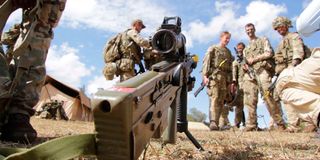
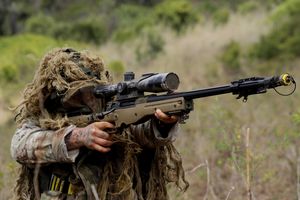
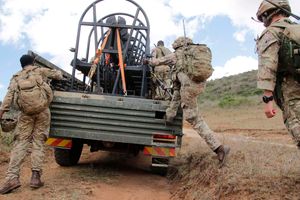
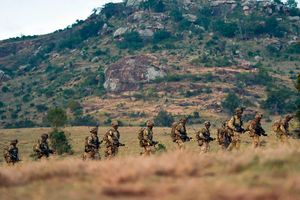
British Army Training in Kenya (Batuk) during an exercise in Laikipia County.
Photo credit: Joseph Kanyi I Nation Media Group
However, despite the government’s announcement, Mr Koech said none of the committee’s conditions have been addressed.
“It is worth noting that, as of today, the concerns raised by this House regarding BATUK, and the conditions attached to the commencement of the DCA, are yet to be fully addressed by the UK authorities,” Mr Koech said.
Mr Koech told the House that myriad meetings have been held and communications exchanged on the need to prioritise the rights of Kenyans and local communities affected by BATUK operations, but the UK has so far been non-committal.
National Assembly Departmental Committee on Defence, Intelligence and Foreign Relations Chairperson Nelson Koech at a past event.
Photo credit: Dennis Onsongo | Nation Media Group
“As a committee, we have sought to directly confer with our UK counterpart committee, without success. The ratification of the DCA therefore remains in abeyance, underscoring the need for a way forward through established diplomatic channels,” Mr Koech said.
Mr Koech pointed out that whereas the partnership is a cornerstone of the defence and security priorities between the two countries, the agreement must be within parameters that safeguard the dignity, rights and welfare of Kenyans.
Section 8 of the Treaty Making and Ratification Act, Cap. 4D, requires the National Assembly to consider and approve all treaties proposed to bind the country.
Section 8(9) expressly states that the National Assembly “shall not approve the ratification of a treaty or part of it if its provisions are contrary to the Constitution, nor shall the House approve a reservation to it.”
The position of the National Assembly therefore remains that a DCA cannot be used to sanitise the commission of grave criminal offences or a lack of community engagement by visiting forces.
BATUK has been operating in Kenya under the UK-Kenya Defence Cooperation Agreement (DCA), which was ratified in 2016 pursuant to the provisions of Article 2 of the Constitution and Section 8 of the Treaty Making and Ratification Act, Cap. 4D.
Soldiers troop during a simulated military excercise of the British Army Training Unit in Kenya (BATUK) together with the Kenya Defence Forces (KDF) at the ol-Daiga ranch, high on Kenya’s Laikipia plateau on March 26, 2018.
Photo credit: File | AFP
In light of the five-year term of the DCA, a new agreement was submitted to the House for ratification on September 6, 2021, by the Cabinet Secretary for Defence.
However, the term of the 12th Parliament lapsed before the new DCA was approved.
The new DCA was therefore resubmitted to the 13th Parliament for ratification in November 2022. After conducting public participation, the committee recommended that the House approve ratification of the agreement on condition that it only commences upon amendment of Articles 6(5) and 23.