All the board members in 65 State agencies have been retired as the implementation of the Government-Owned Enterprises (GOE) Act of 2025, which delinks the agencies’ operations from political patronage, takes shape.
This comes as it emerged that Kenya Electricity Generation Company (KenGen) Chairperson Alfred Agoi became the first casualty of the law after he was ejected from chairing a board meeting on account of his past political history as the immediate former Sabatia MP.
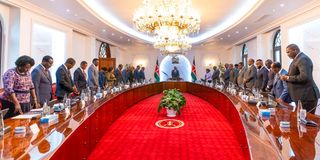
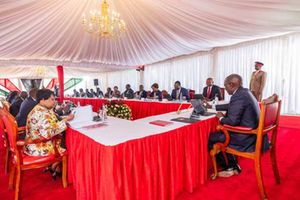
At a recent meeting, President William Ruto, noting the need to get politicians from sitting on boards of government agencies, said that the ongoing restructuring is a masterstroke.
This is informed by years of failed reforms and entrenched mismanagement, including the abuse of public funds and political interference despite recommendations of a taskforce recommending reforming the state institutions.
“We have been grappling for the last 15 years on making sure that those who serve in boards of government agencies are competitively recruited so that we minimize political influence,” said President Ruto.
Section 10 of the GOE Act states that a GOE shall be managed by a board of directors consisting of nine members and shall serve for a period of three years, renewable once.
Principal Secretary of Kenya State Department for Energy Alex Kamau Wachira (Centre) Kenya Electricity Generating Company PLC (KenGen) Chairman Board of Directors Alfred Agoi Masadia (Right) and Managing Director & CEO Peter Njenga (Left) during the Sustainable Energy Conference at Olkaria, Naivasha, Nakuru County, on September 17, 2025.
Photo credit: Dennis Onsongo | Nation
Unlike before, where government agencies served as safe landing pads for political rejects, the new regime provides for a competitive recruitment process.
The Act provides that the independent board of directors’ members shall be selected through a structured, transparent and competitive process overseen by an independent search and selection panel appointed by the National Treasury Cabinet Secretary.
This is designed to inject professionalism in the operations of state agencies and for one to serve on the boards, they must not have been engaged in active politics for the last five years.
The members shall include a chairperson who shall be an independent director and six persons who shall be independent directors.
The other two members include one person who shall be a public officer in the National Treasury nominated by the Cabinet Secretary and one person who shall be a public officer designated in writing by the relevant Cabinet Secretary for the relevant Ministry.
“A person is not qualified to be appointed as an independent director of a GOE if that person has been affiliated with a political party in the immediately preceding five years,” reads section 12 (j) of the law.
The law goes on to explain “affiliated with” to mean “having an official connection to, in the case of a political party, to a governing body of a political party or has identified with a political party for purposes of vying for a political office.”
The ongoing GOE reforms borrow heavily from the report of the Presidential Task Force on Parastatal Reforms, a landmark policy document that was unveiled on November 12, 2013.
The task force was jointly chaired by former Mandera Central MP Abdikadir Mohamed, then senior advisor to then President Uhuru Kenyatta and Isaac Awuondo, then Group Managing Director of Commercial Bank of Africa (CBA).
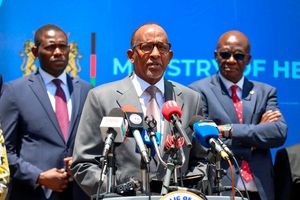
Mr Abdikadir Mohamed. He was a co-chair of the taskforce on Parastatals.
Photo credit: File | Nation Media Group
The task force was commissioned to overhaul Kenya's state-owned enterprises (SOEs) to eliminate financial waste caused by duplication of roles, curb corruption and align them with the national Vision 2030 goals.
Despite being highly praised as a definitive blueprint for public sector efficiency, the task force’s sweeping recommendations faced deep-seated political resistance and went largely unimplemented for over a decade.
While acknowledging the work of the task force, President Ruto, who at the time of the report launch was the country’s Deputy President, recognized the fact that it was not possible to implement the recommendations.
“But I am happy that finally, last year, we managed to pass the law on GOEs and as a result, we have had to retire close to 250 board members of 65 government-owned commercial enterprises,” said the President.
Previously, the President and respective Cabinet Secretaries were responsible for appointing the board chairpersons to some state corporations.
However, the GOE Act provides that the chairperson of a GOE shall be elected by the independent board of directors from among themselves.
The retirement of the board members, the president said, allows the government to “competitively hire professionals to run those parastatals.”
“We set the benchmark very high as the law limits the participation of politicians in boards,” said the president as he singled out KenGen, Kenya Airports Authority and many other agencies that the government is keen to bring on board professionals to run them.
Once fully constituted, each board shall be required to competitively recruit a qualified and competent CEO to conduct the day-to-day operations of the GOE.
Each board shall also be supported by a Certified Public Secretary to ensure adherence to best practice in corporate governance.
According to the president, the GOE Act is designed along the lines of the Conflict-of-Interest Act, which bars public officials from exploiting their positions for personal, financial or familial gain.
“This is meant to introduce greater openness, bring more independent people in the management of government institutions,” said the President, adding; “the Conflict-of-Interest law offers greater scrutiny and openness among others in transactions that involve people who wield political power.”
This restructuring separates Kenya's about 70 profit-driven commercial entities from the broader pool of over 240 non-commercial, public-good statutory bodies that rely directly on the exchequer for funding.
Under the rules of the Act, all designated GOEs must operate as self-sustaining businesses independent of taxpayer bailouts.
The new law explicitly structures 65 existing companies to operate as businesses and 18 statutory entities to be reconstituted as commercial, self-financing public limited companies.
President William Ruto.
Photo credit: Francis Nderitu | Nation Media Group
The original schedules listed 66 commercial companies, but an amendment passed during the legislative process removed the Kenya Pipeline Company (KPC) following its privatization through the Initial Public Offering (IPO) that saw the government raise Sh104 billion.
Under Energy and Infrastructure, there are KenGen, Kenya Power (KP), Kenya National Shipping Line, Kenya Petroleum Refineries and Numerical Machining Complex.
In agriculture and manufacturing are sugar companies that include Chemelil, Miwani, Muhoroni, Nzoia and South Nyanza, National Cereals and Produce Board (NCPB), New KCC, Kenya Meat Commission, Kenya Fishing Industries, Pyrethrum Processing Company, Nyayo Tea Zones, East African Portland Cement, and Rivatex.
Under the Finance and Trade sector, there is Consolidated Bank, Development Bank, Kenya Development Corporation (KDC), Kenya Industrial Estates (KIE), Postbank, Kenya Re-Insurance, Kenya National Trading Corporation (KNTC), National Housing Corporation (NHC) and National Oil Corporation (NOCK).
In the Tourism and Media sector, there is Kenyatta International Convention Centre (KICC), Bomas of Kenya, Safari Lodges and Hotels, Kenya Broadcasting Corporation (KBC), Kenya Literature Bureau (KLB), Jomo Kenyatta Foundation (JKF), BioVax and National Mining Corporation. (NMC).
Under regional and specialized entities, there is the Kenya Seed Company (KSC), with subsidiaries, various university enterprises and specified cross-border subsidiaries.