When former Prime Minister Raila Odinga called businessman Ronny Raburu in 2021 asking for a Kiswahili coalition name that could carry his ambitions after a constitutional amendment collapsed, Mr Raburu says he turned to Tanzania’s history for inspiration.
“I’m disappointed,” Mr Raburu told the Nation on Thursday. “Baba [Mr Odinga] himself was doing ideological politics. Anything Baba was doing was backed with something. How quickly Baba’s legacy is being discarded has shocked me so much.”
The Azimio la Umoja One Kenya Coalition announced on Monday that it had unanimously agreed to change its name to The Ukombozi Alliance, with Wiper leader Kalonzo Musyoka saying the opposition was reorganising ahead of the 2027 elections.
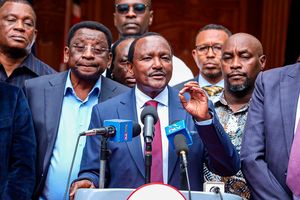
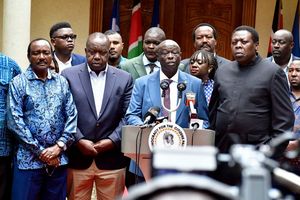
Wiper Party leader Kalonzo Musyoka (centre) addresses journalists, flanked by DAP-K leader Eugene Wamalwa (right), Siaya Governor James Orengo and Democratic Party leader Justin Muturi, among other leaders, at the SKM Command Centre in Nairobi on September 21, 2026.
Photo credit: Lucy Wanjiru | Nation Media Group
Mr Raburu says the 2021 request came after the courts blocked the Building Bridges Initiative (BBI), the constitutional reform process associated with Mr Odinga and then-President Uhuru Kenyatta after their 2018 handshake. Mr Odinga, he says, wanted a name that would preserve the BBI idea of national unity while being relatable to Kenyans by being in Kiswahili.
“He called me and asked me: ‘BBI has collapsed and I need a name that will also embrace the BBI spirit and be a Kiswahili name. So, talk to your friends there and come up with a suitable name,’” Mr Raburu recalled.
He said he consulted friends and elders in Tanzania, including people familiar with the legacy of founding president Julius Nyerere, before sending Mr Odinga about six or seven possible names.
Among them was “Azimio la Umoja”, a phrase Mr Raburu says he adapted from Tanzania’s Arusha Declaration or “Azimio la Arusha” that was associated with Nyerere’s socialist and nation-building project.
“Because BBI had failed, I felt something that would somehow resemble building bridges would match the situation,” he said.
Mr Raburu noted that it was not lost to him that Jaramogi was once associated with the “Azimio” brand.
“Somebody once told me, ‘You see this as Azimio thing? His dad had done it in the ’60s when KPU was banned. They called it a Azimio la Wananchi.’ And I was like, ‘Wow, what a great coincidence that I coined this for him and I simply reminded him of his dad?’” he said.
Days later, he says, he saw Mr Odinga launching the phrase publicly in Nakuru. This later evolved into the Azimio la Umoja One Kenya Coalition Party, bringing together ODM, Jubilee, Wiper, Kanu and several smaller parties behind Mr Odinga’s fifth presidential bid.
The late Raila Odinga, then the Azimio presidential candidate, at the Azimio Manifesto launch at Nyayo Stadium, Nairobi, on June 6 2022.
Photo credit: File | Nation Media Group
The addition of “One Kenya” followed negotiations with Mr Musyoka’s One Kenya Alliance. The coalition agreement filed with the Registrar of Political Parties tied Mr Odinga, Mr Kenyatta and Mr Musyoka together ahead of the August 2022 General Election and limited withdrawals by constituent parties before and immediately after the contest.
Mr Odinga and his running mate Martha Karua lost the 2022 presidential election to William Ruto and Rigathi Gachagua. Azimio thereafter became Kenya’s main opposition formation.
For Mr Raburu, however, the new Ukombozi Alliance name lacks the ideological weight he says Mr Odinga attached to political branding.
“It’s now sloganeering,” he claimed. “It’s just looking for a name that will fit the day and win the election if it can. There is no ideology to it.”
Mr Raburu, who comes from Karateng in Kisumu County, has built much of his adult life in Tanzania. He first moved there as an employee in the tourism sector and later ventured into business as a tour operator. He is now a partner in a company that also builds luxury tented camps for the tourism industry in Tanzania and Kenya.
He says his fluency in Kiswahili and his long stay in Tanzania made him useful to Mr Odinga, who had a deep affection for the country and its liberation history.
“My Kiswahili is okay. I speak like Tanzanians,” he said. “I speak like someone in Bongo as I’ve been here for 25 years.”
Mr Raburu also says he had hoped Mr Odinga, after joining the broad-based government arrangement with Dr Ruto, would help him secure a diplomatic posting in Tanzania, either as ambassador in Dar es Salaam or as Consul-General in Arusha, arguing that his experience and networks would have served Kenya’s interests. All that screeched to a halt after Mr Odinga’s death.
“I felt I would add more value because I know the way of life here, I have the social capital, and I can be of value to my country because I know how the terrain works here,” he says.
The businessman speaks of Mr Odinga as a close friend and mentor whose politics was rooted in a wider historical and ideological frame. He recalls hosting him in Tanzania after the tense 2017 election period – which later saw the former premier swear himself in as the people’s president.
He noted that Mr Odinga admired Tanzania’s nationalism, Nyerere’s legacy and the country’s role in regional liberation struggles.
He recalled learning of Mr Odinga’s death through Mr Wafula Buke, another ally of Mr Odinga whom he describes as a close confidant.
“He told me, ‘Ronny, are you man enough? So, I told him, ‘I was born a man, but even men are weak.’ He said, ‘If there’s any day you have to be a man, it’s this morning,’” recalled Mr Raburu.
The news, he says, left him shaken, and he has never deleted Mr Odinga’s number from his phone.
“I go to the communications we had [with Mr Odinga],” he said. “Sometimes when I see the current politics and people saying ‘Baba told us this, Baba told us this’, I take a screenshot and want to post it. Then somebody will call me and tell me: ‘Don’t do that. Those are your personal collections.’”
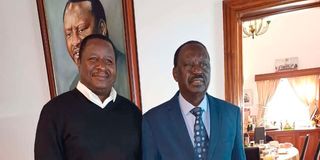
Businessman Ronny Raburu (left) in a photo he took with former Prime Minister Raila Odinga on March 14, 2025 at Mr Odinga's home in Karen, Nairobi. In 2021, Mr Odinga assigned Mr Raburu with the task of coining a name for his yet-to-be unveiled coalition, and he came up with Azimio la Umoja among other names for Mr Odinga.
Photo credit: Pool
His grief is sharpened by what he considers the speed with which Mr Odinga’s political vocabulary is being replaced.
“We are forgetting him too fast,” he lamented. “That is my concern.”
Our phone conversation got emotional as Mr Raburu wept while making the point that Mr Odinga’s allies were never given space to seek closure.
“People like us who were very close to Mzee were not handled well. I know the family has felt it more, but I felt there should have been people to take care of some of us, basically to handle us,” he said, his voice creaking with sorrow. “It’s not to give us money or reward us, but just to take care of us emotionally. Nobody cares about us.”
He had grown up admiring the Odingas, and he first met Raila in 2016 alongside other young professionals through the latter’s spokesman Dennis Onyango.
“He received us warmly. During that meeting, he gave us his personal phone numbers. From that day, I regularly sent him messages of goodwill and encouragement,” Mr Raburu stated in a post after Mr Odinga’s death last year.
Mr Raburu quickly got integrated into Mr Odinga’s inner circle, joining a group dubbed “Baba Diehards” that managed poll agents in 2017. He also helped gather the evidence used in the Supreme Court case that saw the presidential election overturned that year.
The preserved animals at the Kang’o ka Jaramogi museum were also sourced by Mr Raburu, and they came from Tanzania.
“He met a Tanzanian taxidermist and developed interest in animal trophies. He later tasked me with finding buffalo, antelope, zebra and leopard trophies for them. The taxidermist prepared them and, over four years, I delivered them to him at Kang’o ka Jaramogi museum, where he is now buried,” Mr Raburu posted.
Beyond Azimio, Mr Raburu says Kenya must treat Tanzania as a crucial neighbour and economic partner. He argues that political and diplomatic relations between the two countries require people who understand both societies, especially given the movement of food, trade and tourism across the border.
“We are sister countries,” he says. “This is one country we must continue courting. They have always been there for us.”