Kenya’s 2027 political contest is beginning to produce an unusual class of candidates, with some elected politicians appearing willing to surrender positions they already hold to pursue offices that promise greater power, influence and national visibility — but also carry the possibility of total defeat.
From senators and MPs eyeing governorships to governors looking towards Parliament and legislators and leaders positioning themselves for the presidency, the emerging political movement is turning the 2027 election into a high-stakes game of political musical chairs.
For some, the calculation is strategic.
A governor approaching the end of a second term has little choice but to look elsewhere, a move that has seen some even willing to go for lower positions just to remain in power.
For others, however, the decision is more consequential, as an MP with a reliable constituency is abandoning a relatively secure parliamentary seat for a county-wide gubernatorial contest, while senators with established countywide bases are gambling on the more demanding executive race.
Among the most prominent examples are Nairobi Senator Edwin Sifuna, Siaya Governor James Orengo and Kiharu MP Ndindi Nyoro, all of whom have so far shown interest in going for the presidency.
Siaya Governor James Orengo addresses residents of Nyandiwa in Homa Bay County, during the Linda Mwananchi rally on August 16, 2026.
Photo credit: Alex Odhiambo | Nation Media Group
Mr Sifuna has left the door open to a presidential bid through the Linda Mwananchi movement. He has also said the movement intends to traverse all 47 counties before deciding its presidential strategy.
Mr Orengo, meanwhile, has gone further, openly declaring his readiness to compete for the Linda Mwananchi presidential ticket against Mr Sifuna or any other aspirant.
“There is nothing wrong with competing ambitions within Linda Mwananchi or the opposition,” Mr Orengo told the Nation. “What matters is that we subject all candidates to a credible nomination process and, at the end of it, we emerge with one candidate to face Ruto.”
The statement, analysts say, captures one of the central tensions of the emerging opposition politics: whether a politician who already occupies a powerful office should risk it in pursuit of the country’s highest seat.
Nairobi Senator Edwin Sifuna addresses residents of Nyandiwa during the Linda Mwananchi rally on August 16, 2026.
Photo credit: Alex Odhiambo | Nation Media Group
“Orengo, a veteran politician and constitutional lawyer, is already governor of Siaya. But rather than concentrate on securing his political future within the county, he is attempting a leap to national office,” says Dismas Mokua.
“I am committed to the principle that there should be one opposition candidate,” he said.
That position has brought him into direct competition with Mr Sifuna, whose supporters have increasingly presented him as the movement’s presumptive presidential candidate.
The rivalry has become sufficiently significant that analysts have described the two ambitions as a potential test of whether Linda Mwananchi can maintain opposition unity while accommodating competing presidential aspirations.
Across the country, a growing list of MPs and senators are abandoning the relative security of their current positions for county executive offices.
In Nairobi, Westlands MP Tim Wanyonyi is seeking the Bungoma governorship, where he is expected to encounter Kimilili MP Didmus Barasa.
Mr Barasa has branded him a mtalii (political tourist) in Bungoma for switching his ambitions to the rural county after, in 2022, he eyed the Nairobi gubernatorial seat.
Mr Barasa formally declared his intention to run for governor on a UDA ticket after extensive grassroots mobilisation.
Westlands MP Tim Wanyonyi.
Photo credit: Lucy Wanjiru | Nation Media Group
In the capital itself, Embakasi East MP Babu Owino, Embakasi North MP James Gakuya, and Kasarani MP Ronald Karauri are among those positioning themselves for the Nairobi governor’s seat.
The stakes are particularly high because Nairobi MPs who leave their constituencies for the governor’s race are effectively exchanging a defined political base for a contest involving millions of voters and a much larger geographical area.
Ugenya MP David Ochieng’ is seeking to succeed Mr Orengo as Siaya governor. ODM leader Oburu Oginga has even urged Mr Ochieng’ to fold his Movement for Democracy and Growth party into ODM, promising him the party’s support in his gubernatorial bid.
Ugenya MP David Ochieng' during a past event.
Photo credit: File | Nation Media Group
In Kisumu, a crowded field has emerged around the succession to Governor Anyang’ Nyong’o, led by his deputy Dr Mathews Owili. Kisumu Central MP Joshua Oron, Kisumu West MP Rosa Buyu, Woman Representative Ruth Odinga and Senator Tom Ojienda are among those associated with the gubernatorial contest.
In Migori, Uriri MP Mark Nyamita is seeking the governorship.
Mr Nyamita, local political analysts say, has changed the usual combative Migori gubernatorial politics to issue-based discussions.
“Away from the usual confrontations, Nyamita has deployed an issue-based approach, focusing on development, service delivery and policy alternatives rather than personal attacks and political theatrics,” argues Mr Bernard Omondi.
In Kisii, area Senator Richard Onyonka has already declared that he intends to challenge Governor Simba Arati.
“I am running as governor of Kisii County 2027, you can take that to the bank,” Mr Onyonka said when declaring his bid.
The senator has since suggested that opposition aspirants could agree to support a single candidate against Mr Arati, showing how individual ambitions are increasingly being negotiated within broader coalition politics.
Kisii Senator Richard Onyonka during a women empowerment program in Mosocho, Kisii County on July 3, 2026.
Photo credit: Alex Odhiambo | Nation Media Group
Vihiga Senator Godfrey Osotsi has declared his intention to contest the gubernatorial seat. He has already begun popularising his bid while campaigning for Linda Mwananchi.
Kakamega Senator Boni Khalwale is also eyeing the governor’s seat against Fernandes Barasa, who will, however, be defending his seat, hence a possible hard task ahead for the senator.
Kakamega Senator Dr Boni Khalwale.
Photo credit: Isaac Wale | Nation Media Group
There is a broader list of sitting senators seeking gubernatorial positions, including Mr Osotsi, Kirinyaga’s James Murango, Kajiado’s Kanar Seki, Kakamega’s Dr Khalwale, Turkana’s James Lomenen, Tana River’s Danson Mungatana, Wajir’s Abass Sheikh, Isiolo’s Fatuma Dullo and Kitui’s Enoch Wambua.
For senators, analysts say, the calculation is particularly interesting because they already enjoy county-wide mandates.
To become governor, they must persuade voters to give them a second, more powerful countywide mandate — while surviving party nominations, ethnic and clan calculations, campaign financing and the performance record of the incumbent administration.
In Garissa, Senator Abdulkadir Haji is positioning himself to succeed Governor Nathif Jama. The emerging arrangement illustrates another feature of 2027 politics, where politicians are increasingly building succession deals around existing office-holders.
Mr Jama has announced that he will seek the Senate seat when his second term as governor ends and has endorsed Mr Haji to succeed him.
Garissa Senator Abdulkadir Mohamed Haji.
Photo credit: Dennis Onsongo | Nation Media Group
In Isiolo, Senator Fatuma Dullo has declared her intention to challenge Governor Abdi Guyo. In Tana River, Senator Mungatana is positioning himself for the governorship, potentially setting up a contest with outgoing Governor Dhadho Godana. In Turkana, Senator Lomenen is also among those preparing for a gubernatorial run.
In Tharaka-Nithi, Tharaka MP George Murugara and Maara MP Kareke Mbiuki are associated with the race for governor. The two MPs are taking the considerable risk of exchanging constituency-wide political machines for a countywide contest.
Political analyst Javas Bigambo argues that politicians are exercising a constitutional right to pursue public office, while recognising that political ambition is increasingly becoming a source of rivalry within regions.
On Ndindi Nyoro’s presidential ambitions, which have been criticised by some politicians, especially from the Mt Kenya region, who see him as a threat to their political parties, Mr Bigambo has argued that the Kiharu MP enjoys the protection of Article 38 of the Constitution and should not be prevented from exercising his political rights.
“No one has the paternalistic right to control any region,” Mr Bigambo argues, warning that attempts to dictate who should or should not contest political office are contrary to democratic principles.
President William Ruto once described him as “a very fine gentleman” and said he was personally mentoring him. But Mr Nyoro has since broken with UDA, launched the People’s Party of Kenya and joined the opposition camp.
On Wednesday, Mr Nyoro went further, saying he was prepared to lead Kenya and could defeat President Ruto “hands down” if given the opportunity in 2027.
Prof Gitile Naituli argues that Mr Nyoro’s emergence could serve President Ruto’s interests by fragmenting opposition sentiment in the vote-rich Mt Kenya region.
Kiharu MP Ndindi Nyoro addressing journalist at Safari Park Hotel, Nairobi on August 17, 2026.
Photo credit: Lucy Wanjiru | Nation
“It’s Ruto’s plan,” Prof Naituli quipped, arguing that dividing political leadership in Mt Kenya could make it easier for the President to compete without the region’s consolidated support.
Mr Nyoro’s supporters reject that interpretation, pointing to his public break with UDA and his consultations with opposition leaders.
The Kiharu MP’s dilemma illustrates the broader problem confronting politicians leaving established political bases, as the leap may increase their political ceiling while simultaneously reducing the security beneath their feet.
Analysts say that a senator seeking governor must survive a competitive countywide contest, while an MP seeking governor must convince voters outside his constituency, and a governor or legislator seeking the presidency must build a national coalition capable of overcoming the formidable advantages enjoyed by an incumbent president.
“This is why the 2027 election could produce an unusually large number of political casualties among established leaders,” says advocate Chris Omore.
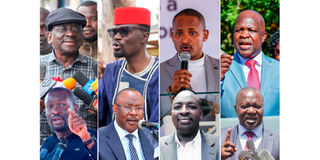
From left (top and bottom): Siaya Governor James Orengo and Nairobi Senator Edwin Sifuna (Linda Mwananchi flag bearer), Kimilili MP Didmus Barasa and Westlands MP Tim Wanyonyi (Bungoma gubernatorial race), Embakasi East MP Babu Owino and Embakasi North MP James Gakuya (Nairobi gubernatorial race), and Kisumu Deputy Governor Mathew Owili and Kisumu Senator Tom Ojienda (Kisumu gubernatorial race).
Photo credit: Nation
In Nairobi, for instance, at least four MPs were pursuing the governor’s office while several MCAs were seeking parliamentary seats.
When an MP leaves for governor, an MCA sees an opportunity to move into Parliament. When a senator moves to governor, parliamentary hopefuls begin preparing for the Senate vacancy.
“The result is an electoral ecosystem in which almost every political ambition creates another vacancy — and another contest, but ambition alone does not guarantee success,” adds Mr Omore.
The politician leaving a “safe seat”, he says, must calculate the cost of party nominations, the strength of opponents, regional alliances, campaign resources and voter expectations.
Mr Onyonka, for example, has acknowledged the delicate balance between pursuing his gubernatorial ambition and performing his Senate oversight role. His contest against Mr Arati could ultimately test whether the visibility gained through Senate oversight can be converted into an executive mandate.
For Mr Osotsi, Dr Khalwale, Mr Wambua, Mr Mungatana, Mr Lomenen and the other senators eyeing governors’ mansions, the Senate provides an existing county-wide platform from which to launch their campaigns. But it also gives incumbents an opportunity to portray them as politicians more interested in the next office than in performing their present responsibilities.
That tension has already surfaced in the Senate, where some governors have accused senators seeking gubernatorial positions of using oversight to score political points. Reports indicate that these ambitions have contributed to increasingly bitter relations between governors and senators.
“Ultimately, the 2027 election will test whether these politicians have correctly calculated the value of ambition against the security of incumbency,” says Mr Dismas Mokua.
A governor commands a county executive, controls substantial development machinery and enjoys a political platform that can propel a politician towards national office. A president commands the entire national executive. For an ambitious politician, remaining in Parliament can therefore appear like settling for less.
“But elections are unforgiving. The politician who leaves a secure constituency can lose the governor’s race and return home without a seat. The senator who gambles on a gubernatorial contest can lose both the executive prize and the political security of the Senate. The governor who pursues the presidency can discover that a formidable county base does not automatically translate into a national coalition,” argues analyst Geoffrey Mboya.
As Mr Bigambo puts it in the debate over Mr Nyoro, no region or political office can be treated as someone’s private preserve.
The 2027 contest, Mr Omore adds, may therefore be remembered not only for who won, but for the politicians who bet everything they had on something bigger — and discovered whether the risk was worth taking.