Former Deputy President Rigathi Gachagua has abandoned his legal challenge at the Supreme Court against a three-judge High Court bench, dropping claims of perceived bias and opting to focus on the ongoing impeachment petitions.
In a fresh filing at the Supreme Court, Mr Gachagua has formally withdrawn his cross-appeal that sought to overturn the Court of Appeal’s decision to uphold the bench’s refusal to recuse itself.
The bench comprises justices Eric Ogolla, Anthony Mrima, and Fredah Mugambi.
His lawyer, Kamotho Njomo, said the matter had been overtaken by events after the apex court declined to halt the High Court proceedings, rendering the appeal moot and no longer worth pursuing.
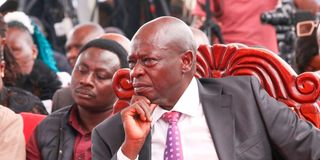
Former Deputy President Rigathi Gachagua at the Milimani law court during the hearing of his ongoing legal challenge against his 2024 impeachment. He is with his wife, Pastor Dorcus, his two sons and Wiper party leader Kalonzo Musyoka on April 27, 2026.
Photo credit: Billy Ogada | Nation
“This honourable court, having declined to issue a stay of proceedings in the High Court, this appeal has been overtaken by events based on the doctrine of mootness. The first respondent, therefore, withdraws the cross-appeal in its entirety,” reads the notice dated May 4, 2026.
The move marks a strategic shift in a high-stakes legal battle that has unfolded across three courts since his impeachment in October 2024.
Lawyer Njomo said the decision was driven by the need to concentrate on the substantive case now actively proceeding at the High Court in Milimani, Nairobi.
“The issue of bias was dismissed by the Court of Appeal and we had filed a cross-appeal to the Supreme Court to challenge that finding,” Mr Njomo said.
“But we have decided to withdraw the cross-appeal since the main case is proceeding at the High Court. We want to focus on the petition,” he added.
Mr Njomo was categorical that the biased question is now settled, at least from their side.
“The issue is now abandoned. We will not challenge the Court of Appeal judgment,” he said.
The withdrawn cross-appeal had targeted the continued sitting of Justices Ogolla, Mrima and Mugambi, whom Mr Gachagua had accused of perceived bias and conflict of interest in handling the petitions challenging his removal from office.
The Court of Appeal, in its May 2025 judgment, had dismissed those claims, finding no sufficient evidence to warrant recusal, effectively clearing the bench to proceed with the petitions.
“We have not found any conflict of interest or any other reason that would bar the three judges from hearing the consolidated matters. We have not found any impropriety in the manner in which the bench has conducted or dealt with the matters,” said the court of appeal.
That decision prompted Mr Gachagua to escalate the matter to the Supreme Court, arguing that the appellate judges erred in failing to order a reconstitution of the bench.
Former Deputy President Rigathi Gachagua appears at Milimani Law Courts alongside his wife, Pastor Dorcas Rigathi, on April 27, 2026, during the hearing of his legal challenge against his 2024 impeachment.
Photo credit: Billy Ogada | Nation Media Group
However, the latest withdrawal signals a decisive retreat by his advocates from that line of attack.
The broader dispute stems from the controversial empanelment of the three-judge bench by Deputy Chief Justice Philomena Mwilu in October 2024 to hear multiple petitions challenging Mr Gachagua’s impeachment.
In May 2025, the Court of Appeal ruled that the Deputy Chief Justice lacked authority to empanel the bench under Article 165(4) of the Constitution, dealing a blow to the National Assembly.
“The main appeal to the Supreme Court was by the National Assembly challenging the Court of Appeal’s finding that the Deputy Chief Justice could not empanel the bench,” he said.
“This was after we succeeded in convincing the Court of Appeal that the bench was improperly empanelled, and after that judgment, the Chief Justice empanelled it properly.”
Following the appellate decision, Chief Justice Martha Koome constituted the same bench afresh, effectively curing the procedural defect that had been central to Mr Gachagua’s earlier arguments.
Despite this, the National Assembly moved to the Supreme Court seeking to overturn the Court of Appeal’s findings on the Deputy Chief Justice’s powers.
Mr Gachagua responded with both an application and a cross-appeal, accusing Parliament of abusing the court process and taking contradictory legal positions.
He argued that the National Assembly had, in another case, previously maintained that the Deputy Chief Justice lacked authority to empanel benches, only to reverse that position in the current dispute.
However, with the High Court proceedings now underway and the bench properly constituted, Mr Gachagua has opted to narrow the legal contest.
His withdrawal underscores a calculated decision to avoid parallel litigation at the Supreme Court that could delay or complicate the main constitutional petitions.
The High Court case, consolidated in seven files, remains central to determining the legality of his impeachment and the events that led to his removal from office.
Those petitions challenge the process adopted by Parliament, including alleged violations of constitutional rights and procedural safeguards.
By dropping the bias claim, Mr Gachagua removes one of the procedural hurdles that had threatened to derail or delay the hearings.
At the same time, the Supreme Court battle is expected to continue on the National Assembly’s appeal regarding the powers of the Deputy Chief Justice to assign judges.
That appeal seeks to reinstate the legality of Ms Mwilu’s decision to empanel the initial bench, a question with significant implications for judicial administration.