The National Assembly Justice and Legal Affairs committee is racing against time as it considers various proposals from the Independent Electoral and Boundaries Commission (IEBC) ahead of the 2027 polls.
The committee is expected to table its report when the House resumes its sittings later this month.
The committee chairman George Murugara confirmed to the Nation that the proposals had been submitted to them and they are currently reviewing.
“Yes, the commission had submitted the various proposals as we had directed and we are looking at them,” Mr Murugara said.
The electoral agency had told parliament that they need all election-related matters considered and concluded by August 31
The commission had in April met with the committee in Mombasa where they came up with a number of proposals they want parliament to consider for effective management of the August 2027 general elections.
After the meeting, the committee directed the commission to sieve the proposals into one document and submit them to parliament.
Among the proposals that the electoral commission wants parliament to consider is repealing of Section 20 (breach of Electoral Code of Conduct) in order to give prosecutorial powers for election-related offence cases.
According to IEBC, the mandate to deal with electoral-related matters is an exclusive function of the commission and not that of the Office of Director of Public Prosecutions.
Integrity Centre in Nairobi which houses the Ethics and Anti Corruption Commission offices.
Photo credit: Pool I Nation Media Group
It’s not only IEBC that is demanding prosecutorial powers, Ethics and Anti-Corruption also recently urged the lawmakers for such a mandate.
Currently, EACC only investigates cases and recommends charges to the Office of the Director of Public Prosecutions (ODPP), which has the constitutional powers to prosecute.
The legal affairs committee is also reviewing a proposal by IEBC, which is seeking to review Clause 19 (8A) of the Elections Laws (Amendment) Bill, in order to provide that for one to be nominated in the county assembly of a respective political party, the individual must be a registered voter in that particular county.
This means if one is a registered voter in Nairobi County, he cannot be nominated as an MCA by his political party in Kwale County.
The commission also argued before the committee during the retreat that the same should apply to the party of those proposed to be nominated in either the National Assembly or the Senate.
“Review Clause 19 (8A) provides that the requirement for one to be a registered voter in a county apply to the lists under Article 97 and 98 for the National Assembly and Senate,” reads the commission’s proposal.
The National Assembly in a past session.
Photo credit: File | Nation Media Group
The commission is also pushing for the amendment of Section 36 (2) of the Elections Law (Amendment) Bill on the nomination of party list members to provide that the list ‘shall contain alternates between male and female.
Currently, the law does not specify which gender should come first, however, the commission now wants the party list of those to be nominated shall commence with the name of a female candidate.
“A party list submitted under section 1 (a), (c) (d) (e) and (f) shall commence with the name of a female candidate and alternate between male and female candidate in the priority in which they are listed.” reads the proposal by IEBC.
The commission argued that the move is to achieve the elusive two-thirds representation in Parliament.
The commission is also pushing for an amendment of section 38A on the number of voters per polling station, which it wants MPs to increase from the current 700 to 800
In its justification for the increase of voters in the polling station, the commission argued that it has new voter identification machines it has are faster compared to those used in 2013, 2017 and 2022; hence, the process would move faster.
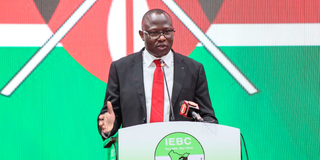
Independent Electoral and Boundaries Commission (IEBC) Chairperson Erastus Edung Ethekon during the launch of the IEBC Strategic Plan 2024–2029 and Election Operations Plan 2025–2027 at the Kenyatta International Convention Centre in Nairobi on June 24, 2026.
Photo credit: Wilfred Nyangaresi | Nation Media Group
According to IEBC, the move to increase the number of clerks in the 2027 elections will help voters to identify their voting stream hence, there will be no more wasting of time by voters looking for their names in a board and where to vote.
According to the commission, the increase in the number of voters in a polling station is also based on empirical research backed by data it did as part of its post-election evaluation of the 2022 polls.
On the proposal to amend section 39 of the Elections Laws (Amendment) Bill as proposed in the Nadco report on determination and declaration of results from the polling station within two hours, the commission rejected the move, saying it is not consistent with the established electoral law.
“The proposed timeline of “two hours” to electronically transmit results is not practical for any election official,” reads the commission proposal to the committee.
For the independent candidates, the commission has supported an amendment to Section 32 of the Bill on the approval of a symbol for independent candidates
The section, however, provides that “The Commission may refuse to approve the symbol of an independent candidate if the symbol is obscene or offensive, is the symbol of a political party or another independent candidate within the same County or so nearly resembles the symbol of a political party or another independent candidate within the same County or another legal entity registered under any other written law.
The commission is also pushing for either an amendment or annulment of Regulation 34 (2) of the Elections (Registration of Voters) Regulations 2012 in order to allow it to register Kenyans in diaspora outside the current designated areas.
Currently, the regulations limit voting and registration of voters only in Kenyan Embassies, High Commissions and Consulates.
The commission argues that the regulations in its current form limits its ability to extend services to eligible citizens residing in countries or regions without proximate diplomatic representation.
According to the commission, the regulation goes against Article 38 of the Constitution, which guarantees every adult the right to be registered as a voter and vote without any restrictions.
Further, Article 82 requires electoral law to provide for the progressive registration of citizens residing outside the country and progressive realisation of their right to vote.
In a bid to achieve all the proposals made by the commission, MPs must amend a raft of regulations such as Election (Voter Registration) (Amendment) Regulations, 2022, Election (General) Regulations) (Amendment) Regulations, 2022and Election (Voter Education) (Amendment) Regulations, 2022
Others include Elections (Party Primaries and Party Lists) Amendment) Regulations, 2022, and Elections (Technology) (Amendment) Regulations, 2022.