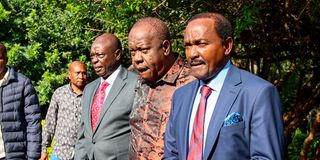
In public, they shake hands at rallies, church services and press conferences, presenting an image of a united opposition determined to remove President William Ruto from power in 2027.
Behind closed doors, however, insiders paint a different picture: an alliance grappling with mistrust, alleged 'backstabbing' and political 'set-ups'. Unless these issues are addressed, they could undermine the alliance's bid for power before the race has even begun.
Recent events, ranging from conflicting messages and uncoordinated public engagements to differing views on coalition structures and leadership, have fuelled speculation that achieving consensus may be more difficult than public statements suggest.
Although the alliance's leaders continue to claim that they will eventually select a single presidential candidate, the process has been marked by public endorsements, mixed messages and increasing debate over whether there are sufficient institutional mechanisms in place to guide one of the country's most politically diverse groups towards a shared goal.
However, political observers say that such challenges are hardly unusual in broad-based coalitions that bring together leaders with varied political histories, regional interests, and presidential ambitions.
They argue that the success of any alliance depends not only on its ability to rally crowds, but also on its capacity to build trust, establish clear decision-making structures, and manage competing interests away from public scrutiny.
Against this backdrop, fresh accounts from within the opposition have shed new light on the coalition's internal workings. They portray an alliance that is still wrestling with questions of organisation, communication and leadership, even as it seeks to persuade Kenyans that it represents a cohesive and credible alternative government.
An interview with Dr Fred Matiang’i, one of the United Opposition's co-principals, alongside accounts from multiple insiders within the coalition, reveals an alliance grappling with internal tensions that could undermine its carefully cultivated image of unity.
Democracy for the Citizens Party (DCP) Party Leader Rigathi Gachagua (second right) addressing a press briefing at the SKM Centre on April 15, 2026. With him are (from left) Wiper Party Leader Kalonzo Musyoka, Jubilee Deputy Party Leader Fred Matiangi and Democratic Action Party-Kenya (DAP-K) Party Leader Eugene Wamalwa.
Photo credit: Francis Nderitu | Nation Media Group
Speaking barely a day after Mr Muturi publicly declared his intention to back Mt Musyoka should he miss the coalition’s presidential ticket, Dr Matiang’i emphasised that any coalition seeking to convince Kenyans it offers a credible alternative to the current administration must first demonstrate “honesty, transparency and good faith in the way its leaders relate to one another.”
"Ultimately, this journey of re-organising Kenya and bringing about real change will benefit a great deal from fundamental good faith among us. We have enough time, but we must build trust and, more importantly, demonstrate to Kenyans that we can be trusted individually and collectively," Dr Matiang’i told Nation in an exclusive interview.
"If I'm not selected as the presidential candidate, the only other principal in the United Opposition I can support is Kalonzo. Let's stop beating around the bush," Mr Muturi said in Machakos last Sunday.
His DP Party issued a statement defending his calls for early nomination of the opposition’s 2027 presidential flag bearer.
“The Democratic Party of Kenya fully associates itself with and supports the position taken by our party leader on the need for the early nomination of the coalition’s presidential candidate,” DP Secretary General Jacob Haji said in a statement.
He went on: “We believe that an early nomination is necessary for several reasons, including adequate preparation, effective campaign planning, resource mobilisation and the establishment of the logistical structures required for a successful presidential campaign.”
The former Interior Cabinet Secretary said Kenya was already experiencing what he termed "a trust drought" in public leadership, warning that opposition leaders should avoid replicating the very political culture they accuse the Kenya Kwanza administration of perpetuating.
"Backstabbing, scheming and counter-scheming will completely destroy the hope Kenyans have in a new government. If we become like those we seek to replace, then there will be no meaningful difference."
Public endorsements of Mr Musyoka by Mr Gachagua and talk of a secret 2027 deal between the two have not helped matters.
Political observers say such statements inevitably fuel perceptions that informal preferences may be emerging even before a formal coalition framework is completed.
Jubilee Deputy party leader (Operations) Jeremiah Kioni told Nation that it was clear Mr Gachagua, Mr Muturi and Mr Wamalwa had settled on Mr Musyoka, even before the coalition had concluded the processes for a common presidential candidate.
People’s Liberation Party leader Martha Karua(Centre) addresses journalists flanked by (from left) Dr Fred Matiangi, former Attorney-General Justin Muturi, former Deputy President Rigathi Gachagua and other opposition leaders at SKM Command Center in Nairobi on July 8, 2025.
Photo credit: Billy Ogada | Nation Media Group
Mr Kioni said that while he did not fault Mr Muturi for publicly expressing his personal preference, he argued that the opposition should ultimately allow Kenyans—not individual politicians—to determine who is best placed to lead the coalition into the 2027 General Election.
"I don't have a problem with what Justin did. Is it a good thing to do? I think so," Mr Kioni said. "But this issue of who becomes our presidential candidate must ultimately be left to Kenyans."
His sentiments are shared by Ms Karua, who insists that the coalition must submit itself to a process that is measurable, transparent and rooted in public opinion.
"Anybody who tells you that we'll lock ourselves in a house and come with a candidate is missing the point. We cannot select a candidate in a boardroom. We must take into account the views of the majority, and there is no other way for a presidential candidate other than a scientific process that tells us what the people want,” Ms Karua said.
On Thursday, Ms Karua sent out a statement, saying the speculation over the coalition's presidential ticket was premature, stressing that the alliance was still putting in place its governance structures and rules before embarking on the sensitive exercise of selecting a candidate to face President William Ruto in the 2027 General Election.
"No decision has been made on the process, criteria, or timeline for selecting the coalition's presidential flag bearer," Ms Karua said.
Seeking to calm the growing speculation, Ms Karua said she and Mr Musyoka, who serve as co-convenors of the United Alternative Government, remain committed to building a coalition anchored on consultation, inclusivity and adherence to agreed procedures.
"As Principals and Co-Convenors of the United Alternative Government, we are committed to building a coalition founded on consultation, mutual respect, inclusivity, and fidelity to agreed processes. These values distinguish our coalition and inspire confidence among Kenyans who seek a credible, democratic, and principled alternative," she said.
Ms Karua, however, revealed that the coalition's Technical Committee, chaired by former Cabinet minister Kipruto Arap Kirwa, has substantially completed its work on proposals for formalising the coalition's structures and governance framework.
According to Ms Karua, the committee will soon present its recommendations to the coalition principals during a retreat where they are also expected to deliberate on a shared political agenda focusing on democratic renewal, economic transformation and constitutional governance.
"However, we equally recognise that the selection of the coalition's flag bearer is one of the most consequential decisions we shall make. It is therefore a matter that must be determined collectively, through an agreed consultative framework and established coalition structures. This process requires patience, goodwill, and discipline from all Principals, members, supporters, and stakeholders."
On Friday, Mr Gachagua, who had last week dismissed claims that he had endorsed Mr Musyoka and said that the race was still open and they would only choose a candidate close to the end of the deadline, threw another spanner in the works in the opposition.
He rubbished a plan by Linda Mwananchi faction of Nairobi senator Edwin Sifuna, now joined by Murang’a governor Irungu Kang’ata, to conduct a rally in Ol Kalou.
“I want to tell my brother, Irungu Kangata, I heard him saying that he wants to come with Linda Mwananchi to Ol Kalou. We don't need you there for DCP unless you are coming to campaign for another party. If you want to come and campaign for UDA, please go ahead. If you want to come and campaign for Jubilee, go ahead or any other party. But DCP, ours, is a local campaign. We don't want confusion in Ol Kalou. He cannot come and bring Linda Mwananchi there to campaign on the last day without knowing what the issues are and how the campaign is being done. That campaign has been going on for two months, led by Senator John Methu and others,” said Mr Gachagua in a presser at his Karen home.
The move comes barely a week after a section of Linda Mwananchi leaders from Western Kenya announced their intention to unveil a new political party and front Mr Sifuna for president.
The resolutions were made on Sunday during a meeting hosted by Trans Nzoia Governor George Natembeya and attended by Mr Sifuna, Vihiga Senator Godfrey Osotsi, Kabuchai MP Majimbo Kalasinga and Bumula MP Wamboka Wanami, among other leaders.
“Our resolution is that Mr Sifuna will contest the presidency in 2027. Soon, we shall announce the party we will use to seek the presidency,” said Mr Natembeya.
“We are going to launch vigorous grassroots campaigns in all 38 constituencies in Western Kenya to mobilise our people to register as voters and support our political agenda,” the governor added.
The battle over the opposition group candidature began last week when, speaking at a function in his Tseikuru backyard, Mr Musyoka endorsed remarks by Kitui Senator Enoch Wambua, who had told supporters that opposition principals had already agreed on his candidacy.
"You've heard how Senator Enoch Wambua has passionately explained to you what is happening and even shared privileged information. Everything he has said, I want to confirm. That's exactly how things are," Mr Musyoka said.
Mr Wambua had claimed that Mr Gachagua was using his 45-day consultations at his Wamunyoro home to prepare his Mt Kenya supporters for Mr Musyoka’s eventual endorsement.
"This is the candidate our leaders have already agreed on. Once Gachagua finishes his consultations, he will officially announce to his people that the United Alternative Government presidential candidate is Kalonzo," said Mr Wambua.
This, as Mr Kioni cautioned that imposing a candidate without broad public buy-in could dampen enthusiasm among voters, undermining the opposition's broader objective of unseating President Ruto.
"We are looking for a president who can do better than Ruto. That person must already resonate with the public, inspire confidence and motivate more people to come out and vote," he said.
In the interview, Dr Matiang'i also maintained that any eventual decision on a flag bearer to face President Ruto must emerge through a process viewed as transparent, inclusive and credible by all coalition partners and the public.
"The process is just as important as the outcome," he told Nation.
The former Interior Cabinet Secretary also dismissed online speculation surrounding his recent encounter with National Assembly Minority Leader Junet Mohamed and Kisii Governor Simba Arati, Dr Ruto’s allies at the Jomo Kenyatta International Airport.
Photographs circulating on social media had prompted claims that he had held political consultations with leaders associated with the broad-based government.
National Assembly Minority Leader Junet Mohamed, Jubilee presidential candidate Fred Matiang’i and ODM Deputy Party Leader Simba Arati.
Photo credit: Pool
"On Saturday morning, after checking in at the Kenya Airways desk at Jomo Kenyatta International Airport, I bumped into Simba Arati and Junet Mohamed, who had also checked in and were travelling to Kisumu.
"It was simply a chance encounter between leaders at the airport. Really, what can you even discuss at the checking point in an airport?”
He added that Kenya's next leadership should inspire confidence not only through promises but also through its conduct during the process of coming together.
"If we can demonstrate trust among ourselves now, then Kenyans will have reason to believe we can govern together later."
While the principals have consistently projected solidarity at rallies, church services and press conferences, Dr Matiang'i argued that the coalition still requires deliberate institutional building if it is to convince Kenyans that it is prepared to govern.