In his book The Art of War , Chinese military strategist Sun Tzu advocates the use of infiltrators, double agents, and spies as the ultimate foundation for military success.
In Kenya, this maxim has gained currency and is being exploited as a crucial political tool, especially for those seeking to maintain power and control opposition politics.
From the Kanu days of President Daniel arap Moi to today’s multiparty age, insiders posing as loyalists have been accused of betraying their allies by leaking strategies to rivals. Leaders whisper of infiltrations of spies and informants embedded by rivals to sow confusion and relay intelligence.
With the 2027 polls about 10 months away, claims of political moles planted by President William Ruto to leak strategies and foment internal division have rocked the opposition and are creating suspicion.
President William Ruto during a thanksgiving service in South Horr, Samburu County on September 6, 2026.
Photo credit: PCS
Within the ruling camp, fears of infiltrators sitting in strategic meetings have also emerged. The scenario has been worsened by elected leaders thought to be buying time before they can jump ship ahead of the contest.
Top opposition leaders have sensationally accused their colleagues of holding brief for the government, with plans of assisting Dr Ruto to recapture the presidency. For the accusers, the moles have been promised political rewards, either before or after the August 10, 2027 polls. The claims have since triggered accusations and counter-accusations.
But behind the claims, also lies another troubling scenario. Some politicians are using the mole tag to discredit their colleagues seen as a threat to their personal interests. This is more in regional supremacy battles, where those who feel challenged, quickly label their perceived opponents as state agents.
The growing perception of political infiltration has been fueled by competing personal interests and ambitions by top officials in both the United Opposition and Linda Mwananchi movement.
There are already fears in the opposition camp that the state – through moles – could engineer a split by sponsoring multiple candidates. The schemes, they say, are designed to boost President Ruto's chances of re-election.
Democracy for the Citizen Party leader Rigathi Gachagua has publicly claimed that one of the opposition principals was on his way to join Dr Ruto ahead of the polls.
“I want to prophesise today, not because I am a prophet but based on experience, foresight and understanding of Kenyan politics. One presidential candidate will be announced; one person will go away. That one person will go away on his own,” said Mr Gachagua.
During an engagement with clergy in Boston, Massachusetts, the former Deputy President further claimed of a plot to disrupt the opposition. He accused Dr Ruto of planning moles within the opposition to frustrate their unity bid.
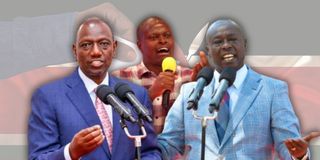
Wiper Party Leader Kalonzo Musyoka (left) and his DCP counterpart, Rigathi Gachagua.
Photo credit: File | Nation Media Group
Gachagua claimed that attempts were being made to disrupt efforts to build a united opposition front. But he said he was confident his party was able to “detect such fellows” before they infiltrated DCP.
Although Mr Gachagua did not mention names, Kalonzo Musyoka’s Wiper Patriotic Front was at the weekend forced to issue a statement to deny any secret engagements with the Kenya Kwanza administration.
Mr Musyoka and top Wiper officials reportedly held closed-door meetings with veteran politician Johnson Muthama, who is a close ally of Dr Ruto and the founding national chairman of the ruling United Democratic Alliance (UDA).
In a press briefing, Wiper national chairperson Jamlek Kamau admitted the Thursday night meeting between Mr Musyoka and Mr Muthama. He, however, denied claims that Mr Musyoka was out to join hands with Dr Ruto. Mr Makau said the meeting was part of Mr Musyoka’s plan to bring back Mr Muthama to his fold ahead of the 2027 elections.
“I am the one who initiated the talks with Johnstone Muthama. At no time has he met our party leader to persuade him to join the government. We have met twice, once at a hotel in Nairobi and again at my home,” said the former Kigumo MP.
Speaking at Mugumo Primary in Kirinyaga County during the funeral service for Mwalimu Jackson Karua, the father of People’s Liberation Party (PLP) leader Martha Karua, Mr Musyoka was again forced to revisit the matter. He warned opposition politicians against becoming Dr Ruto’s moles.
“If any of us becomes Kasongo mole (referring to President Ruto by his nickname), he or she will suffer the consequences of the biblical Lot,” he said.
Mr Musyoka, former President Uhuru Kenyatta and People’s Party of Kenya (PPK) leader Ndindi Nyoro rallied the opposition to remain united and pick a single presidential candidate in denying Kenya Kwanza another term in office.
Jubilee Party leader Uhuru Kenyatta during a meeting of his party's delegates at Kiambu Golf Club in Kiambu County on May 25, 2026.
Photo credit: Evans Habil | Nation Media Group
Similar claims of double-agents and infiltration have also rocked Nairobi Senator Edwin Sifuna’s Linda Mwananchi movement. Embakasi East MP Babu Owino, Trans Nzoia Governor George Natembeya, Saboti MP Caleb Amisi and Kakamega Senator Boni Khalwale have each acquired their own political outfits.
Siaya Governor James Orengo has also indicated his plans to register a new party. Mr Sifuna is yet to announce the political outfit he would be running on, but the fragmentation in the movement is already threatening to dim their political wave.
Governor Natembeya and Mr Amisi have publicly accused each other each other of being out to frustrate Mr Sifuna’s presidential bid.
Mr Amisi, who is the People’s Renaissance Movement (PM) party leader, has repeatedly claimed that his outfit was formed to propel Linda Mwananchi.
“But greedy individuals joined Linda Mwananchi, messed up Sifuna, removed me from WhatsApp groups, and branded my party a mole and wheelbarrow so that people can shun it,” said Mr Amisi.
Mr Amisi claims that those around Mr Sifuna are only seeking to use his name to secure their political seats.
“I fear that some who stand around him want his name more than they want him well. Look at the political parties that have since emerged,” he said.
Siaya Governor James Orengo speaks at Safari Park Hotel, Nairobi on August 17, 2026 during a press briefing. Mr Orengo has declared interest in running for president on a Linda Mwananchi ticket.
Photo credit: Lucy Wanjiru | Nation Media Group
Mr Natembeya has also accused Mr Amisi of being out to cause confusion in Linda Mwananchi. The governor has also questioned the loyalty of Governor Orengo and Suba South MP Caroli Omondi.
The two leaders attended a meeting that endorsed rebranding of Azimio la Umoja One Coalition as The Ukombozi Alliance (TUA). Mr Natembeya was seeking to rebrand the United Democratic Party (UDP) as Ukombozi People’s Party (UPP). His request was rejected after Mr Musyoka reserved the ‘Ukombozi’ name.
“Why would you be in Azimio and at the same time be Linda Mwananchi? We have not joined Azimio, and even ODM had left Azimio, so on what grounds are they still associating with the coalition? I think there are some people who are not with us, but we want to tell them Sifuna will not give in on his bid,” Mr Natembeya said at the height of their fight over ‘Ukombozi’ name.
But Jubilee deputy party leader Jeremiah Kioni claimed that those calling others moles are the real double agents in the opposition. He said some opposition politicians were out to discredit their colleagues for personal gain.
“Anybody who has a better standing is painted in the bad light. It is those in the opposition calling each other moles. It does not help in any way in advancing the broader agenda of the opposition, but to advance personal interests by making the other looks bad,” said Mr Kioni.
“In the long run, it makes the opposition weak. Those quick to call others moles are people with troubled past. They are the same people who put this government in power,” he added.
Democracy for the Citizens Party (DCP) Party Leader Rigathi Gachagua (second right) addressing a press briefing at the SKM Centre on April 15, 2026. With him are (from left) Wiper Party Leader Kalonzo Musyoka, Jubilee Deputy Party Leader Fred Matiangi and Democratic Action Party-Kenya (DAP-K) Party Leader Eugene Wamalwa.
Photo credit: Francis Nderitu | Nation Media Group
But Gatanga MP Edward Muriu believes that the Ruto camp was using every tactic in the book to weaken the opposition. He claims they had resorted to such schemes after ‘losing’ Mt Kenya support base.
“After the Ol Kolau by-election loss, Ruto knew in no uncertain terms that the mountain vote is gone and (there is) no chance of coming back,” he said.
“He had to tact; instead of wining the bloc back, he devised strategy to divide those votes hence the introduction of the politics of moles.”
He claimed the plan is to scatter the opposition by infiltrating it and causing mistrust by sponsoring various propaganda machinery. The MP said the plan included planting multiple presidential candidates.
Prof David Monda, a US-based political analyst, admits that Kenyan politics is fraught with backstabbing, treachery and betrayal.
“It is only natural for this state of uncertainty to persist in the opposition. Frankly stated, the United Opposition is far from united. It is a marriage of convenience between anti-government politicians bound together by threads of distrust and uncertainty,” says Prof Monda.
He observes that each of the key players are using the opposition as a platform to leverage their personal political fortunes.
“If these fortunes in the opposition turn for the worse, they can quickly decamp into the government or be used by the government to undermine opposition unity,” he notes.
“Distrust in opposition ranks will only get worse closer to the election,” he said.