The uneasy truce between President William Ruto’s United Democratic Alliance (UDA) and Oburu Oginga-led Orange Democratic Movement (ODM) is facing a fresh test as the two parties begin confronting the most difficult question in their broad-based government arrangement — who gets to contest where in 2027.
While Dr Ruto and Dr Oginga’s political partnership through their UDA and ODM parties has moved into a new phase, shifting from cooperation in government to the task of developing the joint manifesto that will form their policy blueprint, the formations continue to clash over the thorny political zoning of regions.
The show of cooperation at the top is increasingly masking competition on the ground, with both parties seeking to expand their political footprints while simultaneously negotiating a pre-election arrangement.
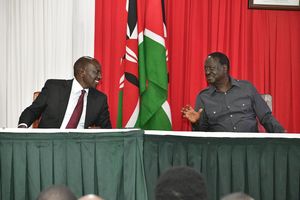
President William Ruto, ODM Party Leader Oburu Oginga and members of the Orange Democratic Movement (ODM) Central Management Committee and the United Democratic Alliance (UDA) Steering Committee during a joint consultative meeting at State House, Nairobi, on Thursday, April 23, 2026.
Photo credit: PCS
For Dr Oginga, the answer is zoning, and he emphasises that UDA should keep off traditional ODM strongholds and allow the party to defend its parliamentary and county seats.
For UDA, however, such an arrangement would undermine its ambition to build a national political machine ahead of the 2027 General Election and disenfranchise its members.
The disagreement is already playing out in counties where the two parties are supposed to be partners.
ODM has since made zoning one of the party’s key demands in negotiations with UDA. The party wants its traditional bases, particularly Nyanza, parts of Western and the Coast, protected from UDA candidates.
National Assembly Minority Leader Junet Mohamed has warned that ODM’s parliamentary strength is not negotiable, saying the party intends to retain all its current seats and win more in 2027.
“We are telling any party that we are associating with, any party in this country that wants to associate with us, our parliamentary numbers are not negotiable,” he said.
President Ruto has said his party is prepared for “friendly fire” with ODM in the next election, arguing that the two parties can compete against each other and still remain partners.
“The political pact negotiations between UDA and ODM are at an advanced stage. The parties will enjoy a friendly fire in the next polls, but we will remain on course,” Dr Ruto said in Kajiado recently.
UDA Secretary-General Hassan Omar has been even more categorical. “There is no zoning, and everyone will have to fight for themselves to win the seats.”
The disagreement is creating an unusual situation in which the two parties are working together in government while building competing political structures at the grassroots.
But ODM National Treasurer Timothy Bosire differs with his counterparts in the party, terming their push for zoning a “warlord move” that undermines democratic competition and risks locking out leaders with ambitions to seek elective positions in areas considered to be controlled by particular political figures.
Mr Bosire argues that ODM should remain open to all aspirants and allow voters to determine their preferred candidates through a credible and competitive nomination process. He cautions that attempts by party leaders to allocate political territories or positions in advance could weaken the party and alienate supporters on the ground.
“Zoning is a warlord move and is against democratic principles. You cannot sit in Nairobi and decide that this region belongs to this person or that position belongs to another person. Let the people compete freely and choose their leaders. If we start zoning the country and telling people who should lead where, then we will be taking away the very democratic space that ODM has fought to protect,” Mr Bosire told Nation .
Former Kitutu MP Timothy Bosire.
Photo credit: File | Nation Media Group
UDA’s grassroots elections in counties long regarded as ODM territory have particularly unsettled the Orange party.
The ruling party has been expanding its structures in Kisumu, Siaya, Homa Bay and Migori, among other counties, a move ODM officials view as an attempt to weaken their traditional political machinery ahead of 2027.
UDA says the exercise is simply part of building a national party capable of competing across the country.
Having taken over the leadership of ODM following the death of Raila Odinga in October last year, his close associates say he must protect the party’s political interests without undermining its working relationship with President Ruto.
For ODM politicians, the stakes are especially high because their bargaining power after the election will depend heavily on the number of elected leaders they take into the next Parliament.
Mr Mohamed has already framed the issue in those terms, arguing that numbers will determine the party’s influence both before and after the election.
Some ODM politicians fear that denying voters the opportunity to choose between competing candidates could produce resentment, voter apathy or defections.
President William Ruto, ODM Party Leader Oburu Oginga and members of the Orange Democratic Movement (ODM) Central Management Committee and the United Democratic Alliance (UDA) Steering Committee during a joint consultative meeting at State House, Nairobi, on Thursday, April 23, 2026.
Photo credit: PCS
The party has also faced criticism over its previous nomination practices, with some aspirants fearing that direct tickets could again be used to protect sitting MPs and other party loyalists.
If ODM insists on zoning, political pundits say, it risks appearing to seek protection from competition. If it accepts open competition, it risks losing some of the seats that give it leverage in the broad-based government.
If it respects ODM’s traditional strongholds, it may frustrate its own candidates and slow the party’s expansion. If it fields candidates everywhere, it could trigger bitter contests with a partner it still needs for the broader political alliance.
In Western Kenya, both UDA and ODM are positioning themselves for influence, with Kakamega Governor Fernandes Barasa (ODM) seeking to strengthen his position while UDA continues to flex its political muscle.
Vihiga presents another complication. ODM controls the governor’s seat, while the county is also closely associated with Prime Cabinet Secretary Musalia Mudavadi, whose political base is being absorbed into the UDA structure.
Bungoma, meanwhile, presents another potential clash, with Ford Kenya leader Moses Wetang’ula seeking to maintain his influence while UDA’s Dismas Barasa eyes the governorship.
At the Coast, the problem is even more immediate.
Mombasa is shaping up for a contest involving ODM Deputy Party Leader and Governor Abdulswamad Nassir and UDA Secretary-General Hassan Omar. The two are senior officials of parties that are supposed to be working together nationally.
The situation illustrates why zoning has become more than an argument about parliamentary seats. It is now about who controls the political machinery and bargaining power within the broad-based government.
ODM is said to be keen on ring-fencing the county for Mr Nassir, with businessman Suleiman Shahbal protesting bitterly and vowing to use other alternative means to contest, even as Nyali MP Mohamed Ali, a former ally of President Ruto, defected to the opposition for fear of being locked out of the gubernatorial race.
Kajiado presents another potential confrontation, with ODM Governor Joseph Ole Lenku facing a challenge from State House Comptroller Katoo Ole Metito, who is associated with UDA.
In Nairobi, Governor Johnson Sakaja is also reported to be considering joining ODM, adding another layer to the calculations in the capital, even as Makadara MP George Aladwa insists he remains the sole ODM candidate at the moment.
President William Ruto and Nairobi Governor Johnson Sakaja at a past event.
Photo credit: Dennis Onsongo | Nation Media Group
“These contests demonstrate the difficulty of drawing neat political boundaries when leaders have their own ambitions and voters are not necessarily prepared to follow coalition agreements made at the top,” argues political analyst Geoffrey Mboya.
The zoning debate is also being complicated by individual politicians determined to pursue their ambitions regardless of party arrangements.
Mombasa businessman Suleiman Shahbal, for example, has rejected President Ruto’s attempt to discourage him from contesting the Mombasa governorship.
Dr Ruto recently advised Mr Shahbal to concentrate on business and investment rather than elective politics, pointing to a Sh12 billion GulfCap-DP World deal to develop a 535-acre Special Economic Zone in Jomvu.
Mr Shahbal has instead announced his departure from ODM and says he will contest the governorship under a new political vehicle even without the party’s backing.
His defiance could complicate the Mombasa equation, where Governor Nassir and Mr Omar are already positioning themselves.
Analysts say that even if UDA and ODM eventually agree on who should contest particular positions, they cannot easily prevent ambitious politicians from seeking alternative party tickets or running as independents.
“That is precisely the danger. A poorly managed coalition arrangement could produce defections, independent candidates and intra-coalition battles that leave both partners weaker,” argues advocate Chris Omore.
Kenya’s political history, he says, offers plenty of warnings.
“Zoning has previously generated resistance among coalition partners, while failure to coordinate candidates has resulted in divided votes and lost seats,” says Mr Omore.
The 2017 NASA experience, for instance, demonstrated the danger of sibling rivalry when coalition parties field competing candidates in the same constituencies.
The two parties have agreed to establish a Broad-based Management Committee comprising party leaders, selected Cabinet ministers and parliamentary leadership to coordinate government business and address outstanding issues, including political differences.
The committee is also expected to help lay the foundation for what the two sides describe as a formal coalition of equals.
For Dr Ruto, the challenge is to keep ODM within the broad-based arrangement while allowing UDA to expand nationally.
For Dr Oginga, however, it is to preserve ODM’s political influence and parliamentary numbers without jeopardising the relationship with State House. But for the aspirants across the country, the uncertainty is becoming increasingly uncomfortable.
“They need to know whether they will face a candidate from their coalition partner, whether they will receive a party ticket and whether agreements reached by party leaders will override grassroots popularity,” political analyst Dismas Mokua says.
As the 2027 race gathers pace, “the zoning dispute could therefore become the first major stress test of the Ruto-Oburu partnership.”