Although some have described the Russian war with Ukraine as the world’s first major Artificial Intelligence conflict, use of propaganda by both sides shows that some war practices remain the same.
The internet and social media have opened up new opportunities to manipulate public attitudes and to attack opponents. Both sides have skillfully manipulated global opinion and, in one case, pulled off a months-long deception involving a Kenyan mercenary fighting for Russia that captured the world’s attention
In January 2026, a viral video appeared to capture a particularly brutal episode from Russia’s war in Ukraine. An African man in Russian military uniform stood with what appeared to be an anti-tank mine strapped to his torso.
A Russian-speaking man hurled racist abuse at him and appeared to order him to run towards Ukrainian positions, describing the African fighter as a human “can opener” who would be used to breach enemy lines.
Originally posted on X, the video had been viewed 5.6 million times by August 2026, and many media outlets had aired the story. For months, the footage circulated as an illustration of the abuse faced by African recruits in Russia’s military.
The man in the video was Francis Ndung’u Ndarua, a Kenyan who had travelled to Russia believing he had been recruited for security work.
On January 9, CNN journalist Larry Madowo inquired about Ndarua on Facebook, asking whether anyone knew the African man caught up in Russia’s war in Ukraine: “An African named Francis caught up in Russia’s war in Ukraine. Do you know someone who made it back or is still there?”
The story moved fast. In February, CNN published an investigation titled, You escape, or you die: African men say Russia duped them into fighting in Ukraine”.
Ndarua’s case then ricocheted through global media. The Telegraph followed with “Mother of Kenyan forced to be a Russian suicide bomber ‘traumatised’”.
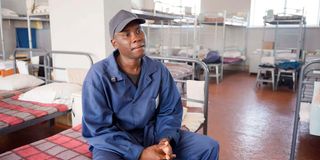
Francis Ndarua during an interview at a prisoner-of-war camp in western Ukraine on July 30, 2026.
Photo credit: Pool
By March, Ndarua’s name reached the European Parliament and was cited in a human rights resolution. By May, Russia had done something it rarely did: it acted. It formally notified Kenya that Ndarua was missing in action. His family was contacted by the State Department for Diaspora Affairs to submit documents to begin the compensation process.
After the viral video, all indications were that he had died.
However, Ndarua is alive and in Ukrainian captivity, where he has been held for more than 270 days by the time of publishing this article, since November 22, 2025.
All of this unfolded while, by his account, he was being detained in what he described simply as “a basement”. Ukraine’s Coordination Headquarters for the Treatment of Prisoners of War did not respond to requests for a comment before publication.
On July 30, 2026, when our investigative team tracked him to a prison camp in western Ukraine, Ndarua narrated his ordeal in Russia and how he came to make the video that shocked the world. “They (the Ukrainians) requested me to do that video,” he said.
He explained that the video showing him with an explosive and apparently being callously sent off to imminent danger by Russian-speaking military officers was a scripted scene staged by his captors, which he had agreed to. It was intended for use as a deterrent to Africans thinking of signing up to fight for Russia.
“This is the video I was told to make: I come from Africa, and so I should take that bomb and act as if this (Russian) guy is forcing me to go to war, and I keep resisting. The aim is to show this is how Africans are being used in the Russian war.” He added that he had agreed to take part in the scheme because the scene echoed some of what he had experienced at the war front. At a river crossing, he said, he had stumbled and grabbed onto what turned out to be a corpse. When he looked around him, he saw numerous other bodies, some decomposed and others apparently quite fresh. A Russian soldier with a gun behind him kept ordering him to move forward even as armed drones buzzed overhead. Ndarua believed he might be shot if he tried to retreat.
“I was told there was no surrender. It was hell,” he said.
He did a second video, dressed in a grey striped wool coat over a white woollen turtleneck. Unlike the earlier staged scene, Ndarua said this time he spoke of his own free will. “Those were my own words,” he said.
Our investigative team sought to establish where the “suicide bomber “footage depicting Ndarua with an explosive originated, who produced it, and how it entered the public domain.
Francis Ndarua during an interview at a prisoner-of-war camp in western Ukraine on July 30, 2026.
Photo credit: Pool
Ndarua’s mother, Anne, received a copy from a Ukrainian telephone number on January 9 and was encouraged to circulate it widely, according to messages reviewed by our investigative team. The Kiswahili message suggested that wider circulation could draw the attention of the authorities in Russia, Kenya, and Ukraine.
It also contained a clue. The sender told her not to lose hope because her son might still be alive and “in captivity”. News organisations failed to consider that Ndarua might already have been a prisoner of war in Ukraine.
The earliest public version of the video our investigative team has been able to trace points to the Telegram channel Exilenova+, on January 9. Ukraine Today subsequently cited the Exilenova + post. Hours later, Anton Gerashchenko, a former deputy minister in Ukraine’s Interior ministry posted the recording on X. By then, the video had acquired a life of its own, igniting global debate on social media, and international legislative bodies about Russian trafficking of thousands of African men into its military.
On January 15, ZMINA, a Ukrainian human rights news outlet, published an article and cautioned that “the video published by Gerashchenko, along with other details, requires further thorough verification.”
Ukrainian military units have frequently published post-capture interviews with prisoners of war on Facebook, often identifying the brigade or battalion that took them into custody. Ndarua’s second video had much the same tenor and presentation as those recordings.
Ndarua’s account of his battlefield experience needed little embellishment, raising the question of why his captors wanted him to act out a version of the events at all. He said he was trafficked to Russia through an employment agency that has been linked to recruitment for Russia. He travelled to St Petersburg via Istanbul, Turkiye. Of the 24, Ndarua is the only one known to be alive; the others are missing or reported dead.
At the front, he watched one commander lose an arm in a drone attack. About a week later, the replacement commander, walking behind him stepped on a landmine and lost a leg. Ndarua then spent weeks in a dugout. Water ran out. For days there was no food.
“I knew I’d die if I continued staying there,” he said.
The danger did not come only from Ukrainian firepower. Ndarua also described growing distrust within the Russian ranks where he was deployed. At one dugout, he said, he was the only African. “They forced me to sleep near the door where it was very cold,” he recalled. “They started mistreating me. They took my gun and put it aside; I couldn’t say no. I guess they couldn’t risk me shooting them if I got pissed off.” After another Kenyan was blamed for exposing a Russian position during a drone attack, Ndarua said suspicion fell on him as well. “They thought I’d do the same to them since I was also Kenyan.”
Francis Ndarua during an interview at a prisoner-of-war camp in western Ukraine on July 30, 2026.
Photo credit: Pool
In November, after weeks hiding in a dugout, Ndarua briefly thought he had finally made it out.
At the outpost, he tried to convince his commander that he was unwell and needed urgent medical attention. “They wouldn’t listen…so I obeyed the orders.” Not long afterwards, the Russian soldiers in his group abandoned him and another man. Exhausted, ill, and isolated, he was captured by the Ukrainians within days.
After his capture, Ukrainian soldiers transported him, blindfolded, to an interrogation centre.
“Why did you come all the way to kill Ukrainians?” Ndarua recalled an interrogator asking. “Have you ever seen our people in your country doing the same?”
“I didn’t do it deliberately. I just found myself here,” he replied.
During our interview, Ndarua spoke in English and Kiswahili, often becoming absorbed in his recollections and talking for nearly 15 minutes at a time, with our questions seeming almost to interrupt the flow of his story. He would periodically break off to ask whether, after the interview, we could meet his mother in Kenya and tell her he was alive and doing well.
Ndarua told our investigative team that he arrived in Russia in August 2025. “On arrival I signed my contract in a language I could not understand,” he said. “I was tricked into signing things I didn’t understand. In Qatar, where I worked in a security job, they’d interpret everything before you sign. But this time, I just signed.”
For a short while, Ndarua said he still believed he might be doing the security work he had travelled to Russia for. “I was armed at the gate. If a car came through, I would inspect it and let it through. At some point I was in the kitchen opening cans of meat.”
That illusion was shattered when another Kenyan recruit returned with news that they were being sent to the battlefield.
“That’s when it fully dawned on me that this wasn’t our workstation, and that we were destined for the war,” he said.
Ndarua’s experience was not isolated. The investigative team found that it fit a broader pattern. Since the war began in February 2022, over 3,000 Africans have been recruited into the Russian army, many under false or misleading promises, placed into military service they did not understand or consent to, and given only cursory training before being sent to the front. According to data collected by Journalists For Justice (JFJ), a Hague-based media investigative team, at least 505 Africans have been killed while many others remain missing, leaving families searching for answers.
Ndarua’s trajectory fortunately, ended in captivity.
Concerns about the treatment of prisoners on both sides have been well documented. Maksym Butkevych, a Ukrainian soldier and journalist released from Russian captivity in 2024, told The Guardian he was beaten, coerced and filmed by Russian propagandists to suggest Ukrainian captives were being treated well.
In its latest human-rights report on Ukraine, published in June 2026, the Office of the United Nations High Commissioner for Human Rights said torture and ill-treatment of POWs continued on both sides, describing Russian abuse of Ukrainian prisoners as widespread and systematic while locating most abuse of Russian POWs by Ukraine during capture and transit.
An Organisation for Security and Cooperation expert mission examining the treatment of Ukrainian POWs found in 2025 that captives in Russian custody had been compelled to appear in propaganda videos and some sham trials were staged.
The practice of exploitative post-capture filming with POWs violates Article 13 of the Third Geneva Convention on the treatment of prisoners of war.