Families of Kenyans believed to be trapped in Russia’s war operations are losing hope as questions mount over recruitment networks, government accountability and the fate of those who disappeared in search of jobs abroad.
Every time her phone rings, Grace Gathoni freezes.
For a while, the mother of three has lived between hope and despair, waiting for a call from her husband Martin Macharia who travelled to Russia as a driver, only to later reveal that he had signed a military contract and disappeared into the shadows of the war in Ukraine.
“My husband went there as a driver. Three days later, he called and told me he had signed a contract to join the military. Every time my phone rings, my heart stops because I keep hoping it is him calling,” said Ms Gathoni.
Grace Gathoni displays a photo of her husband Martin Macharia (left in military uniform) during a press briefing in Nairobi on January 27, 2026.
Photo credit: Lucy Wanjiru | Nation Media Group
That was one of the last clear conversations they had. Since then, silence has swallowed the family’s life, leaving behind unanswered questions, fear and emotional exhaustion.
“I have not lost hope, but we are just in the dark. Nobody is saying anything. The embassy in Moscow only told us to wait. At what point do you keep waiting? I have children. They are trying to move on, but their father just disappeared into thin air,” said Ms Gathoni.
“Every day my children ask about their father and I have no answers for them. How do you explain to children that someone they love just vanished?” she added.
Human rights defenders now say many of the young Kenyans who ended up in Russian-linked military operations were lured by promises of employment opportunities, only to find themselves caught in the brutal realities of war.
Vocal Africa Executive Director Hussein Khalid, Pauline Dume and Grace Gathoni address the media in Nairobi on January 27, 2026. Pauline and Grace's husband were recruited into the Russian army but have since been reported missing.
Photo credit: Lucy Wanjiru | Nation Media Group
The Kenya Human Rights Commission (KHRC) has accused the government of withholding critical information on the number of Kenyans caught up in Russia-linked war operations, even as families continue searching for missing relatives believed to be trapped in the conflict.
The rights body says authorities know more than they have publicly disclosed about Kenyans recruited into Russia’s war operations but have failed to openly account for those affected.
Deployed to active combat zones
“The ministry is aware of who is there and what kind of work they are doing so they should come out clearly. The first responsibility the government should have is to protect the lives of Kenyans. Trade diplomacy should not come at the expense of our people’s lives. You do not just issue warnings and stop there. You open investigations, file charges where necessary and hold agencies accountable,” said Ernest Cornel -- Communications officer, KHRC.
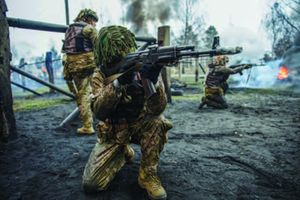
A statement by Vocal Africa revealed that more than 1,000 Kenyans are believed to have been recruited into the Russian army, with at least 772 having signed formal contracts. Of these, about 518 have already been deployed or are in the process of being deployed to active combat zones.
Vocal Africa Executive Director Hussein Khalid (Centre) flanked by families of Kenyans caught in the Russia-Ukraine war recruitment web address the media in Nairobi on January 27, 2026.
Photo credit: Lucy Wanjiru | Nation Media Group
According to KHRC, interest among Kenyans seeking such opportunities remains high despite the risks. The rights group accused authorities of painting overseas jobs as a solution to unemployment without adequately warning citizens about the risks.
“They have made it look so rosy for people to go and work outside Kenya. The government itself has become an ambassador of exporting labour. Young people are picking up on that mantra and believing the best jobs are found outside the country,” said Mr Cornel.
A report by the International Federation for Human Rights (FIDH), Truth Hounds and the Kazakhstan International Bureau for Human Rights and Rule of Law says Russia has recruited at least 27,000 foreign nationals from more than 130 countries since the start of its full-scale invasion of Ukraine in 2022.
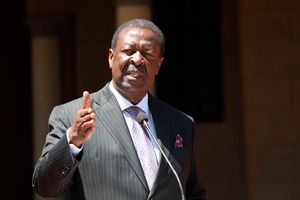
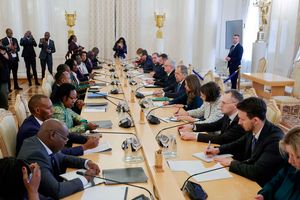
In March, Kenya's Prime Cabinet Secretary Musalia Mudavadi visited Moscow to discuss the recruitment of Kenyans. Officials in Moscow, he said, had agreed to stop deploying Kenyans to the battlefield. But Russian Foreign Minister Sergey Lavrov also said that those with active contracts will have to serve them in full.
Prime Cabinet Secretary and Cabinet Secretary for Foreign and Diaspora Affairs, Musalia Mudavadi, when he appeared before the Senate Committee on National Security, Defence and Foreign Relations at County Hall in Nairobi on April 2, 2026.
Photo credit: Dennis Onsongo | Nation Media Group
Weeks later, however, more Kenyans died on the battlefield, suggesting they had been deployed in spite of Russian promises to stop.
Speaking in Parliament Prime Cabinet Secretary and Foreign Affairs CS Musalia Mudavadi admitted that the Kenyan government has limited capacity to fully account for or assist Kenyans recruited into the Russian military amid the Russia-Ukraine war.
“The government is unable to confirm the number of Kenyans recruited into Russian military operations,” Mudavadi said.
The government of Kenya estimates that about 252 to 291 Kenyans have been recruited into Russia’s Special Military Operations. Of these, 19 are reported dead, 42 injured or hospitalized, 44 have returned home, while others remain active in the conflict zones.