Sometime in the 1980s, activist Mbaraka Karanja was arrested by officers from the Special Branch. Rumours swirled that he had been transferred to Karura Forest, which had been turned into an extension of the Nyayo House torture chambers, where government critics — both real and imagined — faced the full brutality of the Daniel Moi regime.
Testimonies later suggested he was tortured in the forest’s thickets and died there. Police, however, claimed he was shot while attempting to escape and buried — without his family’s knowledge — in an Eldoret cemetery. But when a court ordered an exhumation, his body was never found.
Karanja became not just a missing person, but another statistic of what Karura became at night: a place of brutal shadows. His fate —like that of so many others — transformed Karura from a simple woodland into an extension of Nyayo House’s torture chambers, and a graveyard of secrets where screams dissolved into silence.
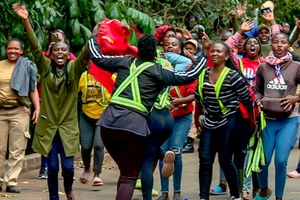
Stranded workers at the Karura Forest, Limuru Road entrance, on August 29, 2025.
Photo credit: Wilfred Nyangaresi | Nation Media Group
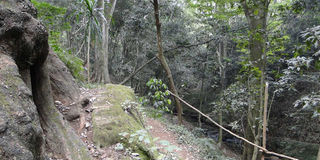
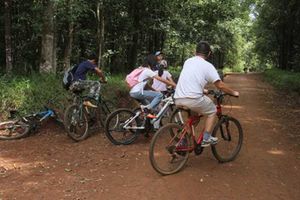
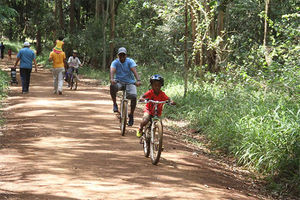
However, Karura is a forest of many faces. By day, the forest glows. Sunlight filters through a canopy of eucalyptus and indigenous trees, casting dappled light along winding trails where joggers and cyclists innocently weave past waterfalls. In the valley below, school children crawl into caves once used as hideouts by Mau Mau freedom fighters, while couples linger beneath the vast embrace of ancient fig trees.
But beneath this beauty, unease has crept back. Word has spread that the government intends to terminate the era of Friends of Karura, the lobby group led by Prof Karanja Njoroge, and that has tended the forest’s fame — clearing its paths, protecting its streams, and nurturing its fragile ecosystems. For those who know Karura’s many faces, the threat stirs not only anger but dread.
Before Friends of Karura returned the forest to civility, parliamentary records and court cases testify to what happened here. Many Mwakenya suspects, accused of plotting to remove President Moi, described being lowered into pits swarming with ants, threatened with snakes, whipped and stripped until they signed confessions. In 1987, Amnesty International reported how police officers tortured a woman within the forest by forcing hot pepper into her private parts.
For historians, Karura is more than a forest; it is a landscape of heritage and memory. Long before Proclamation Number 44 of 1932 gazetted it as a forest reserve, Karura stood as a buffer between Kikuyu and Maasai lands — a frontier that kept rivals apart and allowed a fragile coexistence to endure. In this early sense, Karura’s endurance was not secured by treaties or negotiations, but by its role as a space of mediation — a living boundary that softened the edges of conflict.
Before the colonial government set aside Karura’s 1,062.7 hectares to ostensibly safeguard Nairobi’s watershed and to contain urban sprawl, the place had been turned into a workshop of the empire with logs cut to feed the railway and feed Nairobi with charcoal – the then wood fuel priorities of the colonial state. It is on record that in 1923, the Kenya Railway sourced timber here to feed the iron furnaces of its locomotives. Chief Forester A.H. Gardner further invited tenders for felling eucalyptus—the alien blue gums imported from Australia, planted in military rows, and converted into charcoal for Nairobi’s kitchens and engines.
If the colonial forest was utilitarian, the post-colonial forest turned cruel. When Jomo Kenyatta sought to purchase land adjacent to Karura from Joreth Limited, some land insiders attempted to hive off part of the forest. He refused — perhaps the only recorded instance in which Kenyatta declined to participate in land grabbing. Yet it was not land politics but the forest’s use as a Special Branch site of terror that cast the darkest shadow. From the 1970s, Karura became associated with fear, a reputation deepened in the 1980s when it was marked not only by city carjackers but also by Special Branch units. What had once been an innocent forest canopy had turned into a sinister cover of clandestine operations, an extension of Nyayo House — the notorious torture chambers of President Daniel arap Moi’s regime.
In April 1989, activist William Wahome narrated to court how he was taken to the 24th floor of Nyayo House. After enduring eight days of merciless beatings: slaps, whips, broken chair pieces, kicks, and blows until he bled without respite, Wahome was blindfolded and driven to Karura, where the torture resumed until he confessed to ties with Koigi wa Wamwere’s resistance movement.
Karura was also a terrifying picnic site where beauty and brutality uneasily coexisted. On July 7, 1992, police retrieved the strangled body of a woman after an anonymous caller alerted Muthaiga Police station. Just a week earlier, another woman’s body had been discovered in the same thicket, both victims bearing signs of sexual assault. The two murders, so close in time and place, deepened Karura’s dark reputation. What had once been imagined as a space of leisure and retreat came to embody menace. For many, especially women, the forest ceased to be a sanctuary and instead became a warning — a place where the line between refuge and danger collapsed, and where entering unaccompanied meant courting risk.
Ruth Wangu Muhia, recounted to a court how she was arrested in Murang’a in 1997 and taken to Karura Forest by the police. Inside the forest, she was undressed, beaten until her teeth were knocked out, threatened with rape, and forced to thumbprint false statements. “Karura” became a buzzword of fear—spoken softly, a reminder of what lay behind the trees at night.
In February 1999, journalist David Makali, then with Expression Today, was lured out of his Cargen House office and abducted. He was taken to the depths of Karura Forest, where he was tortured and threatened for “writing negative stories” against a prominent Nairobi political leader. His ordeal revealed not only the personal risks faced by journalists in Kenya at the time, but also the disturbing reality that Karura had become a staging ground for political intimidation.
During the late 1990s, Karura Forest was more than an environmental battleground; it was also a space where goons, acting at the behest of powerful clients, enforced silence through violence. The Makali case illustrated how state and non-state actors alike exploited the forest’s isolation to hide abuses from public scrutiny.
A picnic site inside Karura Forest.
Photo credit: File | Nation Media Group
Even courts acknowledged the brutality. In one murder trial, an accused described being tied with ropes that cut his neck, pricked with sharp instruments, and whipped until he bled.
While Karura absorbed blood, it was also carved up by greed. From independence in 1963, its land became a political currency, parceled out to loyalists and speculators.
The legal notices trace the shrinking. In 1951, Proclamation 15 excised 1.6 hectares; three years later, this was restored. In 1956, another 18.6 hectares were removed. In 1964, Legal Notice 174 reaffirmed Karura as a central forest at 1,044.1 hectares.
But the reductions continued. In 1986, 2.78 hectares were excised. In 1993, 5.86 hectares were cut away in exchange for a dubious addition of 5.63. Then came the most brazen act: Legal Notice 97 of June 13, 1996, which excised 85 hectares. Karura shrank to 956.2 hectares.
Behind the sterile vocabulary of “excision” was naked plunder. Forest land, once public good, was quietly transferred into private hands. Bulldozers rolled in to clear ground for luxury estates. By 1998, residents of Nairobi awoke to the sight of smoke and stumps where trees had stood. Karura was under assault not just by memory but by money.
On January 8, 1999, Karura Forest revealed another face—defiance. Professor Wangari Maathai, already celebrated internationally for her pioneering Green Belt Movement, led a group of citizens, students, and fellow activists into the forest to resist its destruction. For years, she had campaigned tirelessly against land grabbing and unchecked development, defending public green spaces from encroachment by powerful political and business interests.
Karura was not her first confrontation with such forces. Earlier in the 1990s, Maathai had successfully mobilised against plans by British media magnate Robert Maxwell—in collaboration with Kanu elites—to construct a towering complex in Nairobi’s Uhuru Park. That victory made her a household name and a formidable opponent to those who sought to profit from public land.
At Karura, the stakes were even higher. The government had earmarked hundreds of acres of the indigenous forest for allocation to private developers. To Maathai and her supporters, this was not only an ecological crime but also a betrayal of Nairobi’s citizens, who depended on the forest as a vital water catchment, carbon sink, and cultural landmark.
Yet the crackdown only strengthened her resolve. Alongside allies such as George Nyanja, Njehu Gatabaki, and James Orengo, she transformed the Karura struggle into a national symbol of the fight against corruption, impunity, and environmental destruction. What began as an attempt to halt logging and construction became a broader struggle for democracy and accountability in Kenya.
In Parliament, Orengo quipped that perhaps the police should also join the protests—since they had long used Karura as their torture chamber. The remark captured the forest’s dual role: a site of cruelty and a site of struggle.
The battle for Karura would not end in a day, but Maathai’s courage that January morning marked a turning point. It reaffirmed her place as one of Africa’s most fearless defenders of both the environment and human rights—a role that, just a few years later, earned her the 2004 Nobel Peace Prize.
The struggle did not end with beatings. Through the late 1990s and early 2000s, activists persisted. The Friends of Karura, formed to steward the forest, partnered with the Green Belt Movement to restore it. Trails were cut, seedlings planted, waterfalls mapped, caves preserved.
Today, by daylight, Karura is almost unrecognisable from its haunted past. Joggers, cyclists, birdwatchers, and picnickers move through paths once dreaded. Mau Mau caves that once sheltered fighters now echo with children’s laughter. The blue gums of empire still stand, but alongside them rise indigenous trees planted in defiance of bulldozers. But as Friends of Karura face new threats, Nairobians fear that Karura, without vigilance, may once again slide into shadows—whether by bulldozers, by speculators, or by silence. Will the city allow Karura to be stripped again of its dignity and its guardians? Or will citizens rise, as they did before, to declare once more that Karura belongs not to governments, nor to speculators, but to the people—and to history?
By day, Karura still glows. By night, it still whispers. And in both, it remembers.