Prof Phoebe Okowa is not a mainstream name in Kenya’s judiciary. That is because she spent most of her career in class, teaching international law, here and abroad.
From the lecture halls of Nairobi and Oxford, she will now sit on the bench of the International Court of Justice for longer. On Tuesday, she secured majority votes in both the UN General Assembly and the UN Security Council. It earned her nine years on the Court.
Prof Okowa, 61, has built a career shaping the principles that govern relations between nations.
Her election to the ICJ marks another milestone in a distinguished journey spanning more than three decades of scholarship, legal practice and international judicial service.
Prof Okowa is one of Kenya's most accomplished international legal scholars, a jurist whose work has helped shape the development, interpretation and application of international law across the world.
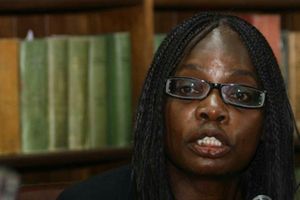
Prof Phoebe Okowa Nyawade during the interview for the Deputy Chief Justice position at the Supreme Court in Nairobi on February 18, 2013.
Photo credit: File | Nation Media Group
Her election to the International Court of Justice (ICJ), where she will serve a nine-year term, places her among the 15 judges entrusted with resolving legal disputes between states and providing advisory opinions on questions of international law. She had already been elected to the bench in 2025, but that was to complete the term of Somali judge Abdulqawi Ahmed Yusuf, who had resigned earlier. She needed a new election victory to be assured of a fresh nine-year term.
It is an appointment that builds on a career defined by academic distinction, landmark appointments and a sustained contribution to the development of international legal principles.
Prof Okowa had already broken ground in a field where African representation, particularly that of women, has historically been limited. In 2021, she became the first African woman, since its establishment in 1947, to be elected to the United Nations International Law Commission (ILC).
The Commission is responsible for advancing the progressive development and codification of international law. It is the organ that makes zero drafts so UN member states can add or remove clauses.
Her work at the Commission drew on decades of research into some of the most complex questions in international law, including state responsibility, accountability for international crimes, environmental protection and the exploitation of natural resources in conflict zones.
A professor of public international law at Queen Mary University of London and an advocate of the High Court of Kenya, Okowa combines academic scholarship with extensive practical experience.
She has advised governments and international organisations on matters of international law and appeared as counsel before the ICJ and the International Tribunal for the Law of the Sea.
Her journey began at the University of Nairobi, where she graduated with first-class honours in law in 1987. Her academic performance earned her a Foreign and Commonwealth Office scholarship to Wadham College, University of Oxford, where she pursued a Bachelor of Civil Law degree.
She subsequently completed a doctorate in law at Oxford under the supervision of the late Professor Ian Brownlie, one of the most influential scholars of international law.
Her academic career began at the University of Bristol in 1993 before she moved to Queen Mary University of London, where she established herself as a leading voice in public international law.
Over the years, she has held visiting academic appointments at the University of Lille, Stockholm University, New York University School of Law and the Graduate Institute of International and Development Studies in Geneva. She was appointed twice as a Global Visiting Professor at NYU Law School, in 2011 and 2015.
In 2024, Stockholm University conferred on her an honorary Doctor of Laws in recognition of her contribution to legal scholarship.
Beyond the classroom, Okowa's influence extends to international legal institutions and professional bodies. Between 2017 and 2022, she served as a member of the Permanent Court of Arbitration in The Hague.
She is also a member of the Public International Law Advisory Panel of the British Institute of International and Comparative Law and the Committee of Legal Experts of the Commission of Small Island States on Climate Change and International Law.
She is joint editor of the Oxford Monographs in Public International Law, alongside Roger O'Keefe, and has served in leadership and advisory roles within international legal associations and academic journals.
Her scholarship has addressed the relationship between state responsibility and individual accountability for international crimes, Africa's engagement with the International Criminal Court, the protection of natural resources in conflict zones and the application of international law by domestic courts.
For Okowa, the ICJ appointment represents a transition from helping shape international law through scholarship and advisory work to participating directly in its interpretation and application at the United Nations' principal judicial organ.
Kenya had presented candidates for two prominent international judicial positions: Okowa for the ICJ and Supreme Court Judge Njoki Ndung'u for the International Criminal Court (ICC).
The two courts have distinct mandates. The ICJ hears disputes between states and issues advisory opinions, while the ICC prosecutes individuals accused of genocide, war crimes, crimes against humanity and the crime of aggression.
Foreign Affairs Principal Secretary Korir Sing'Oei described Okowa as a trailblazer whose scholarship and practical expertise in international law have helped shape global jurisprudence.
Her election will bring her experience to the judicial bench, representing a new chapter in Kenya's contribution to international justice.