The Independent Electoral and Boundaries Commission (IEBC) has acknowledged a looming constitutional challenge as it prepares for 22 by-elections across the country—some of which have already surpassed the 90-day deadline stipulated by law.
One of the most pressing issues on the commission’s agenda is how to proceed with by-elections in electoral areas where the constitutionally mandated 90-day window has already lapsed.
Under Article 101(4)(b) of the Constitution, by-elections must be held within 90 days of a parliamentary seat falling vacant—unless the vacancy occurs within six months of a General Election.
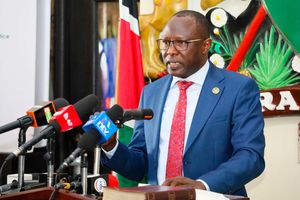
“We have already received writs from the Senate for the senatorial vacancy and are processing the rest. However, we are also seeking legal direction on how to proceed in cases where the 90-day constitutional deadline has lapsed,” IEBC Chief Executive Officer Marjan Hussein Marjan said.
Chief Executive Officer of the Independent Electoral and Boundaries Commission Marjan Hussein Marjan.
Photo credit: File | Nation Media Group
He spoke in Mombasa, where the new commissioners have retreated to for an induction.
Led by Chairperson Erastus Ethekon, the closed-door sessions are part of a week-long orientation involving governance and legal experts, as well as former IEBC commissioners, to guide the team through the commission’s institutional, operational and legal frameworks.
Mr Marjan said the sessions are designed to equip the new team with the knowledge and tools necessary to navigate the complex mandate ahead, particularly amid delayed electoral timelines.
While the IEBC is working toward holding all 22 by-elections on the same day, the legal uncertainty surrounding expired deadlines could complicate this plan.
The commission is expected to announce formal dates once internal deliberations and clarifications are complete.
Mr Marjan acknowledged that the upcoming by-elections will serve as a critical benchmark for the newly formed commission as it lays the groundwork for the 2027 General Election.
“This is a pivotal moment for the commission. It will be the first electoral assignment for the new team, and it will define public confidence in our preparedness going forward,” he said.
On Thursday, the commissioners held consultative sessions with former IEBC officials to draw from their experience and institutional memory.
At the same time, pressure is mounting on the commission to open at least 100 additional diaspora registration and polling centres before the 2027 General Election.
Diaspora voting initiative
The development comes as senators push for the inclusion of more Kenyans living abroad in the country’s electoral process. The lawmakers argue that more than three million Kenyans reside in the diaspora—about six percent of the national population—yet only a small fraction are able to participate in elections. In 2022, only 5,000 of over 10,000 registered diaspora voters cast their ballots.
Currently, there are only 27 polling centres in 12 countries, all located in major cities where Kenyan embassies, high commissions and consulates are based. This setup significantly limits access for many diaspora voters.
Raising the issue in the Senate, Busia Senator Okiya Omtatah said the limited number of polling centres undermines the rights of Kenyans abroad, citing the Constitution, which guarantees every eligible citizen the right to be registered as a voter and to vote.
“The 27 polling centers are limiting the chances of potential voters from exercising their constitutional right to vote,” Mr Omtatah said, noting additional challenges such as high travel costs, visa restrictions, time away from work, and general logistical hurdles.
He urged the IEBC not only to open more centres but also to operationalise and monitor them ahead of the next election to ensure transparency, efficiency, and effectiveness.
“There is a need to increase registration and polling centers in the diaspora to grant an opportunity for Kenyans abroad to vote,” he said.
In 2017, diaspora voter registration occurred in only five countries—Burundi, Tanzania, Rwanda, Uganda, and South Africa—and was limited to capital cities for just two weeks. In 2022, the number increased to 12 countries, with the UK, USA, South Sudan, Germany, Qatar, UAE, and Canada added to the list. This expansion increased the number of registered diaspora voters from 4,223 in 2017 to 10,433.
Mr Omtatah urged the new IEBC leadership under Chairperson Erastus Ethekon to move swiftly, in collaboration with the Ministry of Foreign and Diaspora Affairs, to establish at least 100 registration and polling stations globally, prioritising high-density diaspora zones across North America, Europe, the Middle East, Africa, Asia and Oceania.
Busia Senator Okiya Omtatah speaks to journalists during a press conference at Taj Towers in Nairobi on July 12, 2025.
Photo credit: Bonface Bogita | Nation Media Group
“The Kenyan diaspora continues to support the country economically through remittances and investment. They deserve to participate in the electoral process,” he said.
Vihiga Senator Godfrey Osotsi called on IEBC to decentralise voter registration and polling services from embassies to more accessible community venues. He also advocated for the rollout of civic education and voter sensitisation campaigns in diaspora communities via digital and local platforms.
He urged the National Treasury, led by Cabinet Secretary John Mbadi, to allocate sufficient resources to establish additional polling stations and support the diaspora voting initiative.
“The IEBC should explore secure, verifiable technologies to promote continuous diaspora voter registration and education,” said Mr. Osotsi, who is also ODM’s deputy party leader.
However, the initiative may face funding hurdles. IEBC is currently grappling with a budget deficit of more than Sh4 billion for the 2027 elections.
The Commission had requested Sh61.7 billion, but the Treasury allocated Sh57.38 billion. This follows the Cabinet’s decision to realign and rationalise national spending by capping the fiscal deficit at 4.5 percent of GDP.
Additionally, the Commission is burdened with Sh3.7 billion in pending bills, which threaten to derail its operations.
Last year, a Kenyan in the diaspora, Danson Mukile, drafted the Diaspora Voting Bill, 2024, seeking to enhance voting rights for Kenyans living abroad.
The Bill proposes amending Article 89 of the Constitution to recognise the diaspora as Kenya’s 291st constituency, with a designated returning officer to count and tabulate votes.
Mr Mukile argued that the diaspora population plays a critical role in Kenya’s economy, remitting Sh650 billion in 2023 alone.
The Bill proposes a 90-day diaspora voter registration period, mobile registration and voting centres, and mandatory continuous registration beginning no later than six months after the last general election.
He said diaspora voters have been consistently sidelined in past election cycles and deserve a meaningful role in Kenya’s democratic process.