Ever since CS John Mbadi assumed the C-office at the National Treasury, the issue of fiscal consolidation has evidently moved up the to-do list. Although much has been achieved in that regard, there remain hurdles that are undermining the strategy, not least of them being the huge piles of legacy debts.
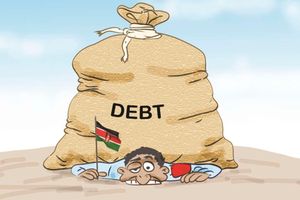
As at the beginning of August 2026, Kenya was in a state of severe debt distress vulnerability, characterised by constrained fiscal space and high liquidity strain. Kenya's total public and publicly guaranteed debt stands at approximately Sh12.896 trillion (National Treasury), out of which the domestic component is Sh7.239 trillion (56.1 per cent), while external debt is Sh5.657 trillion (43.9 per cent).
Total debt accounts for approximately 68.8 per cent of the Gross Domestic Product (GDP) and consumes 69 per cent to 70 per cent of ordinary revenue (customs duty, income tax, VAT and Excise duty), effectively breaching the 55 per cent debt anchor under the Public Finance Management Act (Cap 412A). The current debilitating debt situation is largely attributed to the policy missteps of the 2013-2022 decade. As at March 2013, the total public debt stood at about Sh1.8 trillion. By August 2022, the figure had burgeoned to about Sh8.7 trillion, confirming the high debt appetite in that period.
The key drivers of the debt accumulation were aggressive investments in mega infrastructure projects such as the SGR, highway networks and port improvements. The SGR projects have been flagged by the Auditor-General as some of the investments where Kenya did not receive value for money. A comparison of SGR with similar projects in Tanzania, Ethiopia and Morocco reveals a disturbing wastefulness. The project involved building approximately 600 kilometres of diesel-powered railway line from Mombasa to Naivasha at a total cost of about $ 5.1 billion, translating to an average cost of $8.5 million per kilometre.
The Tanzanian 2000km fully-electrified SGR cost $10.0 billion, translating to about $5.0 million per kilometre. In Ethiopia, the project covered 750km of fully electrified SGR at a total cost of $3.4 billion, and an average cost of $4.5 million per kilometre. The most spectacular one was the Morocco SGR; a 350km fully electrified railway line, complete with a high-speed modern bullet train, built at a cost of $2.41 billion. This translates to about $6.8 million per kilometre, way below what it cost Kenya to build a diesel-powered 20th-century-type SGR.
The Kenyan SGR stands as one of the most expensive infrastructural investments per kilometre in Africa due to structural vulnerabilities and inflating factors. Some of the factors that caused the ballooning of the SGR costs included single sourcing to China Road and Bridge Corporation, geographical challenges, and land compensation over-inflation (speculation cartels, ghost landowners and re-routing). To make it worse, in 2014, Kenya acquired a new status as a Lower Middle Income Economy, blocking the country's access to concessional loans, and forcing it to resort to high-interest commercial alternatives such as Eurobonds and syndicated bank loans.
A total of $7.1 billion worth of six Eurobond tranches (net of interest) were borrowed between 2014 and 2021 at interest rates ranging from 6.3 per cent to 8.5 per cent (averaging 7.15 per cent). According to the Auditor-General and Controller of Budget, there were deviations between the Eurobonds proceeds and the actual amounts that were deposited into the government's Consolidated Funds Account.
For instance, out of the debut Eurobond of 2014, a total of $999 million (Sh 128.871 billion at the current exchange rates) was flagged as untraceable in the economy, having been directly diverted offshore ostensibly to pay off a pre-existing syndicated commercial loan. The specific development impacts of this loan could therefore not be verified.
To stem imminent default on offshore debt obligations, especially short-term expensive Eurobonds, Kenya has repeatedly deployed international refinancing strategies. For instance, the state recently sold a fresh $1.5 billion Eurobond to retire portions of the maturing $2 billion bond. This has driven the country's sovereign debt to its historic peak. The insatiable appetite for expensive loans caused persistent budget shortfalls, widening the fiscal gap. At the same time, the Kenya shilling was on a free fall, heavily inflating the value of the US dollar-denominated offshore liabilities.
Moreover, the economic shocks occasioned by Covid-19 pandemic slowdown compounded fiscal impacts on the Kenyan economy. The combined effects of these legacy factors have led to the current state of revenue cannibalisation where debt servicing costs have reached an unprecedented Sh1.90 trillion annually. In essence, debt repayments devour roughly 50 per cent to 55 per cent of all ordinary revenues, crowding out vital public services such as health, education, water, and electricity.
As the heavy debt burden sucks most of the domestic financial resources, the National Treasury is forced to borrow an average of Sh104 billion every month to bridge its persistent budget shortfalls, translating to Sh3.47 billion per day. With the exalted economic status (Lower Middle Income Economy), the country's access to cheap, long-term multilateral concessional funding has shrunk.
Consequently, the country now increasingly relies on high-interest domestic treasury markets and expensive Eurobond buybacks to not only avail the requisite liquidity for budget support, but also protect its international image.
As the country prepares for a high-stakes election in a year's time, it is very unlikely that the pressure for more external loans will dissipate. Due to these fiscal pressures, it might take a year or more before Kenya comes back fully on track.
That notwithstanding, our collective consolation should emanate from the fact that, despite the pessimistic predictions that Kenya, along with Zambia, Mozambique, Ghana, Ethiopia, Chad and Mali would default on their international debt obligations, it didn't come to pass. If we did it then, we can do it again now.
Professor Ongore is a Public Finance and Corporate Governance Scholar based at the Technical University of Kenya. [email protected]