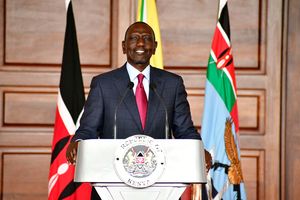
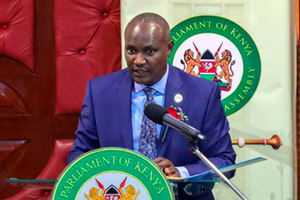
When President William Ruto recently praised Treasury Cabinet Secretary John Mbadi for “providing leadership that has not been witnessed before”, the head of state must have been expressing his sweet surprise at the turn of economic fortunes.
CS Mbadi took the reins of the National Treasury at a time when Kenya and five other African countries — Ghana, Zambia, Ethiopia, Mali and Chad — were on the verge of defaulting on their international debt obligations.
All but Kenya defaulted, suggesting the innovative fiscal expertise of the new ‘sheriff in the National Treasury’ and his team of technocrats.
Between 2014 and 2022, the country pursued an aggressive expansion of its physical infrastructure, financed by expensive short-term Eurobonds and other commercial offshore loans. Repayments on these loans account for approximately 68 per cent of ordinary revenue.
This leaves the country with only around 30 per cent of tax revenues with which to meet the costs of governance and development. Kenya is therefore walking a tight fiscal rope without the adequate domestic resources needed to manage its affairs.
For more than a decade, the country has been operating under a fiscal model whereby the majority of tax revenues leave the economy in order to repay external debts, creating a fiscal gap that is usually bridged by taking out additional loans.
Fiscal consolidation strategy
To mitigate this situation, the Treasury has developed a fiscal consolidation strategy, the main objective of which is to reduce the country’s dependence on offshore financing for budget support.
This involves obtaining cheaper long-term loans to pay off expensive short-term loans, such as Eurobonds, while simultaneously converting US dollar-denominated loans into less volatile currencies, such as the Chinese Yuan and the Japanese Yen. On the supply side, the government is sealing revenue loopholes. While this is a highly plausible strategy, it is constantly facing headwinds due to the country’s narrow tax base.
Kenya’s current tax capacity is conservatively estimated at around Sh5 billion. However, the country’s performance is consistently below par, resulting in fiscal gaps and forcing the government to borrow money to support the budget.
The fiscal gap for the 2026/27 financial year is estimated at Sh1.15 trillion. This situation reflects low tax morale and calls for urgent, practical intervention to improve tax compliance.
The taxpayer compliance continuum comprises four components: registration; timely filing; accurate declaration; and payment of an equitable tax liability. Kenya’s average voluntary taxpayer compliance rate in the formal sector is around 70 per cent.
However, this figure drops significantly to between 30 and 40 per cent among micro, small, and medium-sized enterprises (MSMEs) and in the informal economy, which is estimated to account for around 45 per cent of the gross domestic product (GDP). Informality poses significant challenges to tax administration due to the difficulty of tracing taxable transactions. Kenya has approximately 22.6 million eligible taxpayers on the KRA’s tax register. This figure is based on registered Personal Identification Number (PIN) holders on the iTax platform.
Of these, 9 to 10 million are classified as active taxpayers, representing between 39.8 and 44.2 per cent. A significant portion of the remaining 12 million to 13 million registered PIN holders comprise individuals or small entities in the informal sector who either file “nil” returns or remain completely inactive.
Of the active group, only between 3.2 and 3.65 million Kenyans are formally employed and regularly pay their PAYE taxes. This represents between 26 and 28 per cent of active taxpayers and between 14.2 and 16.2 per cent of all eligible taxpayers.
In short, up to 55.8 per cent of all eligible taxpayers in the country either routinely submit ‘nil’ returns or simply do not bother. Of those who are tax compliant, around a third are employees whose payroll taxes are now automatically pre-populated by the Kenya Revenue Authority (KRA). This confirms the assertion that Kenya’s tax compliance level is too low to ensure economic sovereignty.
While there is no universally accepted tax-to-GDP ratio, global benchmarks range from a minimum target of 15 per cent for developing countries (World Bank) to an average of 34.1 per cent for advanced economies. The continental African average is approximately 16.1 percent, while the figure for Latin America is about 21.5 percent.
According to the OECD, the more advanced the economy, the higher the tax-to-GDP ratio. Highly developed welfare states such as Denmark exceed 45 per cent. Kenya exited the Least Developed Countries (LDC) category in 2014, when it was categorised as a lower middle income economy. Accordingly, Kenya’s tax-to-GDP ratio should be around 20 or 21 per cent to reflect the country’s improved economic status.
The tax-to-GDP ratio measures the size of a country’s tax revenue relative to its overall economy. It is a vital macroeconomic metric for several reasons. Above all, it indicates the level of economic sovereignty.
A higher ratio indicates strong tax compliance and the sovereign ability to finance essential public services, such as education and healthcare, without requiring external budget support funding.
It also measures fiscal capacity, which is an equally vital metric that gauges the effectiveness of a country’s fiscal policy.
This ratio is equally important because of the signals it sends to credit rating agencies, whose verdicts are used by multilateral lenders such as the IMF and the World Bank to evaluate a country’s debt sustainability and creditworthiness.
With a tax-to-GDP ratio of around 14.3 per cent, Kenya is considered undertaxed due to a number of structural issues. However, citizens feel that they are already bearing a heavy tax burden. The impact of the substantial informal sector on the capacity of the tax administration to mobilise domestic financial resources is a key issue.
With more than 80 per cent of businesses comprising informal or semi-informal MSMEs that trade mainly in cash, the Kenya Revenue Authority’s (KRA) ability to trace their taxable transactions is greatly undermined.
This is exacerbated by the fact that the KRA has not invested sufficiently in understanding the business models of those operating in the ‘informal’ sector.
Consequently, market distortions have emerged where businesses of comparable sizes are subjected to different taxation regimes.
Additionally, widespread tax incentives, exemptions and corporate tax breaks fail to achieve their intended objectives and heavily erode the tax base. Kenya’s current fiscal model is simply unsustainable. There is therefore an urgent need to enhance tax compliance.
Improving tax compliance will ensure the government has a reliable source of revenue to repay offshore debts without taking out more loans, and will give fiscal consolidation efforts traction.
Meanwhile, compliant citizens and businesses will be protected from bearing an uneven tax burden on behalf of non-compliant individuals and entities.
The push to improve voluntary tax compliance involves several interconnected goals. Firstly, there is a need for sufficient revenue. Minimising tax evasion and avoidance ensures the government collects the revenue necessary to support national budgets and development plans.
Secondly, it promotes tax justice and equity by ensuring the tax burden is distributed fairly across the population.
Transparent and efficient tax systems encourage informal businesses to register, thereby expanding the tax base and boosting overall economic investment. For individuals and enterprises, complying with tax regulations helps them to avoid costly fines, penalties, interest charges and potential reputational damage associated with tax evasion.
KRA should constantly monitor the quality of its tax administration systems, including eliminating information asymmetry through targeted taxpayer education, and focus on the fairness of tax administration, as this is a dominant factor in taxpayer compliance.
Contrary to local belief, Kenya remains one of the most undertaxed societies in the world. However, the future of Kenya’s fiscal consolidation lies in an intelligent, data-driven approach to tax administration that expands the tax base while protecting citizens and enterprises from high tax burdens.
This is achievable, and the Finance Bill 2026 is already paving the way.
Prof Ongore is a Public Finance and Corporate Governance Scholar based at the Technical University of Kenya. [email protected]