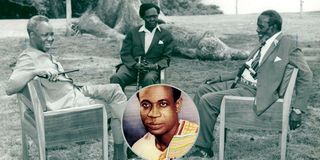
In August 1963, Geoffrey Ellerton, the head of the civil service and permanent secretary in Prime Minister Jomo Kenyatta’s office, was at his Harambee House desk when he received a phone call summoning him for a meeting with his boss.
Kwame Nkrumah, the president of Ghana, had rejected Kenya’s invitation to be the principal African guest at the independence celebration, and Kenyatta and members of his Cabinet were desperately trying to draft an invitation to Emperor Haile Selassie of Ethiopia as a replacement.
As he walked into the tense meeting, Ellerton, in an audio file that is part of the oral history records archived by the Imperial War Museum, recalled Kenyatta, who transitioned from Prime Minister to the country’s first President, telling him: “Mr Ellerton, we want to send a letter to the Emperor of Ethiopia and we are not sure how to address it.” Ellerton replied that he wasn’t sure how to address it either, but he would try.
It later emerged that the reason Nkrumah snubbed the invitation was because Kenya was strongly pursuing the idea of an East African Federation, which was also being supported by the British. At that time, it was the secret wish of Her Majesty’s government that Kenya, Tanganyika (Tanzania) and Uganda should form a federation that would spur the region to economic prosperity
“A sound East African Federation is of course a dream answer to many of our Kenyan problems. I therefore believe we should show ourselves co-operative in aiding establishment of that at earliest practicable date,” the Governor General of Kenya Sir Malcolm MacDonald had advised the British Secretary of State in a telegram marked secret.
In agreeing with MacDonald’s view, the Secretary of State replied: “We have always been in favour of an East African Federation. The only reason why we have not advocated it publicly is that we thought it unwise to give the impression that we are pushing Africans into a federation.”
Nkrumah was, however, opposed to the idea—first because it was being supported by outsiders and second because he felt regional federations were an impediment to the attainment of one United States of Africa.
But there was also no doubt that the Ghanaian leader had ambitions of becoming the president of a United States of Africa, which he feared would be delayed or undermined by an East African Federation.
By early 1962, the idea of an East African Federation was seriously being discussed by Kenyatta, Julius Nyerere of Tanganyika and Milton Obote of Uganda, much to the chagrin of Nkrumah, who made plans to undermine the idea from within East Africa. The only hurdle to sending his agents for this mission was because both Kenya and Uganda were still under colonial rule and Nyerere was his pan-Africanist rival.
Uganda’s independence in October 1962 finally gave Nkrumah the opportunity to position his agents in East Africa to undermine the idea of a federation. The person he entrusted with sabotaging the idea was David Bosumtwi-Sam, whom he appointed Ghana’s High Commissioner to the newly independent Uganda.
According to Dr Grilli Matteo, a senior researcher at the University of Free State specialising in the political history of Ghana, Bosumtwi-Sam was sent to Uganda “specifically to fulfil a mission requested by Nkrumah and Barden: working against the project of an East African Federation”. And according to Ellerton, who by then was also serving as secretary to the Kenyan Cabinet, Nkrumah sent Bosumtwi-Sam with a huge sum of money to sabotage the idea.
“Kwame Nkrumah’s High Commissioner in Uganda, which by that time had achieved independence, was bizarrely spending a lot of money in all three countries, Kenya, Uganda and Tanganyika, trying to whip up opposition to the idea of an East African Federation,” recalled Ellerton.
Bosumtwi-Sam had served as Administrative Secretary of the Bureau of African Affairs, a secretariat set-up by Nkrumah to propagate his pan-Africanist ideologies in Africa. In essence, he was the right man for the mission.
Meanwhile, Nkrumah continued to use pan-African platforms to rally African countries to support his idea of a union of African states and to reject regionalism.
During the inauguration of the Organisation of African Unity (OAU) in May 1963, he proposed a Union of African States that was to be run by an Upper House and a Lower House. He declared that it was only through political unity that Africa could develop and end imperialism and neocolonialism.
This proved to be a big flop, for it was only supported by four countries, Uganda being one of them. Most leaders at the conference rejected the proposal on grounds that it would rob African countries of their hard-earned sovereignty. Driving the final nail on the proposal was the decision by the OAU conference to support regional groupings and its endorsement of an East African Federation.
Following the defeat in Addis Ababa, Nkrumah concentrated on fighting the East African Federation through the Bureau of African Affairs in Accra. He directed the bureau’s director, Mr AK Barden, “to accelerate the work against the East African Federation”. Barden, in turn, contacted Bosumtwi-Sam and told him to double his efforts and stop the idea of an East African Federation in the “shortest time possible”.
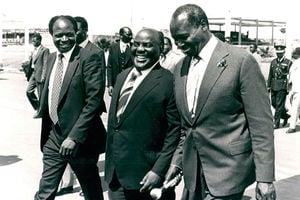
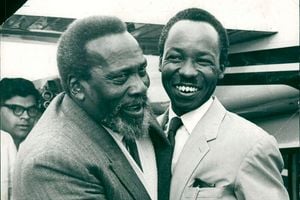
Kenya had just gained internal self-government with Kenyatta as prime minister on June 1, 1963. Four days later, on June 5, Kenyatta, Obote (Uganda) and Nyerere (Tanganyika) held a “little summit” at Harambee House after which they issued a statement expressing their commitment to the establishment of an East African Federation before the end of that year.
To achieve this, the leaders demanded that Kenya be granted independence as soon as possible, since it was the only country that had not yet attained independence thus delaying the realisation of the federation.
That night, MacDonald hosted Nyerere, Kenya’s Minister for Justice and Constitutional Affairs Tom Mboya and Tanganyika’s Foreign Minister Oscar Kambona at Government House, now State House Nairobi.
“President Nyerere stayed with me at Government House; he, Mboya and Kambona dined with me privately. And I also had a talk with Nyerere alone,” MacDonald wrote.
“When I put to Nyerere that it might be difficult to reach the political agreements between the three governments and to make all the practical and constitutional arrangements necessary to establish a federation within a comparatively few months, he agreed with this but said that three governments must succeed in a very early achievement of a federation.”
At the same time, the idea was under a strong covert assault from Bosumtwi-Sam, who had intensified his activities as directed by Nkrumah.
In achieving the objectives of the mission, he was to penetrate Obote’s party and influence its pan-Africanist ideological direction, and to influence Obote himself to withdraw from the project. This, it was hoped, would create a domino effect that would result in the collapse of the entire federation project.
Signs that Bosumtwi-Sam was having some success with Obote were revealed during the night meeting held at Government House in Nairobi where according to declassified records marked “Secret”, Mboya and Nyerere revealed to MacDonald that Obote was very stubborn, but was slowly embracing the idea of a federation. They told the governor that things needed to move very fast before the Ugandan leader changed his mind again.
In June 1963, a decision was made to send Mboya to London to push for a date for independence which was to be followed soon after by an East African Federation.
According to a record of the Cabinet meeting, Kenyatta was of the view that independence, republican status and an East African Federation should be achieved around the same time and asked Mboya to insist on this during his trip to London.
Mboya arrived in London on June 13, 1963, in the company of Mbiyu Koinange and Joseph Murumbi. In a submission to the Secretary of State at the colonial office, he outlined the progress made towards the constitution of the federation. Zanzibar was to be included in case it expressed willingness to join. No other country was to join until the federation was set up.
“Each territory would work through a central body in which the States and the Federal Government were represented although ultimate responsibility for decisions would lie with Federal Government,” Mboya said. He further argued that Kenya’s independence should be before or at most be synchronised with coming into force of a federation.
Even though the Secretary of State committed to convening a conference at Lancaster House that would set Kenya on a path to independence, he refused to give a definite date for independence despite Mboya’s insistence. His argued that “it would be rushing things much too quickly”, but quickly added that “strictly for private information” he had a December date in mind as long as the date of a federation was set before December.
Mboya disagreed with the Secretary of State’s position, saying that he could not accept assurance on purely private basis. He revealed that without a definite date for independence, Kenya was in a much weaker position in its federal talks with the other East African countries.
As the talks came to an inconclusive end, he went back to his hotel room where he placed a call to Kenyatta, informing him of the developments. That same day, Kenyatta visited MacDonald at Government House and insisted on a definite date for independence.
As MacDonald later informed the Secretary of State, “Mr Kenyatta said that it is necessary to set a firm date for independence. This will help to confirm and sustain the progress being made towards federation at about or on the same date”. The Secretary of State eventually set December 12, 1963, as the date for independence.
Preparations for Kenya’s independence and an East African Federation were now in top gear. A working party of lawyers led by Roland Brown, Tanganyika’s attorney-general, were drawing up a framework for a federal constitution that was to be presented to the inter-territorial ministerial working party for approval, before the drafting of the constitution began.
The party was supported by three United Nations experts (financial, fiscal and administrative) who were examining and providing advice on how services were to be distributed between the federation and the three constituent states.
As plans of a federation gathered pace, so did Nkrumah intensify his efforts to sabotage them. In October 1963, more agents from the Bureau of African Affairs in Accra arrived in East Africa to bolster Bosumtwi-Sam’s mission. According to Dr Matteo, these agents arrived in Uganda under firm instructions not to reveal to anyone details of their mission.
By this time, Obote had fully aligned with Nkrumah on the question of the federation, signalling Bosumtwi-Sam’s success in diverting him away from the idea . Meanwhile the Ghanian diplomat had also extended his clandestine mission against the federation to Tanganyika and Kenya.
As preparations for Kenya’s independence, which was to be a precursor to the proposed federation, began, invitations were sent out to leaders from all over world. While Prince Philip the Duke of Edinburgh was to be the chief guest during the celebration, the Kenyan government saw it prudent to invite a prominent Africa figure. Their choice of Nkrumah was not only because of his towering stature as a pan-Africanist, but also because of his earlier association with Kenyatta during their sojourn in Britain.
Nkrumah snubbed the invitation solely on the grounds of Kenya’s pursuit of an East African Federation.
“Nkrumah made it clear that not only was he opposed to the idea of an East African Federation, but that he wouldn’t be coming to independence celebrations,” Ellerton revealed in the archived audio.
With time running out, the Cabinet was desperate to find another prominent guest, as Ellerton put it
An invitation was subsequently sent out to Selassie and a house acquired in Muthaiga to accommodate him. But the invitation was withdrawn a couple of weeks later because of the challenges that would come with hosting a high profile guest such as Selassie and out of fear by the British that his presence would overshadow that of the Duke of Edinburgh, who was to represent the Queen.
Kenya became independent on December 12, 1963, and contrary to what had been anticipated, the prospects of an East African Federation were becoming remote because of Uganda’s stubbornness, influenced by Nkrumah’s hachetman Bosumtwi-Sam.
In a bid to salvage negotiations for a federation, Kenya decided to become independent as a constitutional monarchy with the Queen as the Head of State.
In anticipation of an East African Federation in December 1963, Her Majesty’s government had posted Sir Geoffrey de Freitas the new British High Commissioner to Kenya. De Freitas had served as a British Member of Parliament and high commissioner to various countries, among them Ghana.
He was therefore the best suited person to handle the political and diplomatic challenges that would come with a federation. He had accepted his appointment as High Commissioner to Kenya on one condition—he would eventually become the British High Commissioner to the East African Federation.
In August 1964, he resigned from his post after only nine months to return to Britain to contest for a parliamentary seat. His reasons were that the East African Federation was not a reality and he could not see it materialising for some considerable time.
Meanwhile, after independence, Bosumtwi-Sam was moved from Uganda to Kenya, with the secret aim of continuing to undermine the idea of an East African Federation. However, he didn’t have to do much because with the federation plans already in disarray, his mission had achieved its purpose.
Kwame Nkrumah was overthrown two years later while Obote was deposed by Idi Amin seven years later in 1971.
Even though the elusive dream of an East African political union is still alive, the prospects of actualising it are still remote.