In April 1971, Jomo Kenyatta’s government bought half of the Changamwe oil refinery. Forty-two years later, the plant stopped processing crude.
Between those moments, successive governments defended it, protected its market and promised to modernise it. Eventually, Kenya was left with tanks where an industrial ambition had once stood.
Now, with the proposed Dangote refinery in Lamu reviving the promise of locally processed fuel, Changamwe deserves more than a passing mention. Before we commit public money to another refinery, we should ask what defeated the first. Was it obsolete machinery, multinational interests, government indecision, or the failure to understand how these forces worked together?
Changamwe’s story began with a battle for East Africa’s petroleum market. Established in 1959, East African Oil Refineries offered an attractive proposition: imported crude would arrive through Mombasa, be processed locally and supply a hinterland stretching beyond Kenya’s borders.
The first processing complex was commissioned in 1963, the year of independence.
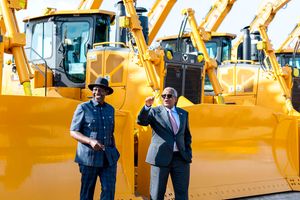
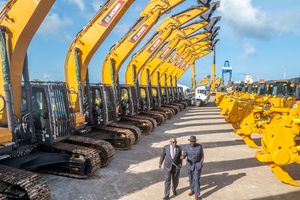
President William Ruto and President and Chief Executive Officer (CEO) of Dangote Group Aliko Dangote walk amid heavy machinery, on the day of a groundbreaking ceremony for the construction of an East African oil refinery in Lamu, Kenya, September 30, 2026.
Photo credit: PCS
But industrial development and commercial rivalry were intertwined from the beginning. The archives show that in 1961, before the refinery opened, BP and Shell refused to agree to process crude supplied by their Italian competitor, ENI. The Italian company was also denied permission to refine or import petroleum products. Its government protested against what it considered discrimination.
Behind the promise of manufacturing fuel locally lay a contest over who could enter the market and these worked cartels. This matters because a refinery can serve two ambitions simultaneously: building a country’s industrial capacity and defending its owners’ commercial position.
Those ambitions may overlap. They do not necessarily produce the same benefits for consumers and that is what we ought to know with the Dangote facility.
In the 1960s, regional competition exposed an early weakness in Changamwe’s business model. When a second refinery opened in Dar es Salaam in June 1966, East Africa had more processing capacity than its market could absorb. Additional supplies depressed heavy fuel oil prices.
Although Mombasa continued operating near full capacity, the competition revealed the limits of a regional market that both plants expected to serve. As President Yoweri Museveni speaks of Uganda having its own refinery, Kenya would do well to remember that neighbouring countries have industrial ambitions of their own.
Changamwe found relief in events beyond east African coast. The Rhodesian emergency increased demand for exports to Zambia, while the closure of the Suez Canal in 1967 boosted demand for ships’ bunker fuel. It was the political upheaval and disrupted shipping that helped us absorb the surplus, temporarily easing the pressure. But these windfalls could not settle the underlying question: was the regional market large enough to sustain competing refineries? And that is a question that we should answer, even today.
An early study raised an uncomfortable question about the refinery’s benefits. It argued that an independent operator could have bought cheaper crude on the open market and passed more savings to consumers. Its calculations suggested substantial excess profits for the owners. Local processing, in other words, did not automatically mean cheaper fuel.
The same study found that Tanzania’s smaller refinery, despite higher production costs, offered a revealing comparison: relative prices for several fuels fell there. Its verdict was that Kenya had allowed the oil companies margins they were prepared to forgo next door. The question was already bigger than whether Kenya possessed a refinery.
To understand Changamwe, we have to recall that Kenyatta’s acquisition belonged to a broader effort to secure public stakes in industries dominated by foreign capital. The state’s 50 per cent holding made it an equal partner and the government secured the right to appoint the refinery chairman.
There was an understandable national ambition here. Independence should bring greater authority over the economy, including the infrastructure supplying its fuel. But shareholding was only the beginning. Whether public ownership delivered public benefits depended on pricing, investment decisions, management and the relationship between the refinery and the companies using it.
Expansion followed in 1974 with a second processing complex. After the East African Community collapsed in 1977, the regional setting changed again. In 1983, the company became Kenya Petroleum Refineries Limited. Its toll-processing model meant oil companies supplied crude, collected the resulting products and paid the refinery for processing.
To understand this model, we have to remember that some customers were also shareholders. They therefore occupied both sides of the transaction: owners of the plant and businesses deciding how much work to send it. As equipment aged and importing finished products became more attractive, that arrangement exposed a difficult question. Who would invest in modernisation when bypassing the refinery offered another route to profit?
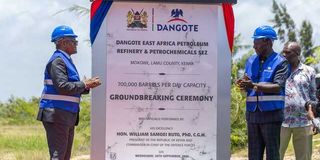
President William Ruto with Aliko Dangote and other Heads of State during the groundbreaking ceremony for the East African Refinery in Lamu.
Photo credit: Kevin Odit | Nation Media Group
By 1993, the warning signs were in Parliament. Anyang’ Nyong’o asked what proposals the oil companies had submitted to modernise the plant. Why import finished fuel, he wanted to know, when Kenya could import crude and process it locally? Energy Minister John Kyalo acknowledged that the refinery required modernisation after three decades.
Petroleum liberalisation the following year sharpened the dilemma. Marketers gained greater freedom to obtain finished products overseas, leaving Changamwe to compete with the possibility of being bypassed. Defending local jobs, Changamwe MP Kennedy Kiliku argued that importing finished fuel created employment abroad. His proposed remedy was replacement of the ageing equipment.
The government continued protecting local processing through a requirement that at least 1.6 million tonnes of crude pass through the refinery annually. That helped preserve business. It also raised a question government could not avoid indefinitely: how much were consumers paying to sustain a plant whose competitiveness depended on protection?
Environmental standards made the cost of postponement clearer. This was the time that debate of leaded petrol kicked up a storm. In July 1995, Energy Minister Darius Mbela acknowledged the dangers of leaded petrol at a time when Changamwe could not produce unleaded petrol with its existing facilities. He put the required upgrade at $300 million, which the government said it could not afford.
The government resisted suggestions that Kenya abandon refining and import finished products. But defending the refinery did not remove its technical limitations. Modernisation was becoming necessary for cleaner fuel as well as commercial survival. Every postponement widened the distance between the plant Kenya had and the plant ministers said Kenya needed.
In 1996, Kiliku warned that unrestricted cooking-gas imports would undermine Changamwe’s market for LPG, which it produced alongside other fuels. He also accused the major oil companies of operating as a cartel and demanded greater access to the refinery for other marketers. His allegations revived a persistent question: the government owned half the plant, but who really controlled its business?
By December 2000, Mbela, now speaking as a former energy minister, described the refinery as inefficient and uneconomical. Without modernisation and expansion, he argued, it could not compete. He further said that consumers were subsidising its operation. What that meant was that the Kenyan taxpayer was paying for the refinery’s shortcomings.
President Mwai Kibaki thought he could revive everything that had collapsed. In 2007, Energy Minister Kiraitu Murungi told Parliament that Treasury had made Sh1 billion available for upgrading. In May 2008, he outlined a Sh21 billion modernisation project saying the Cabinet wanted the work completed by December 2009.
The scandal was that only Sh500 million of the Sh1 billion budgeted for 2007–08 reached the company. Kiraitu cited financial pressures following the post-election violence. More fundamentally, he said the private shareholders wanted the refinery closed and products imported directly. The partners disagreed about whether the enterprise they jointly owned should survive.
That is how India’s Essar was brought on board and was supposed to break that impasse. In 2009, it bought the private shareholders’ half for $7 million. Prime Minister Raila Odinga welcomed the transaction and promised an immediate start on upgrading. But acquiring shares was the inexpensive part. Financing and executing the promised transformation remained the decisive challenge.
By 2012, management was discussing a billion-dollar programme and no one was willing to take a risk. As the delays happened, the refinery also moved from toll processing to merchant refining, buying crude and selling products itself. It assumed greater commercial responsibilities while its equipment problems remained unresolved. A new business model could not, by itself, deliver the machinery needed to make it competitive.
Turkana’s oil discovery supplied a fresh argument for preservation. The argument was why should Kenya export its crude to be refined elsewhere? What Kenyans did not know was that they were hosting a white elephant. At one point, the National Oil Corporation managing director Sumayya Hassan-Athmani told a parliamentary committee that the refinery sometimes supplied fuel oil instead of the requested product.
September 4, 2013, the processing stopped. The following month, Essar announced its intended departure after consultants judged the proposed $1.2 billion upgrade economically unviable. By December, the government was discussing conversion to storage.
After decades of defending local refining, Kenya was preparing to use the installation to hold petroleum instead. In what amounts to another scandal, the state bought Essar’s stake for $5 million in 2016. The storage facilities were subsequently leased to Kenya Pipeline Company.
President William Ruto and President of the Dangote Group Aliko Dangote during the groundbreaking ceremony for the Dangote East African Refinery in Lamu County, Kenya.
Photo credit: PCS
Later, crude trucked from Turkana reached Changamwe to await export. Kenyan oil had finally arrived at the refinery, but would leave without being refined there.
The lesson for Lamu begins with the market. Who will buy the output, under what agreements, and at what price? Regional demand must be tested against existing and planned capacity. Changamwe’s early difficulties show why governments should interrogate those assumptions before treating a large refinery as proof of industrial progress.
The public deserves to see the commercial case before assuming the risks and to know who will answer if promises fail.
Ownership terms deserve equal scrutiny. What rights will Kenya’s investment secure? Who decides on upgrades, supplies crude and sets processing terms? Will consumers be required to support the enterprise through protected markets? These questions determine whether public participation buys influence and value, or merely a share of the financial exposure.
Finally, modernisation needs funded commitments, enforceable milestones and consequences for failure. Changamwe lived for years on assurances that its rescue was approaching.
A refinery must earn its place through dependable production, competitive costs and investment that keeps pace with changing standards. Patriotism cannot substitute for any of those requirements.
Changamwe’s failure does not settle the case against Lamu. It establishes the questions that must be answered before another investment is celebrated. We once bought half a refinery, then spent decades debating how to save it. This time, the lessons should precede the cheque
John Kamau is a PhD candidate in History, University of Toronto. Email: [email protected]