When Raila Odinga walked into his Capitol Hill office in Nairobi, the place came alive.
Politicians, diplomats, businessmen and ordinary Kenyans streamed in and out. Phones rang endlessly. Staff rushed between offices, coordinating meetings, relaying messages and managing the constant flow of visitors seeking an audience with the man they simply called Baba.
Today, that same office is a shell of its former self.
“It is a ghost town,” says Jack Nyamburi, Odinga’s longtime aide and personal assistant. “Sometimes you sit there the whole day, and nobody comes.”
For the men and women who served Kenya’s veteran opposition figure for years—some for decades—the silence is more than physical. It is emotional, political and deeply personal.
To his staff, Odinga was not just a boss. He was a father figure, disciplinarian, benefactor and, at times, an unpredictable leader.
Mr Nyamburi recalls his first encounter with Odinga—one that began with three slaps outside Nairobi’s Serena Hotel but ended up opening the door to a lifelong working relationship.
Jack Nyamburi, Odinga’s longtime aide and personal assistant
Photo credit: Billy Ogada | Nation Media Group
He recalls that Odinga had been meeting Prof Yash Pal Ghai, the then chairman of the Constitution of Kenya Review Commission, at the hotel in 2005, when he accosted him from the facility, just before he got into his waiting car.
That unusual introduction of slaps would define a career that saw him rise from a messenger to Odinga’s personal assistant, working closely with him through the Grand Coalition government and beyond.
“He was firm, but he cared,” Mr Nyamburi says.
That sentiment is echoed by Florence Olang’, a senior administrator who served at Capitol Hill for a decade.
“He never treated us just as employees. He treated us as his people—his sons and daughters,” she says.
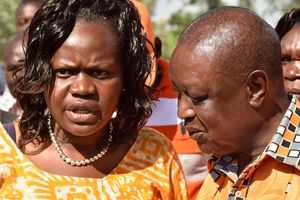
Florence Olang' senior administrator at Raila's Capitol Hill office.
Photo credit: Pool
Staff describe a leader who insisted on discipline but was equally generous—someone who could share money among workers or personally intervene in their personal challenges.
“If you called him and he didn’t pick up, he would call back,” he explains. “Even if he didn’t know the number, he would ask who called and return the call.”
That culture, staff say, has since disappeared.
“Members of Parliament who used to call us every day are no longer picking our calls,” Mr Nyamburi says.
He recounts trying for months to reach leaders he once helped access Odinga—without success. Odinga’s final days, according to his aides, were marked by routine, generosity and little sign of what was to come.
On his last visit to the Capitol Hill office on Tuesday, September 23, 2025, just a day after chairing the ODM Parliamentary Group meeting at Argyle Hotel in Machakos County on Monday, September 22, 2025, he held meetings, engaged staff and, in a familiar gesture, handed out money to be shared among staff.
“He told me, ‘make sure everybody gets something,’” Mr Nyamburi recalls.
That evening, he was admitted to hospital. Even then, he remained engaged—calling his staff from his hospital bed to follow up on official matters.
“We had meetings. We started discussions, but did not finish. He said we would continue when he came back… but he never came back.”
For decades, Odinga operated an extensive support network.
His staff fell into three broad categories: those seconded from government, those paid by the ODM party and those supported personally by him.
This system, while effective during his lifetime, has proved fragile in his absence.
Following his death, some employees were declared redundant, while others were left uncertain about their future.
A tense meeting held months later at Capitol Hill, on Wednesday, March 11, 2026, laid bare the crisis—tears flowed as long-serving staff were informed their roles were no longer needed.
The meeting, described by insiders as emotionally charged, marked a turning point. For some, it was the end of decades-long careers.
Among those affected were individuals who had worked through multiple election cycles, political upheavals and shifting alliances.
“We hope we will be absorbed into the civil service as Raila envisioned,” said Erick Ominde, a driver who had served Odinga for 25 years.
“We are pleading with ODM leadership not to abandon us,” he added.
Amid the uncertainty, one gesture stood out.
Winnie Odinga, Odinga’s daughter, stepped in to support the staff.
At a meeting convened at the Jaramogi Oginga Odinga Foundation (JOOF) after the layoffs, she donated $50,000 (Sh6.5 million) from her earnings at the East African Legislative Assembly (EALA), asking the staff to share the money and use it to rebuild their lives.
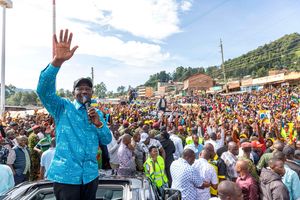
Winnie Odinga addresses a political rally at Kamukunji Grounds in Kibera, Nairobi, on January 18,2026.
Photo credit: Evans Habil | Nation Media Group
“The whole room was emotional,” Mr Nyamburi, who attended the meeting, recalls.
He says: “She (Winnie) looked helpless. We also sympathised with her because there’s nothing else she could do. At least that gesture was remarkable.”
For many, it was the only tangible support they had received.
The challenges facing Odinga’s staff mirror a broader crisis within the Orange Democratic Movement (ODM).
Since his death, the party has been rocked by internal divisions, factional battles and leadership struggles, leading to the formation of two factions – Linda Ground led by Odinga’s brother Dr Oburu Oginga, and Linda Mwananchi, which has Secretary General Edwin Sifuna, Siaya Govenror James Orengo and Embakasi East MP Babu Owino.
“What is happening now is not what he (Odinga) would have wanted,” he says, “In fact, he would die again if he discovered this is what is happening in his party. My plea is for the unity of these factions to uphold Raila’s legacy.”
The transformation of Capitol Hill from a bustling political nerve centre to a quiet office reflects a deeper shift.
Florence describes the change bluntly: “Before, people were flocking in and out. Now there is nothing much going on.”
For many former staff, the transition has been difficult.
Odinga was not just an employer but a support system—someone who provided financial assistance, guidance and opportunities.
“Now it feels like children left without a father,” Florence says.
Some staff are awaiting redeployment through the public service. Others are trying to rebuild their lives independently.
But for many, the loss goes beyond employment.
Perhaps the most painful shift, according to staff, is the silence from leaders who once depended on them, with their calls going unanswered and messages ignored.
“We used to help them access him,” Mr Nyamburi says. “Now they don’t even pick our calls.”
With limited access to party leadership, some former staff are now appealing directly to President Ruto .
Despite the hardships, one theme, that of gratitude, remains consistent in the Odinga-staff testimonies.
“I thank God I had the chance to serve him,” says former chief of staff Andrew Mondoh.
But as the dust settles, a difficult question lingers: What happens to the people who built their lives around one man when he is no longer there?
For now, the future of Odinga’s former staff remains unclear.
But the sense of abandonment continues to haunt many of them. For years, proximity to Odinga was political currency. His aides were the bridge between power and the public—managing access, filtering requests and, in many cases, quietly shaping who got to see him and when.
Members of Parliament, governors and senior officials relied on them to secure a few minutes with the opposition chief.
That access, staff now say, came with relationships built over time—relationships they believed would endure beyond Odinga’s lifetime.
Mr Nyamburi describes how he would receive calls from politicians seeking urgent meetings, sometimes at odd hours. His role was to coordinate, to negotiate timing, and often to persuade Odinga to squeeze in one more visitor.
“You would tell him, ‘so-and-so is here and needs to see you,’ and he would listen,” he says.
Today, those same networks appear to have dissolved.
Part of the challenge, insiders say, lies in the nature of Odinga’s leadership.
Unlike formal institutions with clear hierarchies, much of his political operation revolved around personal relationships and trust.
Decision-making was centralised, and many staff roles evolved organically rather than through rigid structures.
“When everything is tied to one person, it becomes difficult to transition,” says a former insider familiar with the operations at Capitol Hill.
The absence of a clear succession pathway for staff—especially those directly attached to Odinga—has left many exposed.
Mr Erick Ominde who was Odinga's driver for 24 years.
Photo credit: Alex Odhiambo | Nation Media Group
For Erick Ominde, a driver who spent a quarter of a century in Odinga’s service, the transition has been deeply personal.
“I joined Raila when he was still MP for Lang’ata 25 years ago and was being paid through CDF then,” he says. “I then worked with him in the Narc government all through till he passed on last year. Life has never been the same, but we remain hopeful.”
Mr Ominde’s story mirrors that of many long-serving aides whose careers grew alongside Odinga’s political journey—from opposition trenches to government and back again.
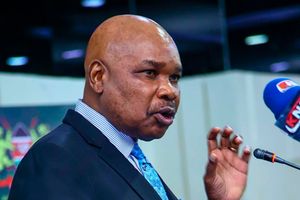
Andrew Mondoh, Odinga’s longtime chief of staff.
Photo credit: File | Nation Media Group
Andrew Mondoh, Odinga’s longtime chief of staff, represents a different trajectory—one shaped by decades in public service. “I served Raila for more than 40 years,” he says. “I met him when I was DC in Kisumu, then we worked together when he served in the Ministry of Roads. We became very good friends.”
Mr Mondoh, on his part, says that with Odinga’s death and having retired from the civil service, he now relies on his pension.
For most, though, the loss of Odinga is not just political—it is economic.