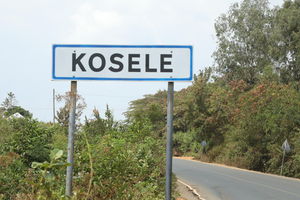
Before Kinoo became synonymous with Waiyaki Way and its rising skyline, before rental high-rises sprouted across the landscape and made it a fast-growing peri-urban settlement, it was a different place.
It was a green, expansive stretch of gently rolling terrain and rich red soil, a place to farm, settle and raise families. But it was also stubbornly dusty, passive and somehow neglected.
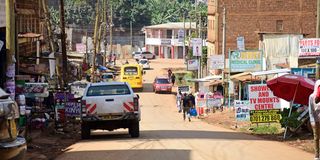
Chief Road in Kinoo.
Photo credit: Billy Ogada | Nation Media Group
Nairobi's central business district, some 20 kilometres to the northwest, was growing but had not yet shown an appetite for this neighbourhood on its fringes in Kiambu County.
For those who lived in Kinoo then, there was something almost idyllic about it. It was quiet and calm, offering a taste of upcountry life a stone's throw from the city.
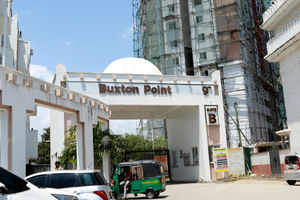
Buildings around Uthiru 87 in Kinoo, Kiambu County.
Photo credit: Billy Ogada | Nation Media Group
The agricultural charm of the wider Kabete area, reinforced under colonial rule, rubbed off on Kinoo. In 1903, the colonial government established an agricultural experimental station at Kabete, followed by veterinary research facilities in 1908. Agriculture and scientific research would become an important part of the area's history.
Long before the Nairobi-Nakuru highway came into being, Kinoo's was a story of contradictions and peculiarities.
Nobody is sure where the name comes from. Kinoo may be a phonetic corruption of the English phrase "King's Knot", or a Kikuyu corruption of "No Through Way", Ki-no, referring to a big "No" sign. It may also be the name of an early ancestor or sub-clan of the Agaciku clan among the Kikuyu. Whatever the origin, the general view is that Kinoo captures the promise and the peculiarities of Kenya's rapidly urbanising areas.
With sizzling nyama choma joints, diverse religious institutions and bustling nightlife, Kinoo has become a beautiful nightmare and an attractive magnet for the younger generation. From Gen Zs to the working class, the settlement is now a melting pot.
'People once knew each other by name and homestead'
Assistant Chief for Gaitumbi Wangari Chege.
Photo credit: Billy Ogada | Nation Media Group
Unlike many residents who have only read about the history of the place, Gaitumbe assistant chief Wangari Chege was born and raised in Kinoo.
She remembers it as bushy. There was no tarmac, infrastructure was sparse, and shops and other amenities were kilometres away.
Ms Chege, the first-born daughter of a police officer and a peasant farmer, grew up in a place where people knew one another not just by face but by name and by the homestead they came from. That is no longer the case.
Her mother was strict, she recalls, and she had to learn the art of dodging the dangers that lurked in the bushes. Looking back, she wonders what might have happened had she been in trouble as a young girl. Whom would she have confided in? How would she have found them? The reflection says something about the kind of community Kinoo once was, and about how quickly it has changed.
"Previously, people knew each other. Now, it's difficult to even know your neighbour," she said.
"This area is now cosmopolitan. But growing up, it was not always like this. Literally, people knew each other by names and their homesteads. Now, it is difficult to even trace those very homes."
What was once a largely rural settlement has become a cosmopolitan neighbourhood of apartment blocks, businesses and people from different parts of the country. The old homes have been swallowed by development, and some have disappeared altogether.
Ms Chege says that in the early 2000s buildings began to sprout across the area, and many of those early structures have since been replaced. One has remained: the infamous "White House" of Kinoo. It has survived the changing skyline and the march of development, even though its owners have since painted it blue and white. The name has stuck. Under any other name, residents say, it would not sound quite as White House-ish as it always has.
Residents also carry another piece of history. Growing up, Ms Chege says, they took pride in hailing from the same region as Waiyaki wa Hinga. They were told he came from the area.
Waiyaki wa Hinga was a prominent Kikuyu leader associated with Kabete and the wider area during the early period of British intrusion. The specific claim that he came from present-day Kinoo is hard to establish from historical records, but the association has clearly survived in local memory.
Flats where there was nothing but farmland
Gerald Mathenge at his spare parts shop in Kinoo.
Photo credit: Billy Ogada | Nation Media Group
Twenty years ago, Gerald Mathenge, 68, who now sells spare parts along Chief Road in Kinoo, was already working in the Nairobi CBD, a few kilometres away. He had a garage in Kariokor.
But Nairobi was becoming increasingly congested, he says, and the then municipal council was making life difficult for traders. He eventually moved out of the city, and Kinoo became his home. When he arrived, he remembers, the place was dominated by farms and greenery.
The transformation has happened almost before his eyes. For him, the changes are easiest to measure in buildings, roads and businesses. He has watched flats rise where there was once nothing but farmland, and he was here before many of the roads were tarmacked.
The buildings came. The businesses followed. The population grew. The landscape changed with it, into what people now see as they ply the infamous Waiyaki Way.
But development has not solved everything. One problem has remained stubbornly familiar, Mr Mathenge says, is drainage. Urban planning gaps and poorly designed or absent drainage systems have made flooding a persistent problem.
"When it rains here, I am sometimes forced to close my shop. The waters rise as high as two metres and, sometimes, submerge part of this shop," he said. With the coming El Niño rains, he is bracing for the worst.
The story of Kinoo, then, is not simply one of buildings replacing farms. It is also about a neighbourhood changing faster than some of the systems that support it.
Drug abuse, particularly alcoholism, is another emerging problem. According to Kinoo Division Assistant County Commissioner Jack Kanga, the drugs come from outside the area, but residents bear the consequences. For the authorities, he says, arresting people is proving insufficient.
"It is becoming difficult to address the issue just by arresting," he said. The answer, he argues, has to go beyond the police station.
"The alternative is speaking and teaching the youth good morals," he said. "I want to see a Kinoo where young people wake up with dreams, not hangovers."
"We must move from reacting to problems to preventing them. From simply asking 'whom do we arrest?' to asking 'how do we prevent the next young person from becoming a victim?'" he added.
The highway that split the neighbourhood
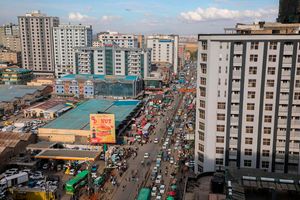
Aerial view of Waiyaki Way at Kangemi area.
Photo credit: Billy Ogada | Nation Media Group
Long before Waiyaki Way cut through the heart of the neighbourhood, residents cared little about zebra crossings or where to cross the road safely. There were just mounds of red soil, dusty in the dry seasons and muddy when the rains came. Then the highway happened. Today, one of Nairobi's major road corridors runs through the middle of Kinoo, splitting it in two.
On one side is Muthiga location. On the other is Kinoo location. Together with Gaitumbe, the three make up the Kinoo division. The wider Kinoo is further divided into estates, from Regen at the farthest end to Uthiru, which is closer to the city. Its people now have to contend with a highway that was once simply part of their land.
They now long for a zebra crossing, flyovers or safe places to cross the road. Living on either side of Waiyaki Way comes with its own daily calculation of risk. Pedestrians weave through traffic, waiting for a gap that sometimes appears just wide enough. A moment of miscalculation can be fatal.
Ask around along the stretch and you will rarely have to go far for a road accident story. Someone has witnessed one. Someone knows someone who was knocked down. Someone remembers a neighbour, a relative or a friend who never made it home.
Yet people stay. For some, Kinoo is home. For others, it is simply closer to work.
At one point, Kinoo carried a reputation for carjacking and other insecurity, and people spoke of it with caution. Today, residents describe a different neighbourhood. Kabete Police Station stands at one end and Kinoo Police Station at the other, with other police posts in between.
By street measures, Kinoo has spent decades transforming itself. That also sets its next challenge: figuring out how to grow without losing the sense of community that once made it feel like home.
The terrain is as rugged as it ever was, but much has changed in the 'hood, whose name not even the original occupiers can explain.