Emperor Haile Selassie of Ethiopia wanted to attend Kenya’s independence celebrations. Jomo Kenyatta wanted him there. But on December 12, 1963, when the Union Jack was lowered and the new Kenyan flag rose over Nairobi, Africa’s most famous emperor was conspicuously absent.
For years, his absence could easily have been interpreted as a diplomatic snub, a scheduling problem or simply one of those mysteries that surrounded the hurried preparations for Uhuru. Newly examined British documents now disclose a more intriguing story: behind the public celebrations, officials in Nairobi and London had become entangled in a battle over precedence, imperial protocol and the political symbolism of the guest list.
Documents show that Selassie did not stay away because he lacked interest. He was prevented from attending after a decision was made in Nairobi that the emperor “should not be at the independence celebrations”.
It was an extraordinary decision given that Ethiopia was Africa’s oldest independent State and the great symbol of resistance to European colonialism. Selassie had survived the Italian invasion, appealed to the League of Nations and returned from exile to reclaim his throne. Kenyatta had also been involved in the Ethiopian campaign in London. Earlier in 1963, Haile Selassie had hosted African leaders in Addis Ababa for the conference that established the Organisation of African Unity.
To the emerging African political class, he was not simply another head of state. He embodied a historical African sovereignty that predated the colonial partition. His presence in Nairobi would have connected Kenya’s independence to a longer continental history of resistance.
Kenyatta appears to have understood this. Before independence, he sent Selassie a warm personal invitation and sent Mbiyu Koinange, one of his closest confidants, to Addis Ababa to deliver the invitation letter.
Former Emperor of Ethiopia, Haile Selassie.
Photo credit: File | Nation Media Group
When the British learnt about the invitation, and rather than ask Kenyatta, they on November 13, 1963, asked Ambassador J.W. Russell of the British Embassy in Ethiopia to establish the emperor’s intentions. His report left no doubt about Selassie’s enthusiasm.
“I first asked the Emperor if he wanted to go,” Russell wrote. “He said yes indeed: he was most anxious to establish personal relations with Mr Kenyatta and others.”
Selassie believed that a personal visit would be “beneficial in the general East African context” and, Russell reported, was “on the whole very keen to go”.
But the emperor was also conscious of his rank. He wanted to know how other States would be represented. Russell therefore asked whether he should first establish “what level other States were likely to be represented”.
The British monarch would not attend personally. Queen Elizabeth II was to be represented by her husband, Prince Philip, the Duke of Edinburgh. That created a delicate question: where would an emperor rank in a ceremony at which the Queen’s representative was expected to occupy the most prominent diplomatic position?
Selassie asked Russell to investigate. Yet there was no suggestion that he was refusing the invitation or demanding impossible treatment. He remained willing to attend and continued to regard Kenyatta’s invitation as a personal and meaningful gesture.
Then the hesitation began. A telegram dated November 22 revealed serious concern that the invitation might be withdrawn. The Secretary of State, Duncan Sandys, warned that cancelling the invitation would cause “major offence” in Addis Ababa.
“The Emperor will ascribe cancellation less readily to second thoughts on protocol than some ill-defined political arrière-pensée,” he warned.
The French expression was revealing. Arrière-pensée refers to an undisclosed motive or hidden political calculation. In other words, Selassie was unlikely to accept that Nairobi had suddenly discovered a harmless difficulty over seating arrangements. He might conclude that somebody had deliberately moved to keep him away.
The danger was heightened because the emperor had sought Sandys’ advice. If the invitation disappeared immediately afterwards, critics could easily suggest that Britain was responsible.
“As cancellation of invitation will come immediately after the Emperor asked me for my advice,” the official wrote, “it will be all too easy for the ill-disposed to suggest that it is in some way my doing.”
He urged Nairobi to reconsider before damaging relations with Ethiopia at the very birth of the Kenyan state.
“On every ground,” he wrote, “I would urge very serious reconsideration be given to this issue before a decision is taken which may well queer Kenya-Ethiopian relations at the highest level from the start.” He then proposed a solution. If the presidents of Uganda and Tanganyika were attending, the emperor could be placed first among the African leaders.
“Are Presidents of Uganda and Tanganyika attending?” he asked. “If so, cannot the Emperor be primus inter pares with them? I am sure he would not quibble at coming after the Duke of Edinburgh representing the Queen.”
But by then, the decision had apparently been made. A handwritten note sent by Governor Malcolm MacDonald to his private secretary disclosed that the Cabinet had decided on November 20 that the emperor “should not be at the independence celebrations”.
That terse sentence is the central revelation in the newly examined documents. Kenyatta had issued the invitation, Selassie had accepted it in principle, and British officials in Addis Ababa were warning against withdrawing it. Yet the Cabinet had resolved that the emperor should not come.
The surviving correspondence does not point to hostility towards Ethiopia. Instead, it reveals the uncertainty of a transitional government trying to stage an African independence ceremony within the protocols of the British monarchy. Kenya was becoming sovereign, but the choreography of its sovereignty was still being supervised through imperial channels. The guest list was not merely a list. It established hierarchy. It determined who stood where, who entered first and whose presence defined the occasion.
Selassie posed a particular problem because he could not easily be absorbed into a programme designed around the Duke of Edinburgh. He was a reigning emperor, an African sovereign and an international figure of far greater historical stature than most of the leaders attending the ceremony. His presence could have transformed the symbolism of Uhuru from a British transfer of power into a continental African gathering.
The documents also reveal how limited Kenyatta’s room for diplomatic manoeuvre remained before independence. He could invite the emperor, but his invitation could still be reconsidered through a Cabinet over which the colonial governor retained enormous influence. The episode captured Kenya in the awkward passage between colonial rule and sovereignty: Kenyatta was already acting like the leader of an independent African nation, while the colonial government was still managing the ceremonies through which that nation would be born.
MacDonald wanted to know whether Kenyatta had sent a second message reversing the invitation. On November 23, he asked the deputy governor to investigate.
“Can we find out from Ellerton, or anyone else, whether Kenyatta has yet sent a message to the Emperor about this, and, if so, what its text says?”
Two days later, MacDonald invited Tom Mboya for drinks at Government House, the residence that would soon become State House. The emperor’s attendance was among the matters he wanted discussed. “Please remind me to raise this with Mr Mboya when he comes for drinks this evening,” MacDonald instructed his private secretary. “Remind me to dictate an answer to Mr Russell tomorrow.”
In another note written on November 25, the governor acknowledged that Kenyatta’s original invitation had already travelled through more than one channel.
“I know that Mr Kenyatta had sent a message earlier to the Emperor, inviting him,” he wrote, “and that was still the position when Mr Mbiyu Koinange went to Addis Ababa recently.”
MacDonald now wanted to know whether another communication had been sent after the Cabinet decision. The search for this second message demonstrates the embarrassment created by the reversal. Nobody wanted to appear personally responsible for telling Africa’s emperor that he was no longer welcome.
Mboya apparently helped negotiate a diplomatic retreat. On November 26, MacDonald informed Russell that the crisis had been resolved.
“I spoke to Mboya about this last night,” he telegraphed. “He told me that everything has now been agreeably arranged with the Emperor.” According to Mboya, the Kenyan ministers had received a message from the Ethiopian consul-general saying that “the position is fully understood by His Majesty”.
The official explanation was that the independence programme was too crowded to give Selassie the attention he deserved.
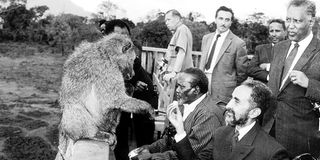
President Jomo Kenyatta (second right) bids farewell to Emperor Haile Selassie of Ethiopia (third right) after the Emperor’s state visit to Kenya on December 24, 1965 at Embakasi Airport.
Photo credit: File | Nation Media Group
“I know that Kenyatta and his colleagues hope the Emperor will visit Nairobi fairly soon after independence,” MacDonald wrote, “when they will be able to welcome him with the full attention they would like to extend to him.”
“They are very genuinely embarrassed,” he continued, “at the prospect of not being able to pay proper attention to him, and to have the talks they desire with him, during the independence programme, which will be crowded with functions and VIPs.”
Perhaps there was some truth in this. Independence celebrations were complicated affairs involving royal representatives, foreign delegations, security arrangements and elaborate ceremonial schedules. But the correspondence suggests that the crowded programme became a face-saving explanation for a deeper protocol dispute.
While Selassie did not come, Julius Nyerere, president of Tanganyika, arrived at Kenyatta’s invitation and became a victim of the confusion. He and his wife were not invited to the Commonwealth dinner on the evening of December 11. In a personal note dated December 14, MacDonald apologised.
“The invitation to you and your wife…went astray,” he wrote. MacDonald also apologised for failing to see Nyerere off when he departed Nairobi on December 13.
“I did not hear that you were departing until your wife arrived at the State Ball without you,” he explained, “otherwise I would have been there.”
Nyerere replied on January 4, 1964, without complaint or diplomatic drama.
“I preferred to leave as quietly as possible,” he wrote.
It was classic Nyerere: restrained, courteous and quietly devastating. The two episodes expose the disorder behind the splendour of Kenya’s Uhuru celebrations. Selassie was kept away because his presence complicated imperial protocol. Nyerere came but was forgotten at dinner and almost departed unnoticed.
More importantly, the records show that Kenya’s independence ceremony remained caught between two political worlds. Kenyatta was looking towards Addis Ababa and the new Pan-African order. The departing colonial establishment was still looking towards Buckingham Palace.
At midnight, the flag changed.
John Kamau is a PhD candidate in History, University of Toronto. Email: [email protected] X:johnkamau1