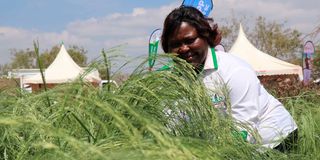
A stand teeming with a luxuriant crop of teff grass turned heads at this year's Makueni Agricultural and Trade Fair in Makindu Township. Many curious visitors thought it was a new variety of pasture grass.
“This is teff,” explained Miriam Mutua, a research scientist at the Kenya Agricultural and Livestock Research Organisation (KALRO), to a mesmerised audience. “Teff flour is used to make injera, an Ethiopian pancake that is growing in popularity in major Kenyan towns”.
Teff, known scientifically as Eragrostis tef, is the smallest grain in the world, according to the Food and Agriculture Organization.
Teff grain.
Photo credit: SHUTTERSTOCK
It is native to Eritrea and Ethiopia. Over the past two years, teff cultivation has spread to parts of Marsabit, Nakuru, Laikipia and Isiolo counties, as Kalro scientists have placed significant bets on this hardy cereal to help farmers build resilience in the face of climate change.
David Mumo has added Kitui County to the list of counties growing teff, while Makueni County has signalled its readiness to embrace the latest crop in the semi-arid region.
Since 2024, the rancher has grown teff grass on a five-acre plot in Kitui County. He was looking for a versatile pasture grass that thrives in drylands when he came across teff grass. It has become a popular source of fodder for sheep.
Teff cultivation begins with land preparation. Agronomists advise farmers to plant teff seeds at the start of the rainy season.
The land is tilled and a drag is used to make the surface smooth before the teff seeds are introduced to the seedbed.
The seeds are introduced either by broadcasting or by drilling shallow holes. Agronomists recommend spacing the rows of teff grass 50 centimetres apart.
“The cost of producing teff grass is negligible. Teff grass is also capable of producing multiple harvests, reducing the cost of seeds. The crop does not require pesticides. As soon as it germinates, it suffocates weeds, so it does not require weeding either,” Mr Mumo told Seeds of Gold in a recent interview in the sun-baked Maliku region of Kitui Rural Constituency.
Mirriam Mutua, a research scientist at the Kenya Agricultural and Livestock Research Organisation, shows Jacqueline Wanja a pack of teff seeds during the Makueni Agriculture and Trade Fair at Makindu Township on July 16, 2026.
Photo credit: Pius Maundu | Nation
After just a few minutes of conversation with Mr Mumo, it becomes clear that injera could soon be on dinner tables across the country.
The promotion of teff grass highlights a concerted effort by government agencies and development organisations to enhance the resilience of farmers in the face of climate change.
“We are telling farmers to grow crops that mature early in response to erratic rainfall caused by climate change. Teff is a hardy cash crop which matures in two and a half months. The tiny grain is highly nutritious. It is rich in calcium, fibre, protein and iron,” Mary Muteti, the Director of Agriculture in Makueni Governor Mutula Kilonzo Junior’s administration, told Seeds of Gold .
Kalro believes that teff holds the key to unlocking the country's economic potential in the face of erratic rainfall associated with climate change. “Teff thrives in drylands, which cover more than 80 per cent of our country. It is environmentally friendly since it does not require pesticides. After threshing, teff residue becomes valuable fodder for livestock,” said Ms Mutua.
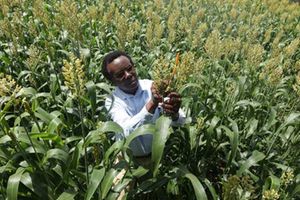
Caroline Wakhungu, a lecturer at the Technical University of Kenya and climate action champion who has studied teff production in the country, says that teff and sorghum have improved food security and household incomes in Isiolo County.
“While sorghum is mainly used as a staple food, teff is mainly used as a cash crop,” she told a recent conference on dryland farming at Lukenya University.
Mr Mumo has determined that an acre of land can produce between 20 and 25 bags of teff grain. After threshing the grain, he mills it and packages the flour before taking it to market. “Teff flour is very popular among Ethiopians living in Nairobi. They mainly use it to make injera,” he said.
Nutritionists market teff flour as a healthy alternative to wheat flour because it is gluten-free. This makes teff suitable for consumers who are sensitive to the gluten protein mainly found in wheat.
To encourage wider adoption of teff, scientists are exploring its use in other products. According to Dr Wakhungu, the flour blending market offers huge opportunities for teff production. Communities that grow teff use it to blend with wheat and maize flour.
The blended flour is used to bake cakes and chapatis, and to cook porridge and ugali.
To address this, Kalro is distributing three high-yielding teff varieties developed in collaboration with the Kenya Plant Health Inspectorate Service.
These are Alia Red, Kis Teff and Lusike White, named after the late Dr Lusike Wasilwa, a distinguished crop scientist and former director of crop systems at Karlo.
In addition to production, Dr Wakhungu has challenged policymakers to play a more active role in encouraging the uptake of drought-tolerant crops such as teff and sorghum.
This can be achieved by improving market access, adding value and promoting financial inclusion, thereby enhancing food security and sustainable livelihoods.