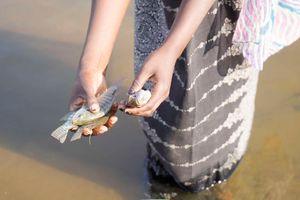
For generations, Lake Victoria has supported fishing communities whose livelihoods depend on its resources. One such community was that of Elizabeth Okullow’s grandmother, who spent more than six decades making a living from the fish trade along the lake’s shores.
Growing up in this environment, Ms Okullow witnessed the opportunities and limitations of the fishing industry first-hand.
While fish provided income and food security for many households, she also witnessed barriers that prevented small-scale players from fully benefiting, including limited access to quality resources, markets, and financing.
Women traders often operated on the fringes of the sector, while farmers and fishermen faced challenges that hindered their ability to expand their businesses.
Meanwhile, large volumes of fish processing waste, including heads, bones, scales and other by-products, were discarded despite containing valuable compounds.
It was these gaps that led Ms Okullow to explore ways of creating value across the fisheries sector, from supporting farmers to finding uses for materials that were previously treated as waste.
“I saw an opportunity to address gaps along the fisheries value chain and create a more sustainable business environment,” she says.
In 2023, she founded AquaMnara, a data-driven aquaculture enterprise that supports smallholder fish farmers across East Africa by improving their access to production information, quality inputs, and financing solutions.
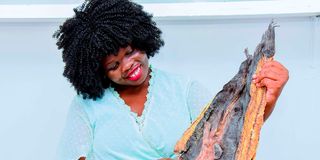
Elizabeth Okullow, founder of AquaMnara, an aquaculture enterprise supporting smallholder fish farmers and Bionala, a fish waste processing company.
Photo credit: Pool
The initiative addresses the constraints that persistently affect aquaculture growth, including limited access to reliable production data, certified farm supplies, structured markets and appropriate financing options.
For smallholder farmers, these gaps can lead to poor production decisions, higher costs and losses caused by fish mortality or limited market opportunities.
AquaMnara, which means 'aquaculture lighthouse' in Kiswahili, helps farmers to navigate the world of modern fish farming by providing them with access to knowledge, technology and market connections.
In Kisumu, the aquaculture enterprise links fish farmers to certified fingerling suppliers, trusted feed providers and buyers.
The company also provides technologies such as digital water quality monitoring systems, which track parameters including dissolved oxygen levels in fish cages and ponds. This helps farmers to identify problems early on and improve farm management.
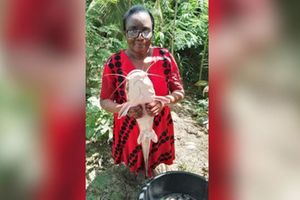
Samuel Nyabinda started fish farming with a borrowed motorcycle and a small leased plot. Support from AquaMnara helped him to improve his production. He started with 200 fingerlings in 2019 and earned Sh10,000 from his first harvest.
When the AquaMnara team visited his farm in 2023, they found high pH and low oxygen levels in his ponds — conditions affecting fish survival. The guidance he received enabled him to improve water quality, install a water supply system, and adopt better farming practices.
“My next harvest brought in Sh150,000, which I used to build a second pond, and later a third,” he says.
The enterprise has since connected him with fingerling suppliers and buyers, and he hopes to develop his farm into a demonstration site where young people can learn about aquaculture.
“Aquaculture is considered a high-risk sector, and our fish farmers lack access to finance. We want to be the link between financial institutions and fish farmers so that they can access the financing they need,” says Ms Okullow.
To address the challenge of accessing farm inputs, AquaMnara has introduced an e-voucher system enabling affiliated farmers to purchase feeds, nets and other equipment from approved suppliers.
The enterprise is also creating more opportunities for women in aquaculture. She says that women around Lake Victoria have traditionally faced cultural barriers that have limited their involvement in fish farming to trading.
Through the Women in Aquaculture programme, the company provides female farmers with production resources, technical support, e-voucher financing and market connections.
“We launched the programme specifically for women fish farmers to provide support from start to finish. We have already enrolled a group of 20 women, and they now operate two cages,” she says.
The programme is enabling more women to participate directly in commercial fish farming. Eunice Achieng, one of the beneficiaries, says that the training has helped her to improve the management of her business.
'Before this project, I depended on middlemen and did not keep proper records. I did not know what I was earning or spending. They taught us about water quality, feed management, and record-keeping. I now track everything from feed use to fish sales and supply directly through the Obunga Depot instead of relying on brokers,” she says.
This has given her better control of her business and a clearer understanding of her production costs and returns.
While working in aquaculture, Ms Okullow identified another issue: large volumes of biological material were being discarded after fish processing. This observation led her to explore ways of turning this waste into useful products.
Research has shown that fish processing by-products contain valuable compounds such as collagen, omega oils and proteins, which are used in the nutrition, wellness and cosmetics industries.
This insight led to the creation of Bionala, a biotechnology and circular bioeconomy company that collects aquatic by-products from artisanal landing sites and processes them into bio-ingredients for food manufacturers, nutraceutical companies, and cosmetics brands.
Bionala explores higher-value applications for materials that were previously discarded, including fish heads, scales, organs, viscera and skins.
Elizabeth Okullow, founder of AquaMnara, an aquaculture enterprise supporting smallholder fish farmers, and Bionala, a fish waste processing company.
Photo credit: Pool
While AquaMnara works with farmers and traders upstream in the fish production and processing chain, Bionala works downstream, converting the remaining materials into products that meet market needs.
“Our goal is to divert thousands of kilograms of aquatic by-products from landfills and waterways each year, while reducing the carbon emissions associated with traditional waste disposal methods,” she says.
Using biotechnology processes, Bionala extracts compounds such as marine collagen, omega oils and protein concentrates from these side streams.
These materials can then be processed into products such as fertiliser, animal feed, and ingredients for use in food and cosmetics.
Throughout production, the company incorporates batch tracking and quality testing, supporting traceability from collection sites to finished ingredients destined for the beauty and nutraceutical sectors.
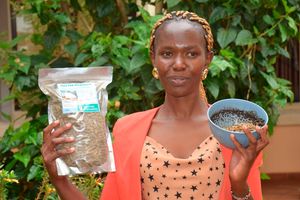
Bionala is developing three product lines derived from aquatic side streams: Type I marine collagen for beauty and wellness applications; omega-3 oils rich in EPA and DHA for the nutraceutical, food, and cosmetics industries; and protein concentrates for food fortification, animal feed, and other value-added uses.
For Ms Okullow, this enterprise demonstrates the untapped value of resources that are often considered waste.
Rather than viewing discarded materials as an environmental burden, she believes they can lay the groundwork for new industries, jobs and income opportunities.
She also coordinates capacity building for early-career ocean professionals across Africa through ECOP Africa, a programme under the UN Decade of Ocean Science.
Her work promotes the sustainable use of marine resources, demonstrating that environmental protection and economic opportunity can advance together.
AquaMnara works with farmers in the early stages of the supply chain, while Bionala adds value by transforming discarded materials into useful products after processing.
“I was inspired to start AquaMnara to support my community, preserve our fishing culture, and promote responsible aquaculture practices,” she says.
She hopes to expand the infrastructure supporting farmers and processors, including cold storage facilities, fingerling production units, and a fish feed processing plant, to boost the aquaculture sector.
“Africa's greatest untapped resource is what it throws away. It throws away its fish, its plastic and, for too long, its talent. My job is to build the companies that prove all three are worth keeping,” she says.
To her, sustainability is not just about protecting natural resources. It is also about recognising hidden value, creating opportunities, and building enterprises that enable communities to benefit from the resources around them.