In Makueni County, where seasonal rivers dry up, and water is carefully rationed, rural livelihoods have traditionally depended on livestock and drought-resistant crops.
Locally produced fish is rare and must be transported from distant markets such as Lake Victoria or the coast. This makes it expensive and out of reach for many households, so it has remained a delicacy reserved for special occasions.
Growing up, Faith Mumo often wondered why families in her region could not farm fish closer to home.
As she grew older, she came to understand the harsh realities facing communities in Kenya’s drylands. Water, the most critical input in fish farming, is scarce across regions that account for nearly 89 per cent of the country’s landmass.
Traditional aquaculture systems consume large amounts of water, making them difficult to sustain in such areas.
“Climate change has further exacerbated the situation through repeated failed rainy seasons and prolonged droughts that continue to threaten food production and livelihoods,” she says.
Instead of seeing the harsh conditions as a limitation, she recognised an opportunity to reconsider how fish farming could work in regions where water is scarce.
She also observed that the fish trade is largely dominated by men, leaving many women vulnerable to exploitative practices such as the fish-for-sex trade, which threatens their health, dignity, and economic independence.
Faith, who holds a Bachelor of Science degree in Fisheries and Aquaculture, is the CEO and co-founder of Iviani Farm and is a certified trainer of trainers through the International Labour Organisation.
Inspired by her passion to make fish farming accessible to all, she has developed smart ponds through Iviani Farm.
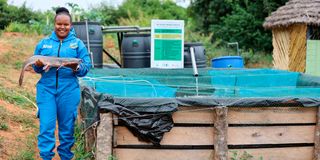
Faith Mumo displays a cat fish harvested from her smart pond aquaculture technology in her Iviani Farm in Makueni County on June 24, 2026.
Photo credit: Boniface Mwangi | Nation Media Group
The system is based on recirculating aquaculture technology (RAS), which enables water reuse and stabilises production conditions. This allows fish farming to continue during drought periods while reducing the overall demand for water.
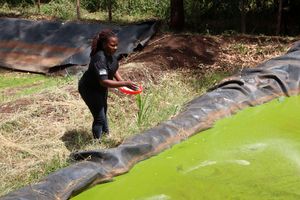
“The raised ponds are made from recycled plastic, are designed for small spaces, and are powered by a locally adaptable RAS that uses minimal water while increasing fish production,” she explains.
The design is further enhanced by a localised, solar-powered, three-stage system that treats and recycles the water in the ponds, eliminating the need for constant drainage and refilling.
As most recirculating aquaculture systems are imported and expensive, the team has developed a more affordable, locally produced alternative using materials that are readily available to suit smallholder farmers.
According to Faith, this technology can reduce water use by up to 75 per cent while minimising nutrient discharge into the environment.
The system is fitted with smart sensors that continuously monitor water quality and fish health, enabling farmers to manage their ponds more efficiently.
Data from the sensors is transmitted to a central system where it is analysed and can be accessed via a mobile app.
Farmers can track changes in key indicators such as pH, temperature, and oxygen levels, enabling them to make timely decisions and prevent losses.
In addition, SMS alerts notify farmers when conditions fall outside of the safe range, and automatic feeders ensure consistent feeding and reduce the need for daily labour.
Each smart pond, measuring four by three metres, can hold up to 1,000 fish and complete a six-month production cycle without the need for routine water replacement, requiring only minimal top-ups.
This enables farmers to harvest market-ready fish in around six months, as opposed to almost a year with many traditional pond systems.
“In the past two years, more than 500 smallholder farmers have adopted smart pond technology, demonstrating its practicality and growing acceptance among farmers,” she says. The team is now exploring ways to expand its reach.
She says that farmers using the system have recorded mortality rates up to 25 per cent lower, feeding efficiency improvements of up to 20 per cent, and household income increases of more than 30 per cent.
“We source raw materials locally for aquaculture feed production, reducing procurement costs and transport-related emissions while strengthening the regional value chain,” she says.
A dependable market has emerged for local growers supplying maize, soybeans and other ingredients used in feed production, which has improved income stability across farming communities.
The cultivation of these crops has expanded to meet rising demand, supporting steady feed production and creating additional income opportunities in rural areas.
However, fish feed remains one of the most significant constraints in aquaculture, with imported varieties often being too expensive for smallholder producers.
To address this issue, Iviani Farm produces BEFA Feeds, a locally formulated brand made from regionally sourced agricultural products.
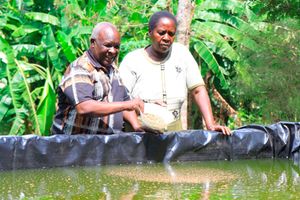
Faith Mumo and some of her three employees display a cart fish harvested from her smart pond aquaculture technology in her Iviani Farm in Makueni County on June 24, 2026.
Photo credit: Boniface Mwangi | Nation Media Group
Expanding the BEFA Feeds facility has generated additional employment and reduced dependence on imported feeds, making aquaculture production more affordable and accessible in Kenya.
Faith notes that, beyond production gains, the project promotes dignity, opportunity, and resilience in marginalised communities while offering a pathway to food security, climate resilience, and economic opportunity.
To ensure that farmers benefit from these gains once they harvest their fish, the company links them to its network of contracted buyers, providing a reliable market and reducing post-harvest losses.
Through its partnerships with county governments, development partners, and private-sector players, Iviani Farm has supported local fishmongers — most of whom are women — across several counties by providing them with training and business support to strengthen fish marketing and promote local fish consumption.
This has created additional opportunities along the aquaculture value chain, increasing access to fresh, locally produced fish.
However, despite these achievements, the modernisation of aquaculture in arid and semi-arid regions continues to be hindered by significant financial constraints, particularly the substantial initial investment required for fish farming infrastructure and technology.
The Smart Pond innovation costs approximately 200,000 Kenyan shillings. While this is more affordable than imported recirculating aquaculture systems, investment is still required in pond construction, filtration units, solar power and monitoring infrastructure.
Even after installation, ongoing costs such as feed, maintenance and technical management remain a challenge for many smallholder farmers, particularly in regions vulnerable to climate change.
She emphasises that scaling adoption will depend on accessible financing mechanisms and strong capacity-building support, including structured credit facilities, cooperative lending models and flexible repayment arrangements.
"Partnerships, farmer training and sustained extension support will also be critical to expanding adoption and ensuring farmers can effectively manage the systems, safeguard productivity and maximise returns," she adds.
Smart pond systems also expand access for groups that are traditionally excluded from aquaculture, including women, young people and disabled people.
'Because they require minimal space and can be monitored remotely via mobile phones, these systems are even suitable in settings where resources are limited,' she explains.
For farmers like Mwende in Makueni County, this innovation has been transformative. She recalls that, prior to acquiring the Smart Pond, she was a full-time housewife with no reliable source of income.
This has since changed, as she now breeds fish on her property and generates an income that enables her to pay school fees, buy food and support her family.
“The pond requires minimal water, and the technical support provided by Iviani Farm has given me the confidence to manage it effectively. Fish farming has enabled me to transition from dependence to making a meaningful economic contribution to my household,” she says.
Faith adds that demand is also growing in urban areas where land is limited, and households are seeking reliable and affordable sources of protein closer to home.
“In this emerging food future, production is no longer confined to high-potential rural zones; it is steadily extending into drylands and overlooked communities that have long been left behind,” she concludes.