The more than 100 young, eager faces in front of me instantly took me back 37 years, to when I sat exactly where they were. The Kenya Veterinary Association (KVA) and the Faculty of Veterinary Medicine (FVM) at the University of Nairobi had invited me this week to give a motivational talk to students pursuing veterinary and wildlife medicine.
I had been asked to speak about what veterinary medical training entails and the range of career options available in the field. I was pleased that the KVA and FVM now recognise the importance of helping students understand, right from the beginning, what their chosen course demands and what they can expect from it.
Many students join university without a clear roadmap or a proper understanding of the course they selected—or the one selected for them by parents, teachers or peers. Some only begin to question the value or relevance of their course after graduation.
Over the years, I have met graduates who completed a degree only to hand the certificate to their parents and request to return to university to study what they truly wanted. I recall one such case: a young woman who had studied law. When she completed the degree, she told her father she had fulfilled his dream. Now, she wanted him to allow her to pursue her own dream—international relations.
Her father asked me to speak with her. It quickly became clear she had carried deep resentment throughout the course because her wish to become a diplomat had been ignored. Out of respect for her father, she endured four years of legal education, but she never enjoyed it. She had no intention of proceeding to the School of Law.
Fortunately, I convinced her to spend two years preparing herself for a diplomatic career instead of repeating another four-year degree. She enrolled for a master’s in International Relations and, three years later, secured a position in diplomatic service. In moments like these, the Biblical statement, “My people perish for lack of knowledge,” rings very true.
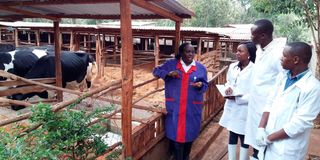
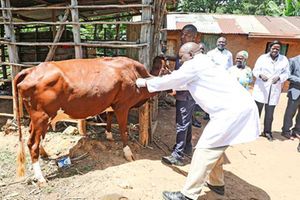
Students on attachment at GardenVet Clinic, Kiambu, gainhands-on farm experience. They are trained by farm manager, a veterinary paraprofessional.
Photo credit: Joseph Mugachia | Nation Media Group
Back to my talk. As I studied the young faces before me, I noticed a striking difference between them and my classmates 37 years ago. This group radiated confidence, curiosity and readiness to learn. My cohort, by contrast, carried the uncertainty typical of those raised in an era when children were expected to be seen and not heard. Asking too many questions—or challenging an adult—invited stern looks, harsh words or even punishment. Still, we eventually gained confidence as the training progressed.
Listening to the other guest speakers, I quickly restructured my speech and abandoned much of what I had prepared. Being one of the last to speak carries the risk that earlier presenters may have exhausted your key points. You must think on your feet or risk boring the audience with repetition.
I chose to outline the structure of university veterinary training, a topic none of the previous speakers had covered. Judging from the students’ attentiveness and their eager responses to my questions, it resonated well.
I explained that university education is built on a foundation of facts, theories, principles and practicals. It exposes students to the breadth of knowledge in their discipline—what is known, what is unknown and what is still uncertain. That is why, at graduation, students are not told they have completed their studies; they are told they are awarded the power to read and do all that appertains to their degree. This signals the beginning of a lifelong journey of learning and applying knowledge.
Veterinary Medicine takes five years, culminating in a Bachelor’s degree.
Year 1 explores the normal animal body—its structure, function and biochemical makeup—through anatomy, physiology and biochemistry. It is essentially an introduction to the healthy animal.
Year 2 focuses on sustaining animal life through animal nutrition, genetics and production. Students also study what undermines animal health: microbiology (disease-causing germs), parasitology (organisms that feed on animals), immunology (the body’s defence system) and pathology (how the body responds to disease-causing factors). Biostatistics introduces data collection and interpretation.
Year 3 covers animal diseases, their treatment and prevention in medicine, gynaecology and surgery. Students also learn clinical pathology (diagnostics), pharmacology and toxicology (substances that heal or harm animals).
Year 4 continues with medicine and surgery and introduces public health—how to keep human and animal populations safe from diseases, disasters and food safety risks. Veterinary economics and business management teach students the socioeconomic value of veterinary practice.
Year 5 is dedicated to advanced clinical practice, refining diagnostic and surgical skills. Theriogenology, the study of animal reproduction, trains students in managing breeding and caring for newborn animals. Students conclude the year with a research project and technical report to build competence in scientific investigation.
Throughout the programme, students undertake practicals aligned to their level of study, as well as field and industrial attachments at the end of each academic year. These placements help them integrate classroom knowledge with real-life veterinary practice.
Finally, I reminded the students that veterinary medicine is a demanding discipline with numerous career pathways. Their first priority in the early months should be to develop coping strategies that will allow them to enjoy the course, manage long hours and handle the rigorous practical work. We discussed these strategies—including self-discipline and seeking support from peers and lecturers whenever challenges become overwhelming.
A strong start, I told them, is often the key to a successful veterinary career.