The Government is under pressure to compensate families whose homes, farms and livelihoods have been affected by river diversion works under the Sh22 billion project to save Lakes Baringo and Bogoria from merging.
The National Land Commission (NLC) is expected to begin valuing the affected properties this week, paving the way for the Government to seek funds from the National Treasury to compensate landowners.
The move follows complaints from residents over lost agricultural land, damaged irrigation infrastructure and threatened investments, including a farm valued at more than Sh50 million.
While the State has promised compensation and humanitarian assistance to farmers whose crops have been destroyed, questions remain over the extent of the losses, the adequacy of public participation and environmental safeguards.
The emerging concern is whether the ambitious rescue plan is addressing the ecological crisis without creating fresh economic and environmental challenges for the communities it is meant to protect.
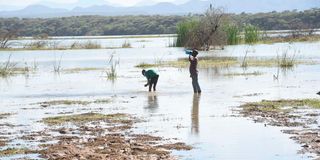
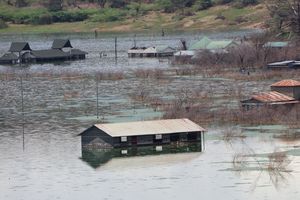
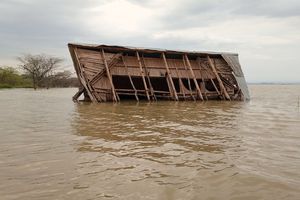
Some structures at Lake Bogoria submerged by rising water levels, which have brought crocodiles and hippos to the alkaline lake, once renowned for its flamingo population.
Photo credit: Florah Koech | Nation Media Group
Principal Secretary for Irrigation Ephantus Kimotho said the Government had formally engaged the commission to assess losses suffered by residents whose land has been taken up by the diversion works.
Speaking during an inspection of the ongoing construction in Sandai, he said the valuation would establish the compensation payable to affected families, after which the Government would seek funding from the National Treasury.
“On compensation, we have written to the National Land Commission and, according to the law, they are supposed to come and carry out an evaluation of the affected land. We will thereafter make a request to the National Treasury for funding to compensate the affected families,” said Mr Kimotho.
He added that farmers whose crops had been affected would receive direct assistance on humanitarian grounds as they awaited the formal valuation process.
“No one should worry about the compensation plans because the Government is aware of the issue, and we will keep updating local leaders on the process,” he said.
Farmers count losses as channels cut through farms
The announcement offers some hope to communities in Loboi and neighbouring villages, where construction has disrupted farming activities with the newly excavated channels having cut through agricultural land, damaged irrigation infrastructure and raised fears of further displacement.
For Michael Kandie, a resident of Loboi, the diversion has already disrupted agricultural activities that have sustained families in the area for years.
Some farms have been cut off by the newly excavated channels, while irrigation canals previously used to supply water to their farms have also been damaged and he expects compensation.
“If somebody's land has been affected by the diversion of the two rivers, then there should be plans to compensate them because we rely on irrigated agriculture for our livelihoods. The canals we have been using for irrigation have also been cut off by the project, and we need them repaired,” he said.
Mr Kandie said compensation should cover all affected landowners, while the Government should also restore irrigation infrastructure to enable farmers to resume production.
The concerns extend beyond individual farmers to established agricultural enterprises that risk losing years of investment.
Mr Vincent Sibilo, who owns Kamoskoi Integrated Organic Farm, fears losing an agricultural enterprise he has spent more than a decade developing.
On his six-acre property, Mr Sibilo grows mangoes, oranges, pawpaws, bananas, maize and cassava. He has also invested in fish farming and beekeeping, estimating the value of his investment at more than Sh50 million.
He said the proposed diversion threatened his main source of income and called for a transparent compensation process that recognises the value of established agricultural enterprises.
Families fear a fresh wave of displacement
The latest concerns come a month after residents of Kamoskoi, Tinytinyon and Kabasis villages protested against the proposed diversion of River Loboi, warning that more than 87 households risked losing their homes and farms.
Among those affected was Mr Harrison Komen, who had already been displaced by the advancing waters of Lake Bogoria. He initially welcomed the Government's intervention to redirect Rivers Waseges and Loboi, hoping it would prevent further flooding.
However, his optimism turned to anxiety after learning that the proposed route of River Loboi could cut through settled areas, threatening homes and farms belonging to his neighbours.
Environmental concerns over river diversion
Beyond compensation, residents have raised concerns about the environmental impact of the excavation works.
Mr Lawi Kiplagat expressed concern over loose soil from the excavation works, which he said was being washed into the lakes, raising the risk of increased sedimentation.
He warned that the diverted rivers could carry more soil into Lake Baringo, potentially undermining the project's objectives.
“Lake Baringo could bear the greatest burden because the diverted rivers will carry more soil and silt into it, potentially worsening the flooding situation. The project also appears rushed, with little attention given to controlling soil erosion and preventing more silt from entering the lakes. Are we solving one problem only to create another?” he posed.
Baringo Woman Representative Florence Jematiah also questioned the decision to alter the natural flow of the rivers, arguing that adequate environmental assessments and wider consultations should have preceded construction.
She said rising water levels had affected the region for years and questioned whether diverting the rivers and constructing dykes was the most appropriate solution.
She proposed constructing check dams along Rivers Waseges and Loboi, as well as at Majimoto and Chelaba, to regulate water flows while allowing residents to use the water for irrigation.
“If you built check dams in Majimoto, Chelaba and along Rivers Waseges, you would slow down the speed of water flowing, allowing locals to utilise it for irrigation and reducing flooding. Instead, you are diverting the rivers and cutting off people's land without proper plans for compensation,” said Ms Jematiah.
She further questioned the level of public participation, saying local communities should have been consulted alongside technical experts before the project commenced.
“Who sat down and established that the rising water levels were causing so much suffering that this had become an emergency? Where were the consultations and agreements before the engineers decided to redirect the two rivers?” she asked.
Government defends the intervention
However, Baringo South MP Charles Kamuren urged residents not to allow compensation concerns to derail the project, saying the Government had put mechanisms in place to address their grievances.
He assured affected landowners that the NLC would undertake valuation in accordance with the law and that the State would facilitate compensation.
“I assure the affected residents that the Government has plans to compensate them for their land. The NLC will come and undertake the evaluation according to the law. They should be patient and allow the project to continue,” said Mr Kamuren.
The compensation dispute is unfolding against the backdrop of an environmental crisis that has steadily transformed the landscape around Lakes Baringo and Bogoria.
For more than a decade, rising water levels have swallowed homes, farms, roads, hotels and public facilities, forcing families to abandon land they have occupied for generations.
Loboi Health Centre, which residents say once stood nearly two kilometres from the shoreline, has been submerged, while tourism facilities and attractions within Lake Bogoria National Reserve have also been affected.
The flooding has raised fears that the two lakes could eventually merge, threatening their distinct ecological characteristics.
Lake Bogoria is saline, while neighbouring Lake Baringo is freshwater and supports fish, hippos, crocodiles and communities whose livelihoods depend on fishing, tourism and other lake-related activities.
Loboi Dispensary in Baringo South on August 26, 2026. It has been engulfed by the flooded Lake Bogoria.
Photo credit: Florah Koech | Nation Media Group
Spatial environmental planner and geologist Prof Simon Onywere has previously warned that the distance separating the two lakes had narrowed from more than 20 kilometres historically to about seven kilometres in 2020, with some assessments placing the remaining gap at less than three kilometres.
A connection between the two water bodies could allow saline water from Bogoria to alter the freshwater ecosystem of Baringo, with potentially devastating consequences for aquatic life and communities dependent on it.
The Government's Sh22 billion intervention seeks to address the flooding crisis, prevent the possible merger of the lakes and turn excess water into an economic resource through irrigation.
The first phase involves restoring Rivers Waseges and Loboi to their original drainage courses after changes in their flow patterns caused them to discharge significant amounts of water into Lake Bogoria.
The Government expects the diversion to reduce the volume of water entering Bogoria, slow its expansion and ease pressure on surrounding communities.
The wider programme includes constructing check dams to regulate water flows and developing irrigation infrastructure to support agricultural production.
In subsequent phases, the Government plans to utilise excess water from Lake Baringo for large-scale irrigation in the drylands of Tiaty, where communities have for years struggled with unreliable rainfall, recurrent drought and pasture shortages.
Project engineers have also been undertaking scientific surveys of Lake Baringo to establish its underwater terrain, depth and water volume. The findings are expected to guide decisions on how much water can safely be drained for irrigation.
The Government says the intervention will combine flood management, water conservation and agricultural development to improve livelihoods in the region.
The project is being implemented in phases, with the immediate priority being to address rising water levels and protect communities and critical infrastructure, particularly in anticipation of the projected El Niño rains.
Mr Kimotho has described the project as an opportunity to transform the region's economic fortunes by putting excess water into productive use.