Long before the government announced plans for billionaire Aliko Dangote’s proposed Sh2 trillion oil refinery in Lamu, the coastal county had already been earmarked for major energy and transport infrastructure under the Lamu Port-South Sudan-Ethiopia Transport (Lapsset) Corridor project.
Kenya Vision 2030’s outline of Lapsset included a proposed oil refinery with a capacity of 120,000 barrels per day, alongside a port, oil pipelines, roads, railway infrastructure and an oil terminal. The refinery formed part of a broader plan to connect Kenya to neighbouring countries, open up northern Kenya to trade and investment, and establish Lamu as a regional transport and industrial hub.
The vision was subsequently elaborated in the 2018 Integrated Transport Infrastructure Master Plan for Lamu Port City, prepared under the Lapsset Corridor Development Authority during the tenure of President Uhuru Kenyatta. The plan set out a broader urban and industrial vision integrating the port with transport, energy and other economic activities.
However, the refinery now proposed by Mr Dangote is considerably larger than the facility outlined in the original Lapsset blueprint. With a planned processing capacity of up to 700,000 barrels of crude oil per day, it is expected to anchor an industrial development requiring substantial land.
The scale of the current project has brought renewed attention to a question that goes beyond the refinery’s economic ambitions: who owns or has a legally recognisable interest in the land required for its development?
At the September 30, 2026, groundbreaking ceremony, President William Ruto said the government had identified 9,000 acres for the project and was seeking an additional 3,000 acres as the plans expanded to include a special economic zone and a new urban centre. The land requirement, therefore, extends beyond the refinery itself to a wider development footprint.
But the status of land earmarked for the project is now being contested in the Environment and Land Court in Malindi, where 133 residents of Chandavai have sued the government, the Lapsset Corridor Development Authority and Dangote Industries, among other parties.
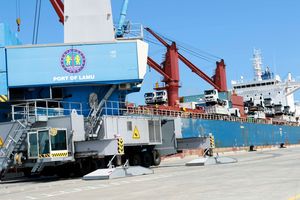
The second equipment batch for the Dangote East African oil refinery project arrives at the Lamu Port in this photo, taken on October 20, 2026. Over 154 assorted construction equipment items were offloaded from Mv Great Prosperity, a Hong Kong-flagged dry bulk carrier, at the Lamu Port.
Photo credit: Kevin Odit| Nation Media Group
At the centre of the case is Land Reference Number 13061, in the Hindi-Manda Magogoni area. The residents claim their families have occupied, cultivated and developed portions of the land for generations, building homes, growing crops, keeping livestock, establishing mosques and shrines, and burying relatives there.
Although they lack formal title deeds, they argue that their ancestral occupation and customary interests entitle them to legal protection. They also contend that the land is community land under the stewardship of the Lamu County Government and that their occupation had not previously been challenged.
Their account of events points to a dispute that predates the refinery’s groundbreaking. The residents allege that on August 7, 2024, government officers, members of the armed forces, local administrators and other agents entered the land with bulldozers and heavy machinery, destroying crops, trees and other property without prior notice, consultation or compensation.
Dangote’s Sh2tr Lamu refinery sparks outrage
According to their court filings, they were later informed that the land had been acquired for Lapsset-related infrastructure and transferred to the Ministry of Defence for road construction and the expansion of the Kenya Navy base at Manda Bay, the US military facility known as Camp Simba, and Magogoni Airfield. They claim they were promised compensation for the destroyed crops but never received payment.
The dispute resurfaced as preparations for the Dangote refinery gathered pace. The residents allege that construction preparations began in July 2026, followed by land clearance ahead of the September groundbreaking ceremony.
They further claim that a compulsory acquisition process was initiated to compensate absentee landowners, some of whom they allege hold fraudulently obtained titles, while their own interests were overlooked.
The plaintiffs accuse the defendants of failing to issue acquisition notices, conduct surveys and valuations, identify affected occupants, facilitate public participation, or provide compensation and a resettlement plan. They argue that taking possession before completing the statutory acquisition process violated their constitutional rights to property, fair administrative action and access to information.
Three residents of Mvinjeni Magogoni have provided witness statements detailing their experiences of settling on and farming the land, seeking formal documentation and losing crops during the clearance.
Kavisi Maithya, a wood carver who moved from Kitui to Lamu in February 2009, said a local resident showed him an unoccupied, bushy area where he settled with his family. He cleared the land, built a house and planted maize, cassava, millet and green grams.
Attempts by residents to obtain ownership documents after the government revoked leases held by ranches did not resolve questions of surveying and demarcation, according to Maithya. He said machinery entered the farms in August 2024 and destroyed crops, while workers promised compensation that remains unpaid.
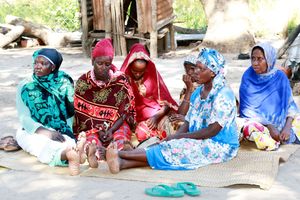
Residents of Kwasasi Village in Lamu County. The village is set to become the site of the Sh2 trillion Dangote East Africa Petroleum Refinery and Petrochemicals Special Economic Zone.
Photo credit: Kevin Odit | Nation Media Group
“We approached them and inquired from them why they were clearing our shambas even without notice,” he stated.
Salim Tima Swale, chairperson of Mvinjeni farmers, traced his family’s occupation to land passed down from his grandfather to his father. He said his family applied in 2015 for formal allocation and demarcation, but the process did not resolve its claim.
Swale said machinery entered the farms on August 7, 2024, destroying food and cash crops. Residents were asked to register their names with a surveyor and were promised a meeting at Lapsset offices, but no communication followed.
His account also reaches back to an earlier dispute over land used for security infrastructure. Swale recounted his grandfather’s account of an arrangement under which some farmers surrendered a small portion of land for a security camp after being promised Sh5,000 each.
The community later discovered that ancestral land had been allocated to others, he alleged.
“It’s shocking and unlawful compensating the companies, us being in possession and developed the suit land as the indigenous people on land,” he stated.
Arafa Lacho Bashora, who was born in Magogoni in 1970, traced the dispute to the establishment of the naval base. He alleged that elders signed a document in the 1970s without understanding its contents, after which families were told to vacate to make way for the base. The promised compensation was never paid, he said.
Bashora returned to the area in the early 1990s and resumed farming land near the base. He later applied for allocation documents in 2015. He alleges that construction subsequently proceeded without notice or consultation and that residents were prevented from meeting to discuss their grievances.
“If the government has a project in our [area], we have no objection to the same,” he stated.
The residents want the court to recognise them as interested persons under the Land Act despite lacking registered titles. They are also seeking orders to stop further entry, excavation, fencing and construction on the occupied portions until the legal acquisition process is followed and compensation is determined.
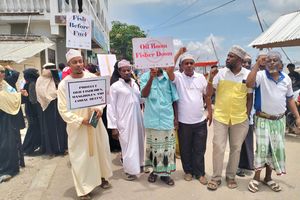
President William Ruto with Aliko Dangote and other Heads of State during the groundbreaking ceremony for the East African Refinery in Lamu.
Photo credit: Kevin Odit | Nation
Their other prayers include surveys and valuations of the land and destroyed property, damages, restoration and resettlement.
The government, however, maintains that the land was previously acquired for the Kenya Ports Authority and that compensation was paid to families during the earlier port-development process.
That position puts the history of acquisition and compensation at the heart of the case. The critical question is whether the earlier process covered the precise parcels now disputed, which interests were recognised and whether the residents currently claiming the land were among those identified for compensation.
Resolving those questions will require evidence beyond the existence of an earlier acquisition. Survey maps, registry records, acquisition notices, valuation reports and compensation schedules could help establish the boundaries of the land acquired and the interests recognised at the time.
The Constitution protects property rights and sets safeguards for compulsory acquisition, including the requirement for prompt payment in full of just compensation to those entitled to it. The central issue is therefore not simply whether some families were paid in the past, but whether the relevant acquisition process covered the land and all legally eligible interests affected by the current development.
The court’s determination will help establish whether the residents’ claims have a legal basis and whether the acquisition and compensation procedures followed by the relevant authorities met the applicable requirements.