Tassia estate was meant to be the future of urban order in middle-income neighbourhoods as part of Nairobi’s reimagined Eastlands frontier in the 1970s.
With Donholm, Tena and Savannah, the four were part of the ambitious post-independence real-estate grand dream intended to herald a new face in the hitherto chaotic area – a blueprint of Israeli engineer and real estate developer Joseph Goldberger.
The millionaire’s dream was to leave behind an imprint of carefully planned middle-income suburbs, devoid of chaos Eastlands had gained notoriety for. The strategy was to replace sprawling informal settlements, patchwork road networks and the squalor of slums.
Hived off Donholm farm around 1976 and sold to Stanley Githunguri’s Tassia Coffee Estate Ltd, Tassia was to be the last phase of the grand project. Githunguri, who died in 2022, was elected Githunguri MP many years later.
The estate traces its name from Githunguri’s company, a name that has stuck.
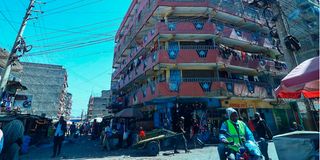
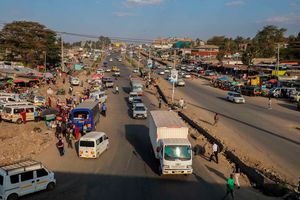
Residential and commercial apartments in Tassia, Nairobi, on August 12, 2026.
Photo credit: Wilfred Nyangaresi | Nation Media Group
The plan ran into headwinds through interference by “old money” until the National Social Security Fund (NSSF) bought the land from Tassia Coffee Estate Ltd and Nokin Investment Ltd between 1994 and 1995 to build residential and commercial properties as part of its investment portfolio.
Like the original plan, this too was thwarted by squatters and grabbers who invaded the land in 2001, putting paid the grand dream.
Court battles followed before a truce was reached in 2005 when NSSF and the illegal occupiers agreed to work together.
Tassia II and Tassia III Settlement Schemes were born after the sale of 5,500 plots, out of which 792 – which had already been developed and formed Tassia I – were sold through NSSF tenant purchase agreements.
Plot owners were to pay up to Sh920,000 at the time, money which was meant to cater for infrastructure development, survey and physical planning fees, engineering and design costs as a condition for the processing of individual title deeds.
On the other hand, NSSF’s planned infrastructure upgrade included tarmac roads and lighting. The roads were to be fitted with culverts and storm water drainage.
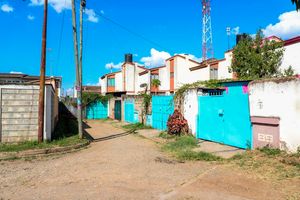
By design, the estate in Embakasi East constituency was meant to have gated communities and to be in courts.
Residential and commercial apartments in Tassia, Nairobi, on August 12, 2026.
Photo credit: Wilfred Nyangaresi | Nation Media Group
That dream is fading. You can hear it in the rev of boda boda engines, see it in the new apartment blocks and the shops squeezed into spaces that once belonged to family homes and feel it in the traffic that seems to thicken with every passing hour.
The old Tassia, according to residents, is slowly disappearing. It was calmer and quiet.
In its place is a denser, busier neighbourhood, one in which apartments rise where bungalows once stood, businesses follow the people and every available piece of land seems to have a future.
For some residents, the transformation is inevitable. For others, it is a warning.
Across Outer Ring Road is Pipeline estate, carrying with it the residue of a neighbourhood that has long surrendered to grime, congestion and neglect.
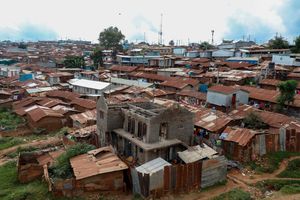
Though sharing more than a heritage, Pipeline is known for its filth and the never-ending wetness of its pathways, where rainwater, waste and everything in between find their way through the estate, eventually feeding River Ngong.
The landscape in Tassia is different, but not entirely. The river skirts the edges of the estate and paths are a little drier and dustier.
The river that connects the two neighbourhoods also separates them. As ordinary as it is symbolic, a section of the River Ngong flows out of Pipeline estate. Its waters are black, contaminated and seemingly abandoned to fate.
Residents of pipeline estate in Nairobi go about their business amid overflowing raw sewage and heaps of uncollected garbage on a street on June 7, 2026.
Photo credit: Dennis Onsongo | Nation Media Group
As the river crosses Outer Ring Road to Tassia beneath the unforgiving sun at noon, it glitters almost beautifully from a distance.
Yet the sparkle is deceptive. It carries the filth, the waste and the adulterations of Pipeline downstream.
Once fortunes improve for many residents of Pipeline estate, they move to Tassia.
If you, however, lived in Pipeline and move to Tassia, not everything from your past disappears. Some follow you – the memories, the daily struggles, the habits, the people and – strangely – even the smelly river.
“A majority of families here came from Pipeline. Landlords from Pipeline are crossing to Tassia and replicating what they are used to. It is worrying,” says Doris Wanjiku, popularly known as Ciku.
Many residents are working class, building lives on modest incomes, one rent payment, school fees instalments and one salary at a time.
To Ciku, moving from Pipeline to Tassia is the clearest sign that one’s fortunes have improved. She talks from experience.
Fresh from college and trying to find her footing in life in 2010, Ciku landed in Pipeline, paying a monthly rent of Sh1,300 for a single room.
At the time, Pipeline was muddy, had no roads and was chaotic day and night. Pipeline was for hustlers, mainly singles starting life in the capital city.
Like others before her, Ciku found love, stars aligned and almost everything got better.
“I got married and moved to a one-bedroom house in Tassia in 2014. Later, we shifted to a two-bedroom house,” she recalls.
Ciku points out that the Tassia of the yore had three phases, with Phase One featuring big plots and houses.
The design was for bungalows and gated communities of sorts with courts. The monthly rent for a two-bedroom house was Sh20,000 to Sh40,000.
Phase Two had flats and maisonettes while Phase Three was for the common mwananchi, covering Kwa Ndege to Baraka estate. This is the first port of call for the “bourgeoisie” from Pipeline.
Tassia has been welcoming people from Pipeline, Umoja and other neighbouring estates for years. The line that divided the place into upper, middle and lower Tassia is fading fast.
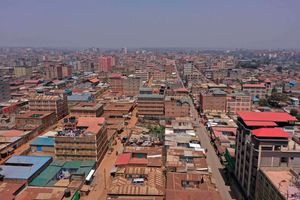
Driven by Nairobi’s surging housing demand, Tassia is growing rapidly and is quickly turning into another Pipeline.
An aerial view of the densely populated informal settlement in Riverbank Phase 1, Tassia, Nairobi, on August 12, 2026.
Photo credit: Wilfred Nyangaresi | Nation Media Group
Landlords from Pipeline estate have smelled the business opportunity and pitched tent in Tassia, bringing along their “bad habits” to cash in on the demand created by the migration.
Every street has kiosks, barber shops, salons and vibandas (makeshift stalls) that sell fast food, chapati, mandazi, groceries and many other items.
“Tassia will be the new Pipeline in five to 10 years. Bedsitters and single rooms are now a common feature,” Ciku says.
Chaos and disorder are creeping into Tassia, with informal settlements, mostly made up of iron sheets, timber and cardboard, mushrooming.
This is a far cry from the initial plan where a Sh5 billion infrastructural development project was to be rolled out in the settlement in the early 2000s.
The plan was to link the new estate to the existing neighbourhoods of Baraka, Nyayo, Embakasi Village and Donholm.
The then-City Council of Nairobi also directed that there should be a major through transport corridor plus feeder roads to service the scheme.
Insecurity is high and burglary is becoming common in Tassia. The roads are dilapidated and fresh water is becoming a dream for the thousands of families there. Residents survive on borehole water. Selling water in jerrycans is now a booming business.
Public amenities like playgrounds have been grabbed. Tassia does not have a public school, with families taking their children to Donholm, Embakasi or Garrison primary schools.
The daily struggles, however, do not tell the true story of what Tassia is turning into. That part has been left to River Bank and Mama Kanyoni (Mabatini) informal settlements – now home to more than 20,000 people each.
English author Charles Caleb Colton wrote in his 1820 book, Lacon: Or; Many Things in Few Words Addressed to Those who Think that “imitation is the sincerest form of flattery.”
John Otieno, a village elder and resident of Riverbank for the past 20 years, during an interview on August 12, 2026.
Photo credit: Wilfred Nyangaresi | Nation Media Group
River Bank village’s bid to copy its more illustrious neighbour has proved that mediocrity cannot pay to greatness.
“I’ve lived here for almost 20 years and it is just by grace,” says John Otieno, who now serves as the River Bank village elder.
Otieno moved from Mukuru Kwa Njenga at the height of the contested General Election and violence in late 2007 and early 2008.
Chaos and death lingered everywhere. One evening, he fled with just the clothes on his body to start life elsewhere. He is now a married man with children.
Benito Otieno, 40, says the turning point for the estate could be traced to early 2000 when four groups were brought in by then-Embakasi MP David Mwenje.
The groups were Kwa Ndege Jua Kali, Mama Kanyoni, Kwa Kassim and Maasai. Members were part of hundreds of people who had been moved to pave way for the expansion of Jomo Kenyatta International Airport.
Otieno says individuals who could not afford the amount demanded were moved towards the river – giving rise to the informal settlement.
“People started building iron sheet structures they would rent out at Sh3,000 a month and bedsitters for Sh5,000. The slums are expanding rapidly and have been a source of goons-for-hire. The rowdy young people are to blame for insecurity in the larger Tassia Estate,” he says.