At least 33 counties depend on hospital fees to run critical operations, painting a grim picture of devolved units whose lifeline rely heavily on individuals falling sick, a new report has shown.
The report by the Controller of Budget (CoB) for the first half of the financial year ending June 30, 2026 has revealed a worrying overreliance by county governments on revenue from hospital fees, which account for almost 50 percent of own source revenue (OSR).
According to the report by Dr Margaret Nyakang’o, only Isiolo, Nairobi, Uasin Gishu, Tana River, Samburu and Narok counties do not have revenue from hospital fees – either through out-of-pocket payments or claims reimbursement after treatment – as their top revenue earners.
Sounding an alarm, Dr Nyakang’o said that during the period under review, counties generated Sh26.94 billion from their own sources, representing a paltry 27 percent of the annual target of Sh99.73 billion.
The underperformance would have been even worse were it not for Sh12.7 billion from facility improvement fund (FIF), which is the fund where revenue from hospital or health fees falls.
Billboards welcoming President William Ruto erected in Homa Bay ahead of the devolution conference on August 12, 2025.
Photo credit: Alex Odhiambo | Nation
The report indicated that collection from health or hospital fees accounted for over 47 percent of total OSR by counties.
According to the report, in counties like Garissa (93 percent), Bomet (91 percent), Elgeyo Marakwet (85 percent), Nyamira (83 percent) and West Pokot (80 percent); revenue from hospital fees accounted for over 80 percent of OSR.
The report indicated that during the period under review, revenue from hospital fees accounted for more than 50 percent of total local revenue in 34 counties, an increase from 28 counties in the first quarter of the current fiscal year.
Other counties with hospital fees accounting for more than 75 percent of local revenue include Meru (79 percent), Homa Bay (78 percent), Kisii (77 percent), Busia and Embu (76 percent), and Kakamega 75 percent.
The situation, the CoB said, exposes the counties to fiscal risks since FIF collections are meant for service utilisation within the respective facilities, but not for general spending.
Illustrating the extent of the overdependence on hospital fees, Dr Nyakang’o noted that some six counties reported local revenue performances of 20 percent or lower largely due to inadequate performance in FIF streams.
The flagged counties include Kiambu at 18 percent, Kericho at 14 percent, Kisumu at 11 percent, Siaya at 10 percent, and Turkana at 8 percent.
“Counties should focus on improving collections from other revenue streams. This approach will help reduce the risk of overdependence on a single funding source,” said Dr Nyakang’o.
Other devolved units where revenue from hospital fees run the roost accounting for 70 percent or more are Kitui and Siaya at 73 percent, Makueni and Kirinyaga at 72 percent, Lamu (7 percent) and Nandi and Kericho at 70 percent.
Six counties received more than a quarter of all the Sh3.73 trillion disbursed to the 47 devolved governments since onset of devolution.
Photo credit: Nation Media Group
Some nine more counties have revenue from hospital fees accounting for above 60 percent include Laikipia (68 percent), Nyandarua (67 percent), Nakuru (66 percent), Machakos (65 percent), Kilifi (64 percent), Nyeri (63 percent), Migori at 62 percent, and Murang’a and Wajir at 61 percent.
Six more counties are in the band between 50 and 59 percent starting with Tharaka Nithi and Trans Nzoia (59 percent), Baringo 55 percent, Mombasa and Marsabit at 53 percent, and Kwale 52 percent.
On the flipside, Samburu County’s strong local revenue performance is attributed to strong tourism-related revenues.
The county government realised Sh238.58 million during the period under review where 72 percent or Sh172 million came from game parks/nature reserves fees, dwarfing Sh43.56 million from hospital fees.
Isiolo realised Sh101.82 million with Sh78.6 million coming from other sources of revenue as the Governor Abdi Guyo-led administration raked in Sh65 million or 64 percent of total revenue from game park entrance fees against Sh23 million from hospital fees.
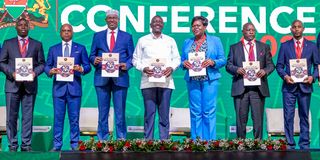
President William Ruto (centre) with Governors (from left) Stephen Sang (Nandi), Senate Speaker Amason Kingi, Ahmed Abdullahi (Wajir) Gladys Wanga (Homa Bay), Mutahi Kahiga (Nyeri) and PS Devolution Michael Lenasalon during the opening of the 2025 Devolution Conference in Homa Bay County.
Photo credit: PCS
Governor Johnson Sakaja’s Nairobi has its lion’s share of local revenue from building permits and parking fees which are at the same level as hospital fees, which accounts for only 16 percent of total collections.
For Narok, park fees contribute 89 percent of its total local revenue raking in Sh2.3 billion with hospital fees bringing in Sh58 million.
Tana River largely depends on revenues from fees from natural resources extraction at Sh19.6 million or 41 percent and Cess at Sh11.25 million or 23 percent. Hospital fees revenue is one of the lowest revenue earners for the county.
In Uasin Gishu County, revenue is evenly distributed with bus park fees contributing 26 percent of local revenue at Sh66.6 million. Fees from health facilities brought in Sh20.5 million.