The planned oil production facilities in the South Lokichar basin are expected to consume up to 34Megawatts (MW) of electricity at peak time, highlighting the energy pressure from the project, which also eyes supplies from the national grid.
A field development plan showed that the central processing facility will have a peak electricity demand of 34MW when crude oil production is expected to be 50,000 barrels per day (bpd).
The project will be mainly powered by gas generators using gas in the Ngamia fields, but will rely on Kenya Power during peak production, in what looks set to present a fresh test on the reliability of the national grid.
“The bulk of the project power requirements are generated by gas generators. However, for periods of peak demand and as a back-up when these are not available, a connection to the Kenyan grid is necessary,” Gulf Energy, the company which is set to commercially produce the oil in South Lokichar says in the Field Development Plan (FDP) of the project.
“The Phase 2 Central Processing Facility (CPF) is expected to have a peak power demand of 34 MW” it added.
The two production facilities in phase one (early production facilities) are anticipated to use 4MW of power each, bringing the total to 8MW.
At 34MW, the peak demand is the equivalent of the production capacity of each of the three geothermal plants at the Menengai geothermal field. Each of the three plants, all owned by private investors, has a capacity of 35MW.
For further scaling, average global estimates show that 1Mw can power up to 900 homes annually, which means that 34MW can serve 30,600 households.
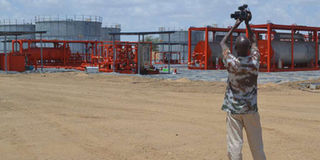
Tullow Oil facility at Ngamia 8 in Lokichar, Turkana County, on February 18, 2020.
Photo credit: File | Nation Media Group
Kenya Power currently struggles to ensure a steady supply of electricity across the country during the peak demand in the evening, a scenario that could worsen when the commercial oil production starts in the South Lokichar basin, Turkana County.
All gas produced in phase 2 will be used to generate power, but the gas deposits are expected to significantly decline from the ninth year of production (2035), which will trigger heavy reliance on the national grid.
Gulf will produce the crude oil from wells in the Amosing, Ekales, Ngamia, Twiga, Agete, and Etom fields.
Kenya, through Gulf Energy, expects to start commercial production of the oil Block T6 and Block T7 by December 2026. An estimated 20,000 bpd of crude oil will be produced in the first phase (2026-2032) before it is scaled up to 50,000 bpd from 2032. The FDP shows that 600,000 bpd of crude oil will be exported every month in phase one. This will jump to 1.5 million bpd in phase two.