When Kenyans trooped to the ballot for a constitutional referendum on August 4, 2010, hope was in the air. After years of agitation, bloodshed, and broken promises, the country finally ushered in a new Constitution, hailed across Africa as one of the most progressive charters ever crafted.
The promulgation followed a rigorous process that began with the failed 2005 referendum, in which a majority of Kenyans signalled their desire for a fresh constitutional order. This culminated in the historic August 27, 2010, when the late President Mwai Kibaki promulgated the new constitution at a public ceremony at Uhuru Park.
Central to it was a robust Bill of Rights, spanning freedoms of expression, assembly, association, and movement, alongside socio-economic entitlements such as education, housing, and health.
The promise was simple yet profound: never again would Kenyans live at the mercy of arbitrary power, police brutality, or state neglect. But fifteen years on, the hard truth is that the spirit of the Constitution has too often remained ink on paper.
Top row (from left): David Machiri Kimani, his father Peter Kimani Machiri and Bob Michemi Njagi. Bottom row: Jamil Longton Hashim (left) and his younger brother Aslam Longton.
Photo credit: File | Nation Media Group
From extrajudicial killings and enforced disappearances to gagged civil society and uneven access to justice, Kenya’s human rights record continues to oscillate between fragile gains and stubborn regressions.
In the immediate aftermath of 2010, there was genuine optimism. The judiciary, bolstered by a reformed vetting process, asserted its independence.
Civil society rode on the momentum of constitutional freedoms to push for accountability. Citizens openly challenged government action, and the courts often backed them up.
Yet, even as the ink dried, cracks began to show. Security agencies, long used to unchecked power, bristled at constitutional limits.
By 2011, reports of police excesses in counter-terrorism operations began to pile up. The Kenya National Commission on Human Rights (KNCHR) warned that unless security forces were reined in, the old ghosts of authoritarianism would return in uniform. Their warning proved prophetic.
The Westgate Mall attack of September 2013, in which 67 people were killed, marked a turning point. While the tragedy exposed weaknesses in Kenya’s counter-terrorism response, it also gave security forces a blank cheque. The government’s war on terror became the perfect cover for sweeping violations. The Garissa University attack in April 2015, which left 148 students dead, further hardened state attitudes.
Human rights groups documented disappearances, arbitrary arrests, and the profiling of ethnic Somalis and Muslims in northern Kenya and the coast. Civil society organisations, once courted as partners, were branded foreign agents and threatened with deregistration.
The Non-Governmental Organisations Co-ordination Board went after outspoken groups such as the Kenya Human Rights Commission and Muslims for Human Rights.
Freedoms guaranteed under Articles 33, 36, and 37 of the Constitution, expression, association, and assembly, were steadily curtailed. Despite a clear Bill of Rights, the narrative of national security repeatedly trumped the rights of citizens, proving how fragile constitutional guarantees become when state power feels threatened.
Few institutions embody Kenya’s human rights paradox like the police. The Constitution envisioned a service accountable to civilians, respectful of life and dignity. In reality, it remains a force, routinely accused of brutality, corruption, and impunity.
From the extra-judicial killings of suspected Mungiki members in the 2010s to the execution-style murders of human rights lawyer Willie Kimani, his client, and their driver in June 2016, the pattern is painfully familiar.
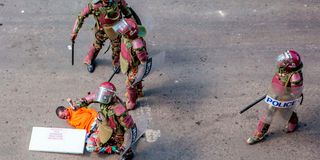
In that case, which drew international outrage, it briefly exposed the dark underside of the Administration Police’s covert operations. Yet even after convictions of some officers in 2022, enforced disappearances and killings continued with chilling regularity. More recently, the police’s heavy-handed response to the 2024–25 Gen Z protests reignited questions about whether the culture of impunity can ever be tamed.
In May 2025, Missing Voices, a consortium of several human rights organisations in Kenya, documented a total of 159 cases of extrajudicial killings and enforced disappearances in 2024. Out of the 159 cases, 104 were incidents of police related killings, while 55 were those of enforced disappearances.
The survey reported that 2024 marked the year that the coalition recorded the highest number of cases of enforced disappearances since 2019, which had the highest number of cases of enforced disappearances at 38.
A photo of the late teacher and blogger Albert Ojwang pictured on June 8, 2025.
Photo credit: Lucy Wanjiru | Nation Media Group
The Independent Policing Oversight Authority (Ipoa), created precisely to hold officers accountable, has struggled to bite. While it has investigated thousands of complaints, only a handful have led to convictions. For many Kenyans, justice remains distant when the uniform is involved.
For activists, this is the core of the problem. David Kamau, the Executive Director of Defenders Coalition, notes that state excesses remain the greatest threat to constitutionalism.
“The 2010 Constitution promised to turn the page on Kenya’s dark past, yet enforced disappearances, police killings, and harassment of activists have continued under different administrations,” he said, adding that,
“The Bill of Rights cannot simply be a beautiful chapter in our Constitution, it must be lived in the everyday experiences of Kenyans.”
The criminalisation of dissent points to an entrenched culture of intolerance, Mr Kamau noted.
“When activists are arrested or threatened for demanding accountability, it tells us that the space for civic action is still fragile, despite constitutional guarantees. That contradiction should worry every Kenyan,” he said.
Haki Africa Executive Director Hussein Khalid (left) flanked by Meshack Ojwang, the father of Albert Ojwang, speaks to outside Nairobi Funeral Home on June 8, 2025.
Photo credit: Lucy Wanjiru | Nation Media Group
On his part, Hussein Khalid, the Executive Director of Vocal Africa, argued that freedoms of assembly and expression are being chipped away in the name of public order.
“We are seeing a dangerous trend where peaceful protests are met with brute force and where voices online are silenced through intimidation or surveillance,
“This is not what Kenyans voted for in 2010. The Constitution was clear, citizens must have the freedom to organise, assemble, and speak truth to power without fear.”
“The resilience of Kenyans is remarkable, but it should not have to be tested at every turn. The state has a duty, not a favour, to respect rights. Until that culture shift happens, the Bill of Rights will remain aspirational for many,” he said.
Kenyans have never shied away from the streets. From independence through the single-party era to the clamour for multipartyism, public demonstrations have shaped the political landscape. The 2010 Constitution cemented this tradition by explicitly guaranteeing the right to peaceful assembly. But practice tells another story. Opposition rallies, labour strikes, and citizen protests frequently meet violent dispersal. Teargas and water cannons remain the government’s default language.
Activists are often arrested on flimsy charges like unlawful assembly or incitement. The irony is striking; a right celebrated in constitutional text remains a gamble on the ground.
For Amnesty International-Kenya Executive Director, Irungu Houghton, the 2010 constitution introduced the right to expression and assembly as fundamental rights and also separated the power to investigate and the power to prosecute. This saw the introduction of independent offices like Ipoa and KNCHR, he explained.
“Without this, citizens would have no protection from state excesses and brutality. Without this Amnesty International would have had very little capacity to protect and seek justice for the violations experienced over the last fifteen years,” he said.
Amnesty International-Kenya Executive Director Irungu Houghton.
Photo credit: File I Nation Media Group
Sadly, Mr Houghton decried the continued trend of police killings and disappearances, which he said are fuelled by the police code of silence, “orders from above” by politicians and the culture of impunity.
“The lack of accountability is the main cause of the persistence of extra-judicial killings and enforced disappearances,” he said.
Kenya, the Amnesty International-Kenya boss said, has badly balanced security operations with civil liberties recently. This is thanks to the excessive use of police force and unlawful abductions of protesters in our streets or their homes has been very worrying.
“The recent misuse of the Prevention of Terrorism Act to charge persons arrested during the July protests has also been very worrying,” he said.
If the streets are dangerous, the internet has become the new frontier. Article 33 guarantees freedom of expression, but in recent years, the state has turned to digital surveillance and intimidation. Bloggers and social media influencers critical of the government have been harassed or arrested under broad interpretations of cybercrime laws.
The rise of disinformation and state-sponsored online propaganda has further poisoned Kenya’s digital civic space. For younger Kenyans, whose political awakening often unfolds online, the message is clear: even the virtual sphere is not entirely free.
The Bill of Rights was not limited to political freedoms. It boldly entrenched socio-economic rights, food, health, education, housing, and clean water into the heart of constitutionalism. This was meant to signal a shift from charity to entitlement.
Yet, 15 years later, the gap between aspiration and reality yawns wide. Public hospitals routinely run short of drugs, housing remains out of reach for millions, and drought cycles continue to expose the fragility of food security. While courts have occasionally enforced these rights, for instance, ordering the government to provide emergency relief in drought-hit Turkana, the broader picture is one of underfunding, poor governance, and empty promises.
Nevertheless, there have been undeniable gains.
Courts have struck down unconstitutional laws, from attempts to muzzle the media to efforts to weaken the judiciary itself. Public interest litigation has grown, giving marginalised groups a legal voice. Devolution, another constitutional innovation, has allowed counties to experiment with citizen participation and service delivery, albeit unevenly.
The very fact that Kenyans can openly critique the government today, despite occasional pushback, is itself a victory when compared to the pre-2010 era. But these gains remain fragile. Without vigilance, they risk being rolled back by a political class often nostalgic for unchecked power.
Kenya’s 15-year journey with the 2010 Constitution is best described as a dance between progress and relapse. The Bill of Rights exists in bold print, but its lived reality depends on political will, institutional courage, and citizen vigilance. The lessons are sobering. Constitutions do not implement themselves, and laws do not restrain power, unless citizens insist they do.
For every court ruling upholding rights, there is a police crackdown reminding Kenyans of the distance yet to travel. When the Bill of Rights was enacted in 2010, it was hailed as Kenya’s shield against its own troubled past. Fifteen years later, that shield is dented but not broken. The true test lies not in what is written but in whether ordinary Kenyans, workers, students, activists, and professionals feel the Constitution in their daily lives.