Across the red soils of Western Kenya, women move through peanut fields, checking plants that will soon be harvested and sold. The air carries the smell of earth and labour, of crops grown with care and too often sold for far less than their market value.
For decades, these harvests left villages as raw commodities, with most of their economic value created elsewhere.
Peanuts, cassava, bananas and indigenous grains often pass through informal networks dominated by middlemen. who set prices and control access. Processing usually occurs far away, leaving farmers with little leverage and minimal returns.
“I grew up in a farming environment and later trained in food science and technology,” says Irene Etyang.
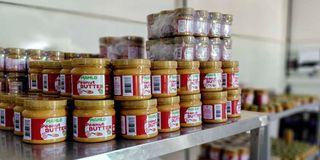
A display of groundnut-based products, developed by Malmo Foods to add value to raw peanuts.
Photo credit: Alex Odhiambo | Nation Media Group
She observes that farmers are not poor because they lack productivity, but because they lack ownership over value.
“I watched women do everything right and still struggle. They planted, harvested and worked hard. The problem was never effort. The system was designed so that value was created elsewhere,” she adds.
Ms Etyang founded Mamlo Foods to tackle this challenge. The social enterprise and agricultural technology firm operates community-based, solar-powered, containerised micro-factories within farming communities in Amagoro, Busia County.
The company rebuilds the groundnut value chain from the community outward, placing small production units close to farms.
At these micro-factories, peanuts are processed on-site, transforming raw crops into higher-value food products. Farmers gain greater control over how their crops are sold and retain more of the profits from their labour.
“Each unit processes groundnuts and other crops grown within a roughly 50-kilometre radius, ensuring value addition happens close to the source. Instead of sending raw peanuts to distant urban centres, we process them locally,” she explains.
This proximity delivers immediate financial and livelihood benefits, as transport costs fall, post-harvest losses shrink, and profits remain within the community.
With more than 10 years of experience across food processing, product development, and agribusiness, she also brings policy insight to her work. She has contributed to discussions shaping Kenya’s agricultural trade environment, particularly around strengthening inter-county trade.
Irene Etyang, food scientist and founder of Mamlo Foods, during the interview with the Daily Nation on January 28, 2026.
Photo credit: Alex Odhiambo | Nation Media Group
Ms Etyang says that starting the company required disciplined choices, and that its early capital of Sh2.5 million came from a blend of personal savings, innovation grants and impact-focused support programmes.
Rather than investing in large centralised plants, resources were directed toward prototyping equipment, developing food safety systems and building trust within communities.Scalability was pursued through repetition, not scale through concentration.
“Trust was the first challenge. Many farmers had encountered short-lived projects that promised transformation but delivered little,” she says.
Mamlo Foods invested time before transactions, working with farmer clusters to explain ownership structures, revenue sharing, and operational responsibilities. Progress was gradual, but credibility grew through consistency.
Access to finance presented another barrier. Container-based factories co-owned by rural women did not fit conventional lending templates.
She navigated this through blended financing and partnerships with organisations that understood social enterprise models. Operational hurdles followed, from training first-time processors in food safety standards to managing logistics in regions with limited infrastructure.
“There were days when it felt like the need was running faster than our capacity. But we were intentional about building something that would last,” she admits.
Each micro factory is equipped with shared smart dehydration technologies that significantly improve quality and safety. These systems operate at controlled temperatures, reducing drying times and limiting spoilage.
Crucially, they address aflatoxin contamination, a persistent threat in groundnut production. Aflatoxin poses serious health risks and can render entire harvests unsellable, wiping out income for farming families.
The efficient, controlled drying processes allow farmers to protect their crops and meet higher market standards. The company currently operates its micro-factory system at approximately 55 per cent utilisation.
“We source shelled peanuts from organised clusters of smallholder farmers trained and supported in partnership with the Ministry of Agriculture at the sub-county level,” she says.
Each micro-factory is a right-sized community enterprise designed to process up to 180,000 kg of peanuts per year, anchoring value addition, jobs, and income generation within rural communities.
Throughout the growing season, farmers are supported in all stages of production and once the peanuts are dried, shelled, graded, and purchased through the structured sourcing system, payments are made within 14 to 28 working days.
At production site, peanuts are cleaned, roasted, refined and processed into peanut butter under food-grade systems.
A display of groundnut-based products, developed by Malmo Foods to add value to raw peanuts.
Photo credit: Alex Odhiambo | Nation Media Group
Finished products are filled into 800g, 400g, 250g and 125g jars, then sealed, batch-coded, labelled, and packed before being distributed to dukas and mini-marts. At current production levels, the company turns out over 20,000 jars per month across this mixed packaging range.
It is also expanding value addition into other high-potential crops such as millet, sesame, moringa and amaranth, adding plant-based protein foods to its product range.
At present, the company offers several core products, including peanut butter and roasted peanuts, made for both household consumers and institutional buyers such as government agencies, food companies, schools and nutrition programmes that require safe, traceable, and scalable protein supply.
Products are positioned to balance affordability and quality. They remain accessible to local households while accounting for the added value of safe, traceable processing.
This pricing strategy allows farmers to earn more by reducing intermediaries, without making products prohibitively expensive for the community.
A jar of the peanut butter is priced competitively against imported and urban alternatives, yet farmers earn more due to reduced intermediaries and localised production: “Our goal was never premium for the sake of image. It was fairness. Farmers deserve better returns, and families deserve food they can afford and trust,” she says.
The benefits to farmers extend well beyond pricing. Women organised into clusters become co-owners of the micro factories. They earn from crop sales and share in processing revenue.
Skills training in food safety, equipment handling, cluster governance, and marketing builds long-term capacity within the community, strengthening resilience season after season.
The social impact extends beyond the factory itself. The micro-factory model creates employment for rural youth in processing, logistics, and distribution.
Mamlo currently employs 15 staff and works with approximately 500 smallholder farmers, more than 70 per cent of whom are active suppliers within its sourcing network.
“Rather than remaining passive at the base of agricultural value chains, communities become active creators of value. Income circulates locally. Assets remain locally owned,” she adds.
Rahab Waruguru Muthui, an employee of Mamlo Foods, displays a product transformed from raw peanuts into value-added goods.
Photo credit: Alex Odhiambo | Nation Media Group
Beyond this, environmental considerations are integrated into operations, solar energy reduces reliance on fossil fuels, shorter supply chains cut transport emissions, and lower waste limits resource loss between the field and the consumer.
The company also plans to establish additional micro-factories, broaden product lines, and strengthen market access without compromising ownership structures.
“Real empowerment does not come from external control but from within communities. When people have the tools, the technology and the trust to use them, they define their own path to prosperity,” she says in conclusion.