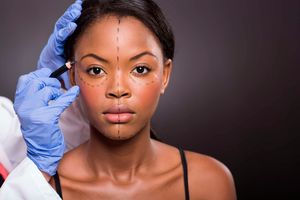
A stray hair or two on the chin is easy to ignore for a while. Once the hairs become more frequent or noticeably thicker, though, the question changes from how to get rid of them to why they are showing up in the first place.
Doctors say that not every chin hair points to a hormonal issue, but some do, and knowing the difference can save you a lot of plucking and a fair amount of worry.
Dr Richard Mogeni, an obstetrician-gynaecologist at Moi Teaching and Referral Hospital, says a few tiny chin hairs are completely normal.
"They become more noticeable when hair follicles are more sensitive to androgens (male hormones )," he explains.
"This can be because of genetics, ageing and hormone-relatated conditions such as Polycystic Ovarian Syndrome (PCOS) and hirsutism, a condition that causes women to grow thick, dark hair in areas where men typically grow hair such as face, chest and back.”
Androgens are present in every woman's body in smaller amounts, and hair follicles on the chin and upper lip are among the first places to respond to them. Genetics and ethnicity play a part in how strongly they respond. Facial hair can appear at any age, but Dr Mogeni says coarse chin hairs tend to become noticeable from age 30 onwards, and especially through the 40s and 50s.
Tweezing works well when there are only a few hairs, but it carries its own risk of folliculitis if the skin is not cleaned properly.
That timing is closely tied to the hormonal shifts of perimenopause and menopause. As oestrogen declines, androgens become relatively more pronounced, even when the levels themselves haven't changed much.
"This can make facial hair coarser while scalp hair becomes thinner," Dr Mogeni says.
Many women find it the most unfair part of midlife: thinner hair up top, coarser hair below.
"Often yes," says Dr Mogeni. "Facial hirsutism can result from elevated androgens, particularly testosterone, or increased sensitivity of hair follicles to normal hormone levels. In younger women, PCOS is one of the most common causes."
However, not all facial hair means high androgen levels; some women have perfectly normal hormone levels but follicles that react strongly to them.
Dr Mogeni adds that hirsutism and PCOS are being diagnosed more often, although nobody knows whether that reflects a true rise or simply better awareness and testing. Metabolic factors such as insulin resistance can also trigger both conditions.
Then there is the belief that facial hair can appear after a woman stops taking the contraceptive pill. Dr Mogeni says there is only a little truth in it.
"Stopping the pill does not usually cause facial hair by itself. Rather, it can unmask an underlying tendency to excess androgen activity, such as PCOS, that was previously suppressed by the pill."
He also addresses oestrogen injections, which some women wonder if they can assist in counteracting the elevated androgens.
“They are not a standard treatment for chin hair, and what actually helps depends on the cause, from hormonal medication and anti-androgens to laser or electrolysis for the hair itself.”
The hair alone is rarely the whole story, and the other symptoms that come with it are what doctors pay attention to.
"Rapidly increasing or widespread coarse hair, particularly with irregular periods, acne, scalp hair loss, infertility or increased body hair, suggests an androgen-related problem and warrants assessment," Dr Mogeni says.
He advises seeing a doctor if the facial hair is new, increasing quickly or accompanied by any of those symptoms, or by significant weight changes or masculinisation such as a deeper voice. These features may call for investigation for PCOS or, more rarely, other hormonal disorders. If it is only a few unwanted hairs with nothing else going on, they can usually be managed cosmetically through shaving, threading, waxing, laser or electrolysis.
Where hirsutism is significant, treatment may address both the underlying cause and the hair itself, depending on the diagnosis.
Dr Hashim Kardabhai, a consultant dermatologist and venereologist at Aga Khan University Hospitals, says the first thing he considers is whether the growth is a new or unusual change. There are several reasons someone might develop chin hair, including hirsutism, hypertrichosis, hypertrichosis (excessive hair growth on any part of the body), and virilisation where a female develops exaggerated physical male characteristics.
However, in dermatology clinics hirsutism is one of the more common reasons women come in with excessive facial hair.
When a patient walks in, he looks at her age, how long the hair has been there, what type of hair it is and how much has developed.
"Most of the time, they pluck," says Dr Kardabhai. "But when more hairs begin appearing, patients eventually seek medical help. By then, they may have considerably more chin hair than the one or two hairs that first concerned them."
Women naturally have hair on many parts of the body, and the concern with facial hair is when it turns coarse, rather than the fine, light hairs that are normally present. He describes the ordinary light growth some women have as a different thing from hirsutism, because it does not usually involve hormonal changes or acne.
"With hirsutism, the hairs are coarse and thicker and appear in areas like the chin, chest, armpits and pubic area. In many cases, the growth is linked to something else, such as PCOS or excess androgens."
Laser hair removal is the option many women are most curious about, and also the one where the details matter most.
This is why the hair is not the only thing he looks at. A woman with PCOS, for example, may have acne that is hard to control, chin hair and irregular menstrual cycles all at once, and in that case the treatment may involve addressing the underlying hormonal changes. Medications such as spironolactone may be used for patients with acne, PCOS and excessive hair growth.
"Once the hormonal irregularity is managed, there can also be an improvement in the way the patient presents, including hair growth," he adds.
When it comes to removal, women with only one or two unwanted hairs can handle them safely at home.
Shaving is among the options doctors commonly recommend, but Dr Kardabhai says it is often done incorrectly. Using a blade without shaving gel or cream can lead to folliculitis, which is inflammation of the hair follicles, as well as pigmentation. He is also keen to put an old myth to rest.
"There is a common myth that shaving makes hair grow back thicker or increases the amount of hair. It does not. Shaving only cuts the hair at the surface; it does not affect the root."
Tweezing works well when there are only a few hairs, but it carries its own risk of folliculitis if the skin is not cleaned properly. He points out that what looks like a pimple on the chin can turn out to be an inflamed follicle, which is worth remembering before you attack it with more tweezers.
Epilation, which can be chemical or mechanical, is another option. Chemical epilation uses a cream that makes the hair easier to remove, and here he urges particular caution for African skin, since sensitivity and sun exposure can differ from Caucasian or Asian skin types.
Even if the label says to leave the product on for three minutes, he recommends testing it on another area, such as the arm, and watching how the skin reacts before it goes anywhere near your face.
Laser hair removal is the option many women are most curious about, and also the one where the details matter most. He cautions against thinking of laser as a single treatment, because there are different lasers and some are not suitable for African skin.
"For African skin, an Nd laser is preferred because it is less likely to cause pigmentation and burning when used correctly," he says.
"Laser treatment works differently because it targets the root of the hair. But the energy used by the machine has to be adjusted for each person, depending on the amount of melanin in their skin," he explains.
"This is particularly important for people with darker skin tones. Because the laser targets pigmentation, using the wrong laser, incorrect settings or too much energy can damage the skin and cause post-inflammatory pigmentation as it heals."
Where you have it done is therefore just as important as what you have done. He advises seeing a licensed aesthetician who understands which laser and which settings suit your skin type.
There is no single treatment that works the same way for everyone, because the amount, thickness and severity of hair vary from person to person.
Shaving may be needed about once a week, while threading is usually done every two weeks. Chemical hair removal may last through a hair cycle, which runs around 30 to 45 days.
Laser is the outlier, since it goes after the root, which is why it takes careful planning rather than a quick lunchtime visit.
"The aim is not simply to remove the hair but to do so without causing unnecessary damage to the skin,"says Dr Kardabhai.