For decades, Karura Forest has been Nairobi’s sanctuary – a place of birds, waterfalls and cool air, where conservationists fought developers and restored an urban paradise.
As new government fee structures take hold, the fight to keep this gem accessible to everyone is on once again.
A stroll from Gate C ushers one to a woodsy fragrance. I walk down the path with colleagues Isaac and Benjamin, who are in the forest for the first time. The dusty straight road from the gate has a few things that can make a visitor stop and gaze.
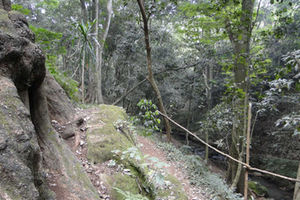
Then the beauty of this gem hidden in the northern part of Nairobi starts to manifest – the canopied tall trees, singing birds, babbling rivers, splashing of Karura waterfall and the serenity.
Karura sits on more than 1,000 hectares, making it one of the world’s largest urban forests. Had it not been for environmentalists like Prof Wangari Maathai and the Greenbelt Movement, the splendour of this forest could now be history.
The forest has faced numerous threats in the past, including being a hideout for criminals.
While the central issue in the 1990s was the granting access to private developers by the government, a new directive to consolidate all payments via E-Citizen has sparked uproar from conservationists and the community surrounding the forest.
With the system, said Mr Alex Lemarkoko – the Kenya Forest Service (KFS) Chief Conservator – during the “Fixing the Nation” TV show, there will be additional costs on VAT and a convenience fee of Sh50, which is billed for every transaction.
We paid Sh638 for the three of us, including parking fee for the company vehicle.
“The government directed the introduction of the payment system, from manual to the digital portal. The agenda is to shift to a digital superhighway,” Mr Lemarkoko said.
In 1997, a pilot project on Participatory Forest Management (PFM) was introduced in Arabuko Sokoke, Kilifi County.
Stranded workers at the Karura Forest, Limuru Road entrance, on August 29, 2025.
Photo credit: Wilfred Nyangaresi | Nation Media Group
The idea was to involve the people around the forest in its conservation. Kenya officially introduced Community Forest Associations under the Forests Act, 2005. That is how the FKF came to be.
It manages Karura with KFS under a Joint Management Agreement (2021–41). Activities and expenditure in the forest are jointly reviewed and agreed to by Joint Management Committee representatives every month.
Dr Winnie Kiiru, an environmentalist and former FKF chairperson, told the Sunday Nation that since 2009 when the FKF started its activities, a lot has happened.
“When we came in, a large part of the forest was covered by exotic trees that had been planted by colonialists. There was need to restore it to indigenous status,” she said.
Unlike 2010, when only a handful of people could walk in and out of the forest, Dr Kiiru says Karura now receives about 75,000 people a month.
“We ensured the forest was safe, trained communities around and capped the fees to just Sh100,” she said.
“Karura cannot just be safe because of an electric fence. We have also ensured social fencing by involving communities.”
While we only walked five kilometres of the forest trails towards the waterfall, Dr Kiiru said the expanse has about 50 kilometres of nature trails.
There are more than 200 unique tree species in the forest, including sandalwood and oak, she added.
Sandalwood tree numbers have been falling in Kenya due to illegal harvesting. As recently as May 2024, approximately 300 kilos of illegally harvested sandalwood valued at Sh2 million, was destroyed in Samburu County.
The animals were reintroduced into Karura Forest from areas in central Kenya where they were under threat because of deforestation.
According to Dr Kiiru, colobus monkeys depend on high canopy tree cover for survival. Since their reintroduction, more than 100 have been born there.
“If visitors pay attention to what’s happening in the canopy as they walk on the family trail, they will see the monkeys,” she said.
Animals that are easy to spot include the smallest antelope in the savannah known as suni, the Harvey’s duiker and bushbuck.
Others are the African palm civet, the night-strike jackal and the clawless otter.
Dr Kiiru said the otter is an indicator of the purity of the rivers in Karura, as they only thrive in places with clean water.
“The African crowned eagle, a predator, has been spotted nesting in the forest. It is one of the 200 bird species here,” she said.
There are five rivers in Karura Forest – Ruaka, Karura, Gitathuru, Thigiri and Mathare.
Dr Kiiru said maintaining an urban river can be unnerving, but that a 2021 ban on single-use plastics in protected areas in Kenya helped reduce pollution.
She said Karura Forest has been a gift to the rivers. Even with the ban on plastics, the rivers in Karura have not been spared pollution.
A picnic site inside Karura Forest.
Photo credit: File | Nation Media Group
“The rivers naturally clean themselves because of the regeneration of the forest. We do cleanups but the truth is most of what a river depends on is being able to flow through an area of good vegetation. With that, the river can clean itself,” she said.
One of the forest sights, Lilly Lake, has faced problems due to invasive species like the water hyacinth and Salvinia molesta.
“We have made attempts to control this so that the lake may look better. You may not see the lillies that used to be here but we want to restore the lake to its former glory,” she said.
It is this delicate balance of conservation, community management and affordable access that has made Karura to thrive after decades of neglect and near destruction. The balance, however, now appears fragile.
The debate over digital payments may sound insignificant to some, but to conservationists and the communities around the forest, it could mean something else. Is Karura still a people’s forest or are people who helped save it being elbowed out?
For a forest that was once defended with blood, tears, toil, sweat and international solidarity, the danger lies not in bulldozers or thugs, but in government policies and systems that could quietly destroy years of progress.
Karura still stands serene, its waterfalls singing and its canopy shading the city from the Sun.
Beneath that calm, unfortunately, is uncertainty.