For 18-year-old Anita Georgin, the admission letter to Jomo Kenyatta University of Agriculture and Technology (JKUAT) should have marked the beginning of a new chapter.
Instead, it remains at home with her in Siaya County.
Anita scored a B (plain) in the 2025 Kenya Certificate of Secondary Education (KCSE) examinations and was placed to pursue a Bachelor of Science in Entrepreneurship. She is expected to report on September 1, 2026, but her family cannot raise the money required to get her through the university gates.
“According to the JKUAT fees structure for first-year government-sponsored students, we are supposed to pay Sh75, 252 for the first semester,” Anita says.
Her father, Charles Onyango, a photographer, has told her the family cannot afford the amount. She has applied for funding through the Higher Education Funding (HEF) system and is waiting for assistance.
“I am now stuck at home,” she says.
Anita Georgin, 18, who scored a B plain in the Kenya Certificate of Secondary Education (KCSE), is staring at a future she worked hard to secure but cannot afford to pursue because of poverty.
Photo credit: Pool
Anita is among thousands of students caught between securing admission to university and finding the money to take up their places.
In Taita Taveta County, Martin Mwamachi, who scored a grade of B- in KCSE, has been admitted to Egerton University to pursue a Bachelor of Science in Economics and Statistics at the Njoro main campus.
The programme began on August 17, but Martin has yet to travel to Njoro.
His mother, a former house help, is at home battling diabetes, while his father is a casual labourer and the family's breadwinner. Martin's twin brother was forced to drop out of school because of poverty.
“I am the only hope for my parents. They have put all that they have to ensure I go to school. It is sad that their dream might be cut short because of poverty. I wish somebody would come and help me,” he says.
He also needs a scientific calculator, bedding, a raincoat, stationery and a bucket.
In Mombasa, Kioko Alfan Kioko scored a mean grade of B+ and secured admission to the Technical University of Mombasa to pursue a Bachelor of Science in Information Technology.
“My dream was to join university to pursue IT and it came through. However, I have an obstacle — I lack fees. I have applied for HELB (funding from the Higher Education Loans Board) and I am still waiting,” he says.
In Kilifi, 19-year-old Haidery Sajjad, a former student of Dr Aggrey High School, scored a C+ and was admitted to Murang’a University of Technology to pursue a Bachelor of Science in Criminology and Security Studies.
He is expected to report on September 2 but needs about Sh85, 000 per semester.
“My father is a casual labourer and my mother went to Saudi Arabia to look for employment,” he says.
Haidery, the firstborn in a family of three children, says his secondary education was made possible through harambees.
“I have applied for HELB. Please help me to go to university to change my home,” he says.
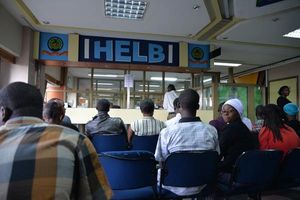
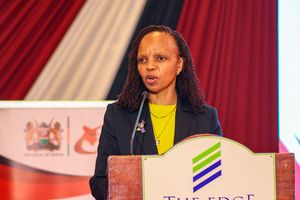
Higher Education Principal Secretary Beatrice Inyangala and Higher Education Loans Board CEO Geoffrey Monari before the Senate Education Committee on March 20, 2025.
Photo credit: Dennis Onsongo | Nation Media Group
For 18-year-old Neema Mumbua, securing a university place was a chance to break a cycle of poverty that has kept members of her family from pursuing higher education.
Neema, who completed secondary school at St John’s Girls High School in Kaloleni, Kilifi County, scored a B- and was placed at the Technical University of Kenya to pursue a Bachelor of Science in Land Administration.
Her parents are unemployed and she is the third-born in a family of six. The county government sponsored her secondary education.
“The rest stopped at Form Four due to poverty, but I want to complete my education so that I can change my future and my home,” she says.
She is expected to pay about Sh45,000 per semester, excluding accommodation and other expenses.
“I need shopping, accommodation, a laptop, power bank, extension cable and shoes for field projects. I have already applied for HELB, so I am still waiting. I am supposed to be in university by Monday, but so far, I have nothing,” she says.
In Nandi North, 19-year-old Moureen Tanui sits outside her mother's mud-walled house clutching an admission letter from Chuka University.
The Chepterwai Girls High School alumnus scored a C+ and has been placed to pursue a Bachelor of Education, specialising in geography and business studies.
“I worked so hard at Chepterwai Girls because I knew education was the only way to lift my struggling mother out of poverty,” Moureen says.
“I am appealing to our governor, Stephen Sang, and any well-wisher who can hear my cry. I promise to work hard, graduate and come back to serve my community as a teacher,” she says.
Maureen Tanui, worried about possibility of joining Chuka university to persue Bachelor of Education with Geography and Business Education as teaching subjects.
Photo credit: Titus Ominde | Nation
Hundreds of kilometres away, Meshack Ekai Ekiru, from Kalomwai village near the border of Turkana and West Pokot counties, faces a similar struggle.
He has been admitted to study for a Bachelor of Education but has resorted to artisanal gold mining to try to raise money for university.
“My family is unable to raise the university fees due to poverty,” Ekiru says.
His secondary education was made possible through the intervention of well-wishers. But the money he earns from gold mining is mainly spent on food for his family of seven, leaving little for university fees.
For these students, academic achievement has secured a place at university but has not guaranteed access to higher education.
And even for those who make it to campus, the financial struggle does not necessarily end.
At the University of Nairobi (UoN), 18 engineering students face the prospect of abandoning their studies after the institution issued demand letters over accumulated fee arrears.
Among them is David Brian, a third-year Environmental and Biosystems Engineering student who owes the university Sh292,856.
The entrance to the University of Nairobi.
Photo credit: File | Nation Media Group
“The University of Nairobi management do hereby write to notify you and demands that in the first instance you unconditionally settle Sh292,856 outstanding tuition fees and related charges reflected in your student account and owed to the University of Nairobi,” reads the demand letter in part.
Brian applied for financial assistance through the Higher Education Loans Board and the Universities Fund but was placed in Band Four, meaning a higher household contribution towards his fees.
His parents struggle to support six children, and he says the university has withheld his third-year results, preventing him from progressing.
His course mate, Titus Odego, is facing a similar predicament. He was also placed in Band Four and has a Sh282,000 fee bill, with his results withheld.
His mother is a smallholder farmer in Kisii County and is ailing, while his father is trying to build a business to support him and his five siblings.
A second-year Geospatial Engineering student at UoN has accumulated a Sh117,724 fee balance after being placed in Band Four. His father is a driver while his mother is a casual labourer.
The student appealed the band placement several times without success and was locked out of end-of-semester examinations in July, leaving him facing the possibility of repeating the second year.
The cases illustrate the other side of the student-centred funding model introduced in 2023: students who overcome the initial hurdle of joining university can still struggle to remain there.
Under the model, students are assessed and placed in funding bands according to their level of financial need. Band Five comprises students assessed as least needy and therefore receive the lowest level of government scholarship support.
Some students have been placed in Bands Four and Five based on information such as their parents' Kenya Revenue Authority (KRA) records, even where parents have since retired, become ill or died.
A third-year Quantity Survey student at the Technical University of Kenya says his household contribution rose from Sh45, 000 a year to Sh83, 000 after the introduction of means testing.
Raised by a single mother, the student appealed three times, with the latest appeal made in September 2025, but says he has received no response.
“In the second semester of third-year, I was considering deferring because there was a lot of institutional pressure such that the university want you to clear fees on time but don’t accept instalments,” he says.
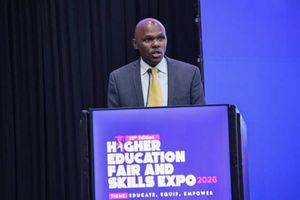
Universities Fund acting Chief Executive Officer Dr Edwin Wanyonyi during a past event.
Photo credit: Wilfred Nyangaresi | Nation Media Group
At Karatina University, student leader Stephen Maina says some students in higher funding bands have also been unable to meet their household contributions.
He cites cases of orphans placed in Bands Four and Five, as well as students in expensive courses such as architecture and nursing who have deferred their studies because their families cannot raise the required contributions.
“For instance in my class, when we started, we were 350 but now are at 183. Many have left for teachers training colleges and others to TVETS,” says Mr Maina, a Political Science in Public Administration student.
“Exam cards have a QR code which is scanned to confirm fees payment status. This results to increased cases of deferment and cases of students changing courses from or to TVET institutions where they can afford,” he says.
The financial pressure comes as the government struggles to keep pace with the rising number of students qualifying for support.
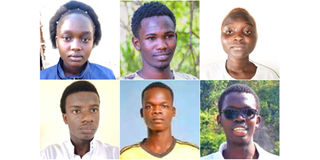
Students (clockwise from top left) Maureen Tanui, Martin Mwamachi, Anita Georgin, Haifery Sajjad, Meshack Ekai Ekiru and David Brian.
Photo credit: Nation
Universities Fund data shows that the number of students supported through the government scholarship system rose from 118,153 in the year ending June 2024 to 253,042 the following year and 408,879 by June 2026.
The number is projected to reach about 608,879 students in the current financial year.
Funding, however, has not kept pace with demand.
In 2023/2024, the government provided the full Sh12.4 billion required for scholarships. In 2024/2025, the allocation rose to Sh16 billion but left a Sh9.6 billion deficit.
In 2025/2026, the government provided Sh18.9 billion against a requirement that was Sh12 billion higher.
The funding gap has now widened to Sh17 billion in the current financial year, according to the Universities Fund.
“In this current financial year, we are projecting disbursement at the level of 65 per cent of the requirement,” Universities Fund acting chief executive Edwin Wanyonyi said.
In July, President William Ruto announced that the government was changing the funding model and all students admitted to university, no matter their background, would be paid for in full by the government.
This new plan, however, depends on the passing of the Tertiary Education Placement and Funding Bill 2026, which is before Parliament.
The proposed reforms President Ruto mentioned are contained in the Tertiary Education Placement and Funding Bill, 2026, which seeks to overhaul Kenya's higher education financing system by replacing HELB, the Universities Fund and the TVET Funding Board with a single Tertiary Education Funding Authority.
For students admitted to public universities, the immediate concern is how to meet their household contribution while awaiting government support.
At JKUAT, Anita has been told that students who apply for funding will pay the household amount allocated on their HEF portals. Those who do not apply for government funding through HEF/HELB are expected to pay the full Sh150, 503 indicated in the fee structure.
Fees must be paid upfront according to the university's fee policy, with students who have not paid 100 per cent by the end of the fourth week required to take academic leave.
Tuition is only part of the burden. Students must also meet the costs of accommodation, food, laptops and other personal and academic requirements.
JKUAT estimates that students spend about Sh6, 000 a month on meals at the Students’ Cafeteria.
For many, the admission letter has therefore become both a symbol of achievement and a reminder of what remains beyond their families' reach.
And for those already in university, mounting fee arrears threaten to turn the promise of the new funding model into another barrier to completing their education.
-Reporting by Lynet Igadwah Winnie Atieno, Titus Ominde, and Sammy Lutta