In 2023, the government introduced a new university funding model aimed at addressing socio-economic inequalities among students, stabilising the financing of higher education institutions, and improving learning quality.
Packaged as an innovative approach to university funding, the model was framed as a panacea to Kenya’s long-struggling higher education sector. It was part of the recommendations of the Presidential Working Party on Education Reforms appointed by President William Ruto in September 2022 and chaired by the late Prof Raphael Munavu.
The student-centred funding model was layered and allocations clustered into five bands based on learners’ socio-economic status. Learners from poor backgrounds were categorised in Band One and allocated 70 per cent government scholarship, 25 per cent loan and Sh60,000 annually for upkeep.
At the other end of the bar was Band Five, which clustered learners from fairly well-off backgrounds and were eligible for 30 per cent government scholarship, 30 per cent loan to pay for tuition and Sh40,000 for upkeep.
The rationale was that the government would provide generous support to learners from low-income families and enable them to pursue university education while those from well-off households were required to contribute significant amounts of cash towards their schooling.
Launched with pomp and fanfare, the programme was marked by conceptual weaknesses right from the outset and attracted a fair share of informed criticism over its design and implementation. And inevitably, it has come a cropper. The reality has sunk in; the experiment was impractical and unsustainable.
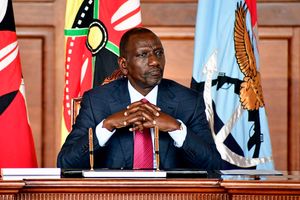
President William Ruto at State House, Nairobi on June 23, 2026. He has said that a "final version" of a new funding model proposal was before Parliament and urged MPs to fast-track its approval.
Photo credit: File | Nation Media Group
Recently, President William Ruto announced that the government was changing tack in financing higher education and will roll out a free university programme for all eligible students in university and tertiary colleges from September.
This marks yet another chapter of disingenuous policy framing and calls for thorough interrogation. The problem with university funding is not the model, but lack of cash and a proper strategy for sustainable higher education. Decisions are often ad hoc, poorly conceived, and politically driven, with little or no supporting research.
At present, the public universities are grappling with a crippling Sh57 billion budget shortfall. Some 23 universities are on the verge of bankruptcy due to soaring debts and declining revenues, risking their long-term sustainability.
In the current financial year, the university sector has been allocated Sh163.9 billion while the Higher Education Loans Board (Helb), Sh56.3 billion against a required budget of Sh112.1 billion, leaving a 50 per cent deficit.
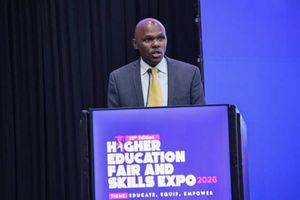
Universities Fund acting Chief Executive Officer Dr Edwin Wanyonyi during a past event.
Photo credit: Wilfred Nyangaresi | Nation Media Group
This raises the critical question: Where will the State find the resources to pay fees for all eligible students in September when no such expenditure was provided for in the current budget?
In the current budget, education was allocated Sh784 billion, representing 16 per cent of the national budget. The question that arises, therefore, is whether the government will raise this budget to meet the expected jump in expenditure when all students are to be funded by the State?
So far, Kenya is implementing free primary education and subsidised secondary education; however, it has consistently failed to remit the resources required to schools, leaving them in persistent financial straits. What then is the magic formula that will be applied to guarantee consistent funding for all university students?
At present, the university budget was based on the current model where the government pays a percentage of tuition and students meet the balance, including personal upkeep. Implementing the new government pronouncement will require that universities prepare fresh budget proposals that align with the new development where students no longer pay any fees.
Estimates by Helb indicate that about 1.2 million students will require funding when the new academic year begins in September, and this is based on the current financing model. In a scenario where all students will be funded, the number of those requiring State funding will shoot up, requiring new planning.
Significantly, the government needs to provide a clear roadmap about the transition from the current model to the new plan and clarify whether it will also apply to continuing students. Equally, it has to clarify whether the funding covers just tuition or includes students’ upkeep.
Understanding the current debate requires a historical review of university funding models since independence. During the first decade of independence, 1963 to 1974, the government operated a full-scholarship policy, providing 100 per cent tuition and personal expenses for all students. Then, Kenya only had the University of Nairobi – and its constituent college, Kenyatta – with a minimal number of students recorded as 3,400 in 1974.
However, with the rising student population rendering free university education programme untenable, the government introduced a student loan scheme in 1974 that remained in place until 1991. Under the scheme, Kenya gave loans to students to be repaid upon completion of studies and through that, create a revolving fund to support university education. But it failed due to poor loan recoveries owing to weak administrative structures.
Higher Education Loans Board CEO Geoffrey Monari.
Photo credit: File | Nation Media Group
Kenya’s university education recorded dramatic student population growth in the 1980s with the setting up of Moi University in 1984, upgrading Kenyatta to a full-fledged university in 1985 and later establishing Egerton, Maseno and Jomo Kenyatta University of Agriculture.
The third model covered the period 1991 – 2017 when the government implemented a cost-sharing policy pushed by the World Bank and International Monetary Fund, reducing State spending on social sectors and requiring students to contribute substantial amounts of money to their education. Concomitantly, the government established the Higher Education Loans Board (Helb) in 1995 to manage student loans and through aggressive recovery and create a sustainable revolving fund.
Like the previous approaches, the cost-sharing also failed and was replaced with the differentiated unit cost (DUC) model (2018 – 2023), which gave way to the present student-centred funding approach.
Through the differentiated unit-cost model, the government was expected to allocate funds to students based on the actual cost of the course they were pursuing, a shift from the previous uniform cash allotment. However, it flopped because the government was unable to allocate the funds as envisaged, precipitating a major financial crisis in universities.
Moreover, it roped in private universities which were allocated students for whom the government was to pay – but which it never did. At present, the government owes private universities more than Sh60 billion, illustrating the depth of crisis in the entire higher education sector.
Taken together, historical evidence shows that the fundamental challenge facing university education is not the lack of funding models, but the adequacy, predictability, and sustainability of financing. Therefore, any attempt to introduce free university education without a practical and credible financing framework is an invitation of failure.
Funding university education should be addressed within the broader context of development of higher education in Kenya. The first question to address is whether the country needs all the universities it has presently when most of them are under-enrolled, have duplicate programmes, have bloated workforce at the lower levels and acutely fewer lecturers, compromising quality learning.
With 36 full-fledged public universities, five specialised universities and seven constituent university colleges, the higher education budget is stretched to its limit, leaving resources too thin and deepening financial strain.
It is worth noting that the country has a total of 88 universities and colleges, including 32 chartered private universities, two private constituent colleges and seven private institutions operating with letters of interim authority. The reality is that the country has an inordinately large number of universities when it would be better served by fewer and more well-resourced institutions.
Free university education was experimented more than 50 years ago and failed. Given the current economic performance characterised by a budget deficit of Sh1.15 trillion and a debilitating debt burden of Sh12.8 trillion, mobilising additional cash to fund free university education sounds unrealistic.