Confusion over the government's promise of free university education has deepened after President William Ruto and Education Cabinet Secretary Julius Ogamba appeared to contradict each other on the legal framework that will anchor the policy.
Just days after the Nation established that the proposed law had not been transmitted to Parliament despite government claims, fresh questions have emerged over the identity of the Bill itself, with the President and the Ministry of Education referring to two different pieces of legislation.
The conflicting descriptions have fuelled speculation that Cabinet may not yet have approved the proposed legal framework, a mandatory step before any Bill with major financial implications can be introduced in Parliament.
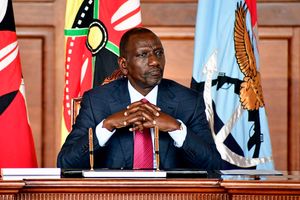
On July 21, 2026, while announcing the policy at State House, Nairobi, President Ruto said free university education would be anchored in the Higher Education Loans Board (Amendment) Bill, 2026, which he claimed was already before Parliament.
“There is a law in Parliament called the HELB (Amendment) Bill, 2026 that will enable us to ensure that every Kenyan student who has been placed in a TVET or a university gets state funding,” President Ruto said.
“I am not drunk and I am not a fool. I know what I am saying,” he added.
However, a statement issued by the Ministry of Education identifies a different piece of legislation, the Tertiary Education Placement and Funding Bill, 2026, as the law intended to overhaul higher education financing from September 2026, if enacted.
“The proposed framework seeks to introduce a new financing model designed to ensure that every Kenyan who qualifies for tertiary education has access to higher education financing,” the ministry said.
It added that “the Bill is now in Parliament for debate and approval” and would establish a sustainable funding framework capable of supporting future generations.
The conflicting references have raised fresh questions about whether the proposed legislation has received Cabinet approval.
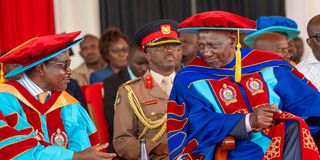
President William Ruto after being awarded an Honorary Degree in Leadership And Service To Humanity, by the University of Eastern Africa Baraton, during the 42nd graduation ceremony on August 18, 2024.
Photo credit: Jared Nyataya | Nation Media Group
Under government legislative procedures, any Bill with significant financial implications must first be approved by Cabinet before it is transmitted to Parliament.
“The lack of Cabinet approval, essentially committing the government to financing the programme, appears to be a poorly crafted attempt to assuage the youth, heavily burdened parents and the middle class ahead of next year's elections,” said High Court advocate David Ochami.
According to the Ministry of Education, the Tertiary Education Placement and Funding Bill, 2026 proposes merging the Higher Education Loans Board (HELB), the Universities Fund and the Technical and Vocational Education and Training (TVET) Fund into a single body, the Tertiary Education Funding Authority (TEFA).
Under the proposal, funding for universities, colleges and TVET institutions would be administered through one authority.
“This way, funding for college, TVET and university students will be coordinated and administered under one authority,” reads the statement.
The ministry defines tertiary education as all formal post-secondary education offered in universities, colleges and technical and vocational institutions recognised by the relevant regulatory authorities.
The debate comes as Parliament's Education Committee raises concerns over a funding crisis in public universities, where pending bills have exceeded Sh100 billion, even as schools continue to receive less capitation than budgeted.
Although the capitation policy allocates Sh22,244 per senior secondary student, Sh15,042 per Junior Secondary learner and Sh2,330 per primary school pupil each term, National Treasury Cabinet Secretary John Mbadi recently told MPs that the government can only afford Sh16,900 per secondary learner and less than Sh1,500 per primary pupil.
For the 2026/27 financial year, the State Department for Higher Education received Sh164.1 billion, funding that Parliament says remains inadequate to support universities, scholarships, student loans and infrastructure development.
President Ruto did not explain how the proposed free university education programme would be financed.
However, the ministry says the proposed Bill would guarantee funding for all eligible students and trainees in tertiary institutions, covering tuition, accommodation and living expenses.
“Universal coverage requires additional resources to ensure that funding is sustained for all eligible students and trainees,” it says.
To achieve this, the Bill would empower TEFA to mobilise resources beyond the Exchequer, including private capital, non-traditional financing mechanisms, consolidated public bursary and scholarship schemes, education savings products and stronger loan recovery systems to finance future cohorts.