President William Ruto's grip on the vote-rich Mt Kenya region is increasingly emerging as a tale of two political realities after recent by-election results delivered sharply contrasting verdicts in the eastern and western flanks of the mountain.
While Kenya Kwanza has comfortably defended seats in Mt Kenya East, Deputy President Kithure Kindiki's political backyard, the coalition suffered a symbolic and politically significant setback in Nyandarua's Ol Kalou constituency on Thursday.
The Independent Electoral and Boundaries Commission (IEBC) declared Sammy Douglas Kamau Waweru Ngotho of Rigathi Gachagua-led Democracy for the Citizens Party (DCP) the winner of the Ol Kalou by-election after he defeated his closest challenger by a landslide.
Mr Ngotho garnered 35,440 votes against President William Ruto's United Democratic Alliance (UDA) candidate, Muchina Nyaga, who managed 5,460 votes.
The defeat has reignited debate over the President's standing in a region that overwhelmingly backed him in the 2022 General Election.
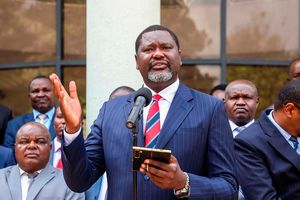
When it became clear that the opposition was headed for a resounding victory in Ol Kalou early on Thursday, Public Service Cabinet Secretary Geoffrey Ruku declared: "We, as Mt Kenya East, do not care what happens in Mt Kenya West."
For the past six months, Mr Ruku has championed the political independence of Kirinyaga, Embu, Tharaka Nithi and Meru counties, now collectively referred to as Mt Kenya East.
The push for a political split of the Mt Kenya voting bloc is widely seen as an attempt to salvage President Ruto's dwindling fortunes amid former Deputy President Rigathi Gachagua's efforts to consolidate the region behind DCP.
Mr Ruku's campaign is also viewed as an attempt to shield Deputy President Kindiki's political backyard from Mr Gachagua's growing influence.
The CS and his allies argue that Mt Kenya East can marshal more than two million votes independently.
While political analysts view the Ol Kalou by-election as a barometer of the political mood across the wider region, Mr Ruku has downplayed the implications of UDA's crushing defeat west of the Mountain.
"We do not care about the results of the Ol Kalou by-election. Mt Kenya West can do whatever it wishes with its politics. Mt Kenya East has already made its decision to remain in government and continue supporting President William Ruto and his deputy, Kithure Kindiki, for a second term," Mr Ruku said.
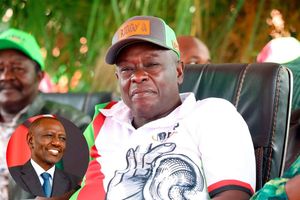
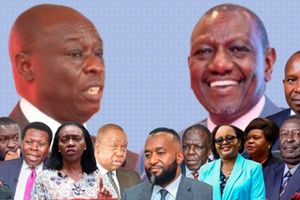
President William Ruto (left) and Democratic Citizens Party (DCP) leader Rigathi Gachagua.
Photo credit: Boniface Mwangi and Bonface Bogita | Nation Media Group
Political analyst Prof Gitile Naituli, however, said that while retreating into tribal and geographical cocoons is common during election cycles, several factors ultimately determine political outcomes.
"The idea that Mt Kenya East only matters when supporting a Kikuyu from Mt Kenya West may resonate emotionally, but it oversimplifies political history. Power in Kenya has never been a monolith within Mt Kenya. Internal competition, elite bargains and shifting alliances have shaped outcomes more than geography alone," Prof Naituli said.
UDA emerged with narrow victories in the November 2025 by-elections across Mt Kenya East, results many analysts interpreted as evidence of Prof Kindiki's growing political influence in the region.
UDA candidate Leonard Muthende won the Mbeere North parliamentary seat with 15,802 votes, defeating Democratic Party candidate Newton Kariuki (Karish), who garnered 15,308 votes.
Mr Duncan Mbui of Chama Cha Kazi came a distant third with 2,480 votes, leaving Mr Muthende to win by a slim margin of 494 votes.
The contrasting outcomes now present President Ruto with a difficult balancing act as attention gradually shifts to the 2027 General Election.
Political analysts argue that his immediate task will be to consolidate support in Mt Kenya East while mounting an aggressive political offensive to recover lost ground in Mt Kenya West, where Mr Gachagua continues to wield considerable influence.
Throughout the Ol Kalou campaign, Mr Gachagua portrayed the contest as a referendum on President Ruto's administration, telling supporters that the constituency had an opportunity to demonstrate that Mt Kenya was charting a new political direction.
"This Ol Kalou by-election marks the death of UDA in this region," Mr Gachagua declared on Friday.
For months, President Ruto has relied on Prof Kindiki to spearhead political mobilisation in Meru, Embu, Tharaka Nithi, Kirinyaga and parts of Laikipia and Isiolo.
Prof Kindiki has increasingly become the face of Kenya Kwanza in the region following Mr Gachagua's dramatic fallout with the President.
UDA candidates have largely held their own in by-elections across Mt Kenya East, reinforcing the narrative that Prof Kindiki has stabilised the coalition's support base despite sustained opposition criticism over the cost of living and unmet campaign promises.
The picture, however, changes dramatically in Mt Kenya West.
CS Ruku says Mt Kenya East leaders are not concerned by Ol Kalou outcome
Political analyst Martin Andati says the contrasting by-election results should not be viewed as isolated contests but as an indication of the region's evolving political direction ahead of 2027.
According to him, political trends in Mt Kenya West have historically influenced voting patterns in the eastern counties, making the Ol Kalou outcome particularly significant.
"Mt Kenya West is like a bigger brother to the East. Where the West goes, the East follows," Mr Andati said.
"The shift we are witnessing in the western flank of the mountain is politically significant because it often sets the pace for the rest of the region. If that trend holds, then the East could gradually move in the same direction."
He argues that UDA's defeat in Ol Kalou could foreshadow a broader political realignment before the next General Election.
"Now that the West has shifted from Ruto to Gachagua, the East will do the same in 2027 and vote against Ruto," Mr Andati said, adding that sustaining support in Mt Kenya East will depend on whether the government can counter Mr Gachagua's growing influence.
On Monday, Mr Ruku met youths from Embu, Meru, Isiolo and Tharaka Nithi counties to lay the groundwork for his Mt Kenya East political independence campaign.
Addressing more than 300 youths at a hotel in Meru, he said they were determined to lock the opposition out of the region.
"Going forward, we will install beacons between Mt Kenya East and Mt Kenya West. We will ensure Gachagua has no breathing space here in the East. In 2027, Mt Kenya East votes should be counted separately because they are enough to hand President Ruto another term," he said.
He claimed the push for autonomy would secure President Ruto's re-election and position Prof Kindiki for the presidency in 2032.
Deputy President Kithure Kindiki.
Photo credit: DPCS
To reinforce that campaign, 61 members of the Meru County Assembly this week publicly reaffirmed their support for President Ruto despite growing dissent across Mt Kenya.
Prof Macharia Munene, however, cautions against interpreting the by-election results as a political revolt confined to Mt Kenya West, arguing that the economic frustrations driving voter discontent are being felt across the country.
"The people in Mt Kenya East are suffering just like those in the West. It is across the board," Prof Munene said.
He argued that prevailing economic hardships have affected households regardless of political affiliation, suggesting dissatisfaction with the government's performance extends beyond counties that have recently voted against Kenya Kwanza candidates.
"It is not just in the Mountain. Even in the Great Rift itself. It is not just a message from the Mountain; it is a national message," he said.
Mr Ruku has gone even further, warning that Mt Kenya East could politically sever ties with the western counties if they fail to support Prof Kindiki.
"The time has come for us to politically divorce as the Mountain. If you cannot support our son, Kithure Kindiki, after we have supported you all along, then let us split the Mountain," he said.
The argument appeared to receive tacit backing from President Ruto during his recent tour of Meru County, where he repeatedly expressed confidence in Prof Kindiki's leadership.
Even so, the Ol Kalou by-election offered perhaps the clearest indication yet that Mr Gachagua's influence remains formidable in his political backyard.
The result handed UDA a painful defeat in what was once considered one of President Ruto's strongholds.
Although by-elections are often influenced by local dynamics, personalities and voter turnout, analysts regard them as important indicators of shifting political sentiment, particularly in regions central to an incumbent president's re-election prospects.
For President Ruto, the implications extend beyond the loss of a single parliamentary seat.
His 2022 victory was built largely on overwhelming support from Mt Kenya after forging a formidable alliance with Mr Gachagua.
Today, that alliance no longer exists.
Since falling out with the President, Mr Gachagua has mounted sustained political campaigns across Nyeri, Nyandarua, Murang'a, Kiambu and parts of Nakuru, accusing the Kenya Kwanza administration of abandoning the region and failing to honour campaign promises.
His message appears to be resonating, particularly in counties regarded as the heartland of Mt Kenya West.
The Ol Kalou outcome therefore suggests that Mr Gachagua still commands an organisational machinery capable of influencing electoral outcomes despite no longer being in government.
For State House strategists, that raises fresh questions about whether President Ruto can retain sufficient support in western Mt Kenya without either repairing relations with his former deputy or building an equally influential political network.
While Prof Kindiki has stabilised the coalition's fortunes there, he says sustaining that support will require continuous political engagement and visible government delivery.
The eastern counties have benefited from repeated presidential tours, infrastructure launches and promises of accelerated development.
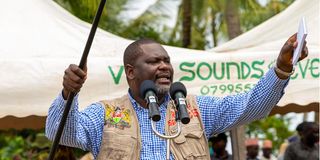
DCP Ol Kalou MP-elect Sammy Kamau Ngotho when he met his supporters at St Lwanga Catholic Church in Mirangine, Ol Kalou, Nyandarua County, on July 12, 2026.
Photo credit: Boniface Mwangi | Nation Media Group
"Kenyan politics has repeatedly demonstrated that electoral loyalty can shift quickly if economic frustrations persist or rival political formations gain momentum," Mr Omore said.
"The challenge facing President Ruto is therefore twofold. First, he must reverse the growing opposition momentum in Mt Kenya West before dissatisfaction hardens into a permanent political realignment. Second, he must ensure victories in Mt Kenya East do not breed complacency within Kenya Kwanza."
Mt Kenya remains one of Kenya's largest voting blocs, making it indispensable for any presidential candidate seeking victory.
Even a modest decline in support could significantly alter the arithmetic of the 2027 contest, forcing President Ruto to seek larger margins in Rift Valley, Western, the Coast and parts of Nyanza.
Should Mr Gachagua continue consolidating western Mt Kenya while UDA retains the east, the region could become one of the country's fiercest political battlegrounds ahead of the next General Election.
Mr Omore, however, cautions against reading too much into the latest by-election results.
"History shows by-elections often reflect immediate political sentiments rather than definitive electoral trends. Governments have previously lost by-elections only to recover during general elections, while opposition victories have not always translated into national success," he said.
"Nevertheless, the latest contests have offered valuable political signals. They suggest that Prof Kindiki has strengthened UDA's footing in Mt Kenya East, but they also underline Mr Gachagua's enduring appeal in Mt Kenya West."