A committee of the Senate has rejected the National Assembly decision to scrap a proposal to give the Independent Electoral and Boundaries Commission (IEBC) the sole ownership rights and unrestricted access to election result servers.
In a report laid before the House on November 11, 2026, the Justice, Legal Affairs and Human Rights Committee shot down the National Assembly’s amendments to the Elections (Amendment) Bill 2024, arguing the changes significantly watered down the consensus reached during the National Dialogue Committee (Nadco) process.
The House committee chaired by Bomet Senator Hillary Sigei, noted that the National Assembly changes “warranted further consideration to arrive at a more ideal framing of the text.”
“The committee resolved to recommend that the Senate rejects the proposed amendment to clause 23 of the Bill,” the committee’s report reads in what is likely to send the Bill to a mediation committee should the House plenary agree to its committee’s recommendation.
The proposal in the Bill sought to expand the scrutiny of election technology to ensure that it is in line with the constitution, the Access to Information Act, Elections Act, the Data Protection Act and the IEBC Act.
Clause 23 of the Bill as passed by the Senate, sought to amend section 44 (4) of the Act by inserting new subsection 4A.
The clause also vested the intellectual property rights of the procured Kenya Integrated Elections Management System (KIEMS) technology with IEBC and provided that processing of data would only be effected through a server or data centre located in Kenya.
“In procuring the election technology, the commission shall ensure that intellectual property rights to the technology vest in the commission,” read the Bill as adopted by the Senate.
The Bill, a product of the National Dialogue Committee (Nadco) process, was adopted by the Senate on December 5, 2024 and transmitted to the National Assembly for review, consideration and concurrence.
But in the changes adopted on October 22, 2026, the National Assembly deleted the entire clause to only retain the sub clause on the technology being accessible and available for scrutiny by candidates, courts and such other persons as are required under any law.
Homa Bay Town MP Peter Kaluma argued that the changes adopted by the Senate made no sense as he questioned the wording of the clause.
Homa Bay Town MP Peter Kaluma.
Photo credit: File I Nation Media Group
“What are we talking about?” posed Mr Kaluma during the passage of the Bill by the National Assembly.
“When you procure something, it becomes yours. These are not things to put in law,” the Homabay Town MP argued as the National Assembly agreed with him.
"In procuring the technology, the commission shall ensure that, subject to the constitution, this Act and the Data Protection Act, the technology is accessible and available for scrutiny by candidates, courts and such other persons as required under the law," reads Mr Kaluma’s amendment, which the House adopted.
“When we start saying that the server and data centre shall be located in Kenya, what are we talking about? I am requesting that we delete this,” said Mr Kaluma.
To justify his amendment, Mr Kaluma argued; “May I ask those who are knowledgeable in Information and Communication Technology (ICT) where this place called the ‘Cloud’ is, or where our information is?”
“Can you locate it within the borders of a country? Where is the 'World Wide Web?” posed Mr Kaluma as he dismissed the requirement that election servers be hosted in the country.
The Senate had also pushed to grant the commission the mandate requiring that the supplier of the technology or their associates, shall not have been found guilty of violating any procurement law, committed a crime, violated professional standards, or been barred from participating in public procurement in any jurisdiction.
“Should these be matters for the tender or procurement documents rather than a law like this?” posed the Homabay Town MP as the House agreed with him.
Currently, IEBC has its election servers hosted in Data Centres outside the country, a situation that the Bill wanted addressed based on the risks spanning national security, legal compliance, operational sovereignty and public trust, making it a highly contentious topic in local politics.
The Bill is one of the “progressive reforms” meant to assert the independence of the electoral commission in the management of elections while promoting the interests of foreign companies providing the election technology.
Granting IEBC ownership of the intellectual property rights aimed at promoting integrity in managing election results, especially, when previous technology providers have denied the commission access to election servers despite valid Supreme Court orders.
A proposed new section 82A of the Bill had also provided that “the commission shall ensure access to information including any technology used in elections and shall not charge fees where the information requested is provided in soft copy.”
“Where an access request is made pursuant to scrutiny of votes, the commission shall facilitate access in the case of a presidential election, within three days of the date of the request and in the case of any other elective position, within seven days of the date of the request,” the Bill proposes.
The MPs did not alter the requirement where information requested is to be provided in hardcopy format, “the commission may charge a prescribed fee for the provision of the information.”
“The fee shall not exceed the actual costs of making copies of such information and, if applicable, supplying them to the applicant,” reads the Bill.
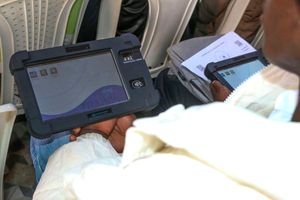
An IEBC official displays a KIEMS kit during a simulation process in the past.
Photo credit: File | Nation Media Group
While IEBC, in connivance with technology providers, has hitherto blocked its stakeholders, including political parties, candidates in elections, among others, from accessing information it holds, it has been accused of allowing unauthorized access to its election servers, exposing it to risks of manipulating stored data- election results.
The IEBC's failure to open the servers was among the reasons the Supreme Court nullified the August 8, 2017 presidential election results and directed that a “fresh, fair and credible” presidential election be held on October 26, 2017.
The Sigei-led committee’s stance is informed by the 2022 circumstances where Venezuelan firm Smartmatic International Holding BV, which provided the Kiems kits technology, denied IEBC access to the servers holding the election results despite the Supreme Court directive.
It is because of this that the Nadco report proposed an amendment to the Elections Act “to cure such legal challenges.”
Smartmatic supplied and managed the software and hardware for the Kiems kits, used for biometric voter registration, electronic voter identification on election day and the electronic transmission of election results from polling stations to tallying centres.
The Venezuelan firm supplied IEBC with over 14,000 new Kiems kits and upgraded the software for the other 41,000 existing kits to power the 46,229 polling stations across the country during the 2022 general election.