The recent breach of President William Ruto’s security in Kilifi has brought to the limelight the elite unit tasked with protecting the Head of State with many questioning the performance of the officers. The special team protecting the Kenyan President, archival documents reviewed by the Nation show, had a foundation linked to political rivalry and suspicion.
A report marked “top secret” compiled by the British 22 Special Air Force Service (SAS) Regiment, who were tasked with the formation of the Kenyan unit in 1964, read: “The special Force Unit should be a small, loyal, tough and highly skilled unit, with above average leadership, discipline and esprit de corps.”
Unbeknown to many, the formation of this elite commando unit was actually influenced by the subjective fear of Jaramogi Oginga Odinga, who was then serving as Minister for Home Affairs.
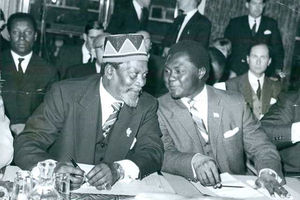
Then vice president Jaramogi Oginga Odinga and president Jomo Kenyatta.
Photo credit: File
In February 1964, Bruce McKenzie, the then Kenyan Minister for Agriculture said to have been a British and Israeli spy, met his close friend Col David Stirling the founder of the SAS, to discuss the danger Jaramogi posed to Prime Minister Jomo Kenyatta and the need to establish a special unit to protect the man who would later become Kenya’s founding President. Also involved in these discussions were Cabinet Ministers Dr Njoroge Mungai, James Gichuru and Joseph Murumbi.
It was just a month after the armies of the newly independent countries of Tangyanyika, Kenya and Uganda staged mutinies demanding better pay and the Africanisation of the military. Despite the rebellions being ignited by the soldiers’ own grievances, British intelligence and the pro-West leaders in Mzee Kenyatta’s cabinet scapegoated the Soviet Union as the inciters. Jaramogi being a radical nationalist and a key channel for the Soviet influence in East Africa, became an easy bogeyman.
Among the arguments fronted by these Kenyan Ministers in requesting for British assistance in the creation of a special unit to protect Kenyatta, was that Jaramogi had sent so many Luo students for further education in the Soviet Union, and that he might use them in future to overthrow Kenyatta. For this reason, they wanted to have at their disposal some trustworthy force capable of protecting Kenyatta and suppressing a coup d’état. The unit was to be largely made up of Kikuyus drawn from the General Service Unit of the Kenya police.
In February 1964 when Bruce Mckenzie and Gichuru travelled to London on official duties, they used the opportunity to officially put up their case on the creation of a special unit. In May 1964, McKenzie met another top British official and expressed to him his fear about the warm welcome Jaramogi had been accorded in Moscow, which he said could only be compared to the reception given to President Abdel Nasser of Egypt and President Ben Bella of Algeria. While appealing for urgency in the creation of the unit, he told the official that Jaramogi had sent 86 Luos to Bulgaria for what he suspected to be military training.
Prompted by the allegations, Walsh Atkins, the British Under Secretary of State, decided to make discreet enquiries in Kenya to find out whether Kenyatta lacked adequate protection as insinuated by Mckenzie, Mungai, Gichuru and Murumbi. He tasked Walter Bell, the then MI5 intelligence liaison officer in Nairobi, to find out from Kenya Police Commissioner Sir Richard Catlin. It turned out that despite being in charge of Kenya police, Catlin had been kept in the dark by this clique around Kenyatta that was pushing for a special unit.
Bell would later report to London: “Catling says that he has heard nothing more of this. He was never approached about it officially. He considers that the proposal has little merit.”
Catlin also outlined to Bell the measures he had put in place to protect Kenyatta, including providing him with armed police bodyguards, and arming KANU youth wingers loyal to him.
Bell went on to inform London: “The inspector General does not consider that there is a significant threat to the prime minister’s life at present time. Arrangements have been made to assign strong police reinforcement to Gatundu, in the event of threatened trouble.”
But still, the Kenyan ministers remained persistent in pushing for a specially trained unit to protect Kenyatta. It happened that around that time Israel and Egypt had also sent Kenya their proposals to train elite units and were desperately pushing for it.
Although the British officials had expressed satisfaction with the measures Kenya police commissioner Catling had put in place to protect Kenyatta, they feared that failure to meet the demands of the clique around Kenyatta could result in Israel or the Soviet allied Egypt establishing a foothold in Kenya’s security sector.
A British diplomat advised in a document marked top secret, “If the Kikuyu cabal cannot get help from us they may seek it from the Israelis, who would probably agree. In some ways this would be as good a solution as any but we could not rely on the Israelis to do the job properly and would find them hard to live with. It would be odd if we were to refuse to help, to the small extent proposed, against a threat of subversion, which we ourselves can by no means dismiss as real.”
President Jomo Kenyatta and Vice President Jaramogi Odinga at Ichaweri in Gatundu in 1964.
Photo credit: Pool
Consequently, in July 1964 Lieutenant Colonel John Woodhouse, the Commanding Officer of 22 SAS, was dispatched to Kenya to discuss the arrangement of training a special unit to protect Kenyatta. Woodhouse’s mission was to be known to top Kenyan government officials only. One official suggested that the visit should be given a fake cover story of being connected to the operation against the shifta in North Eastern.
But in an urgent telegram to the British Defence Advisor in Nairobi, the Commonwealth Relations Office observed, “We are naturally anxious that purpose of visit by Commanding Officer SAS shall be kept a secret. Army Department here are opposed to any cover story because of danger of leakage by Kenyans of true purpose of visit.”
Woodhouse arrived in Nairobi in July 1964, and spent two days examining the organisation, equipment and operational methods of the GSU and compiled a report. Among his recommendations were that the proposed special unit should not have any contact with the military because apart from guarding Kenyatta it would also be used to collect intelligence on dissident military officers and to counter any military coup.
The British military officer also visited GSU training school Embakasi which he said was not suitable for hosting a special unit because it was within the city.
“To enable the unit to operate in the Nairobi City area and in country district, and obtain the maximum security and tactical surprise, the Special Force Unit should be quartered on the outskirts of Nairobi,” he observed.
He went on to conduct further reconnaissance towards Kenyatta’s home in Gatundu, where he identified a building at Ruiru as a possible location.
According to Woodhouse, what made this building at Ruiru suitable was because it was located on a route Kenyatta regularly used to travel to and from his home in Gatundu.
Secondly, it could be used as a safe house to hide the president for security reasons. Thirdly, it could accommodate an emergency government in case certain offices in Nairobi became untenable. Also, it was an excellent location for the installation of a radio transmitter which would enable the president to communicate with people if the normal facilities were not available.
Lt-Col Woodhouse also suggested that the first group selected from the GSU be sent to Britain for a three-month course at SAS headquarters in Herefordshire. Meanwhile one SAS officer and two non-commissioned officers were to be attached temporarily to the GSU in Kenya to train the subsequent groups in Kenya.
Although the initial recruits were all Kikuyu, Sir Malcolm MacDonald, who was then serving as British High Commissioner to Kenyatta, later expressed his reservations about this.
Jomo Kenyatta is sworn in as Kenya’s Prime Minister on June 1, 1963 in Nairobi. Kenyatta wanted Jaramogi Oginga Odinga as his number two.
Photo credit: File | Nation Media Group
“Mr MacDonald said he thought it would be a pity if the Special Unit were Kikuyu. In his own views tribes like the Kalenjin and Akamba were just as capable potentially but had never had the chances that the able Kikuyu had,” a diplomat reported, citing his conversation with MacDonald.
Consequently, the following year it was decided that around 15 GSU personnel from different tribes, carefully selected and vetted by ministers loyal to Kenyatta, be recruited into the elite unit. They were to form 15 per cent of the unit, as the Kikuyu made up 85 per cent.
The fear among some British officials during the formation of this commando unit, which is now headquartered in Ruiru, was that its creation could further strain their(British) relations with Jaramogi Oginga Odinga, who had just taken over as Vice President. They felt Jaramogi could not take it lightly if he learnt about its formation, composition and aims. In the end the consensus among these British officials was that the fear of antagonising Jaramogi should not override the need of having such a unit.
In fact, one official wrote, “We should antagonise Odinga permanently, though we have probably achieved that already.” Another diplomat citing his conversation with Sir Malcolm MacDonald reported, “He (MacDonald) agreed that we need not be deterred by fear of further antagonising Odinga, though he was reluctant to give up hope of improving relations with him which he intended to try to cultivate.”